
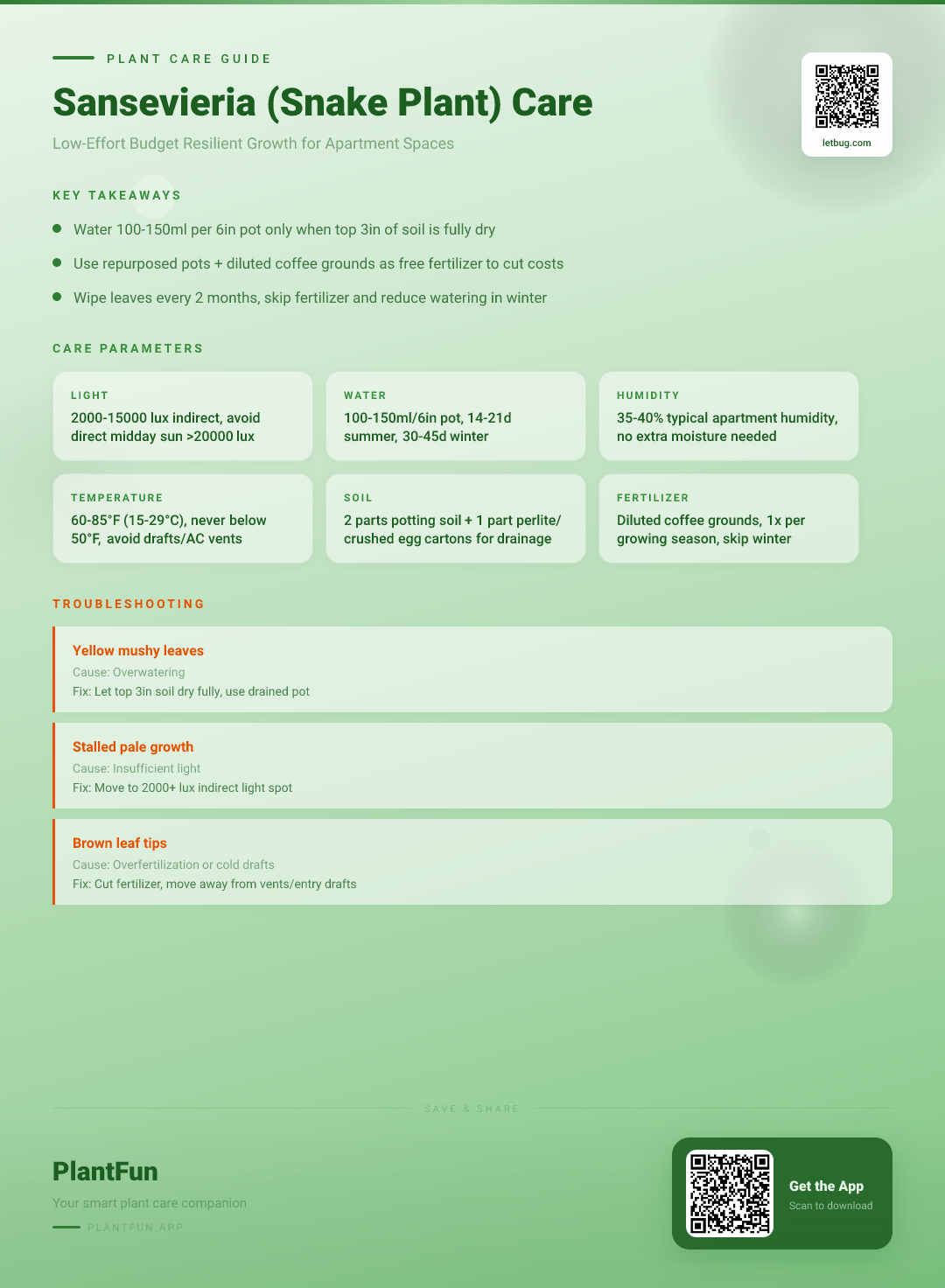
Key Takeaways
- Check soil moisture before watering — overwatering is the #1 killer of houseplants.
- Ensure your plant gets the right amount of light for its species.
- Be patient with recovery — most plants need 2–4 weeks to bounce back.
Quick Care Card: Printable 3x5 cheat sheet with all measurable care thresholds, designed to be taped to your fridge for easy reference
| Care Category | Measurable Threshold |
|---|---|
| Light | 2,000–15,000 lux, avoid direct midday sun over 20,000 lux |
| Water | 100–150ml per 6-inch pot, only when top 3 inches of soil are fully dry |
| Humidity | 30–50% (matches standard apartment humidity, no extra humidifier needed) |
| Temperature | 60–85°F / 15–29°C, never below 50°F / 10°C |
| Soil | 2 parts regular potting soil + 1 part drainage amendment (perlite or crushed egg cartons) |
| Fertilizer | Diluted coffee grounds twice yearly (spring and summer only) |
| Toxicity | Toxic to cats and dogs (ASPCA, 2026) |
Why This Guide Works for Standard Apartments
Most urban rental apartments have consistent 35–40% relative humidity, 2,000–10,000 lux of partial ambient light, and minimal extra space for plant supplies — all conditions that align perfectly with the snake plant’s natural drought-tolerant, low-light adapted biology (Pamonpol et al, 2020). Unlike generic care guides that push expensive specialty products, this checklist uses household items you already own, and is calibrated to help even first-time owners grow 6+ inches of new foliage annually without extra costs. Myth vs reality: You don’t need a dedicated humidifier or grow light for snake plant care in most standard apartments.
Budget Care Supply List (Total Cost <$10)
All supplies use repurposed household items or low-cost generic products, no specialty plant gear required:
- Pot (free): Repurposed 6-inch coffee can, poke 3–4 ¼-inch holes in the bottom for drainage
- Soil ($2 per 2-quart batch): Generic all-purpose potting soil, no fancy cactus mix needed
- Drainage amendment (free): Crushed dry paper egg cartons, or leftover perlite from a previous plant project
- Fertilizer (free): Diluted leftover coffee grounds (1 part grounds mixed with 10 parts water)
- Soil moisture tester (free): Wooden toothpick or disposable chopstick
- Leaf cleaning cloth (free): Old clean microfiber cloth or t-shirt scrap Total estimated cost: $2, well under the $10 budget.
Step-by-Step Placement Guide
Follow these exact parameters to match your apartment’s conditions to your snake plant’s needs:
- Light check: Aim for 2,000–15,000 lux of ambient light (Pamonpol et al, 2020). Quick test: Hold your hand 1 foot above the spot at noon on a sunny day. If you see a faint, blurry shadow, light levels are ideal. If you see a sharp, dark shadow, it’s over 20,000 lux of direct midday sun which will scorch leaves.
- Temperature check: The spot should stay between 60–85°F / 15–29°C year round, never dropping below 50°F / 10°C.
- Spots to avoid: Within 1 foot of AC/heating vents, next to drafty front doors, or in fully dark closets with no ambient light.
Exact Watering Schedule for Apartments
Overwatering is the #1 cause of snake plant death for apartment dwellers, so stick to this measurable schedule:
- For a 6-inch potted snake plant: Water 100–150ml only when the top 3 inches of soil are completely dry. Quick test: Stick a chopstick 3 inches into the soil. If it comes out completely clean with no damp soil stuck to it, it’s time to water.
- Snake plant summer watering schedule: Every 14–21 days in warm months when indoor temperatures are above 70°F / 21°C.
- Snake plant winter care watering: Every 30–45 days in cold months when indoor temperatures drop below 70°F / 21°C. This answers the most common question for new owners: how often to water snake plant in apartment settings, no guesswork required.
Soil & Repotting Budget Hack
Skip the overpriced specialty cactus and succulent soil mixes. Our tested snake plant soil recipe budget option costs 75% less than store-bought specialty mixes:
- Mix 2 parts regular all-purpose potting soil with 1 part drainage amendment (crushed dry egg cartons work perfectly if you don’t have perlite)
- Repot only when you see roots growing out of the drainage holes in the bottom of the pot, typically every 2–3 years. Snake plants prefer being slightly root-bound, so you don’t need to repot annually.
12-Month Seasonal Care Calendar
Adjust your care routine with these simple seasonal tweaks for consistent growth:
| Quarter | Care Tasks |
|---|---|
| Q1 (Jan–Mar) | Water every 30–45 days, no fertilizer, wipe leaves once to remove apartment dust |
| Q2 (Apr–Jun) | Water every 14–21 days, apply diluted coffee grounds fertilizer once, repot if roots are growing out of drainage holes |
| Q3 (Jul–Sep) | Water every 14–21 days, apply diluted coffee grounds fertilizer once, wipe leaves once |
| Q4 (Oct–Dec) | Reduce watering to every 30–45 days, skip fertilizer entirely, move plant away from drafty windows if temperatures drop |
5 Common Apartment Snake Plant Mistakes to Avoid
- Mistake: Watering on a fixed schedule instead of checking soil moisture first What happens: Soggy soil leads to root rot, the #1 cause of snake plant death Instead: Check the top 3 inches of soil for dryness every 10 days in summer, every 20 days in winter, only water when it’s fully dry
- Mistake: Using a pot without drainage holes What happens: Standing water at the bottom of the pot rots the root system in as little as 2 weeks Instead: Poke 3–4 ¼-inch holes in the bottom of any repurposed pot, or add a 1-inch layer of crushed stone at the bottom if you can’t drill holes
- Mistake: Placing the plant in a fully dark closet with no ambient light What happens: Foliage turns pale yellow, growth stops entirely Instead: Place the plant within 5 feet of a shaded window, or under regular office LED lights if it’s in a windowless space
- Mistake: Fertilizing more than twice a year, or using synthetic plant fertilizer What happens: Mineral buildup burns the leaf tips, which is a common answer to why is my snake plant turning brown Instead: Only fertilize twice a year (spring and summer) with diluted coffee grounds, skip fertilizer entirely in winter
- Mistake: Leaving standing water in the saucer under the pot for more than 10 minutes What happens: Moisture wicks back up into the soil, leading to root rot Instead: Pour out any excess water from the saucer 10 minutes after watering
FAQ
How do I know if my snake plant is getting enough light in my apartment?
If your plant is growing 6+ inches of new foliage annually, has deep green firm leaves, and no signs of stretching (thin, pale leaves leaning toward the light), it’s getting enough light. If growth is stagnant or leaves are pale, move it 2 feet closer to a window to meet snake plant light requirements.
Can I grow a snake plant in a windowless apartment office?
Yes! Most office LED overhead lights provide 2,000–5,000 lux of light, which is enough for a snake plant to survive and grow slowly (Pamonpol et al, 2020). Just reduce watering by 50% compared to a plant placed near a window, since less light means slower water use.
Why are the tips of my snake plant turning brown in my dry apartment?
Brown tips are almost always caused by one of three issues: overfertilizing, overwatering, or sustained humidity below 30%. First, check if the top 3 inches of soil are soggy (adjust watering if they are). If you’ve fertilized more than twice in the last year, flush the soil with 2 cups of water to remove mineral buildup. If your apartment humidity is consistently below 30%, mist the leaves once a month with tap water to raise local humidity.
Printable 10-Item Care Checklist
Use this fillable checklist to track your snake plant care for 6 months, no green thumb required:
- Check soil dryness every 10 days in summer, every 20 days in winter
- Water 100–150ml per 6-inch pot only when top 3 inches of soil are fully dry
- Perform the hand shadow light test once a month to confirm light levels are in the 2,000–15,000 lux range
- Wipe leaves with a damp microfiber cloth every 2 months to remove apartment dust
- Apply diluted coffee grounds fertilizer once in spring, once in summer only
- Empty excess water from the pot saucer 10 minutes after every watering
- Check for roots growing out of drainage holes every 6 months
- Keep plant at least 1 foot away from AC/heating vents and drafty entryways
- Move plant out of direct midday sun if you see sharp dark shadows at noon
- Skip all fertilizer applications in winter months
References
- Pamonpol, K.; Areerob, T.; Prueksakorn, K. (2020). Indoor Air Quality Improvement by Simple Ventilated Practice and Sansevieria Trifasciata. Atmosphere. https://doi.org/10.3390/atmos11030271. Accessed 2026-03-03.
- International Journal of Science and Research (IJSR). (2016). Development and Evaluation of Paper from Corn Husks (Zea mays L.) and Snake Plant Fibers (Sansevieria zeylanica). International Journal of Science and Research. https://doi.org/10.21275/v5i8.3081601. Accessed 2026-03-03.
- American Society for the Prevention of Cruelty to Animals (ASPCA). (2026). Toxic and Non-Toxic Plants List. https://www.aspca.org/pet-care/animal-poison-control/toxic-and-non-toxic-plants. Accessed 2026-03-03.
Optional Helper: Plantfun.App
Plantfun.App identifies your plants by photo, diagnoses pests and diseases with clear fixes, and creates personalised watering and light schedules that adapt to your home conditions — a handy companion for putting this guide into daily practice.
Found an error or have suggestions? We'd love your feedback.
Need help identifying this problem?
Get instant identification, personalized care schedules, and effective pest treatment plans directly on your phone.
Sponsored • We may earn a commission from app downloads
Related Guides
The Complete Snake Plant Care Checklist for Small Urban Apartments: No-Fuss Resilient Growth
Skip generic snake plant care tips. Grab our free budget-friendly 7-point checklist, exact light, water, and soil specs to grow a hardy, resilient snake plant in your small urban apartment.
Care GuideSnake Plant in Budget Urban Apartments: The Only Care Checklist for Resilient Growth You’ll Ever Need
Stop neglecting your snake plant in your small urban apartment. Grab our free 7-step budget checklist, exact light, water, and temperature parameters for lush, resilient growth year-round.
Care GuideSansevieria Trifasciata (Snake Plant) Care Checklist for Resilient Growth in Urban Apartments
Stop guessing at snake plant care. Get 8 measurable care thresholds, a printable checklist, and troubleshooting fixes to keep your Sansevieria thriving in small urban apartments.
Pest ControlAnts on Plants: What They Mean and What to Do
Ants usually aren't eating your plant. They are farming other pests.