
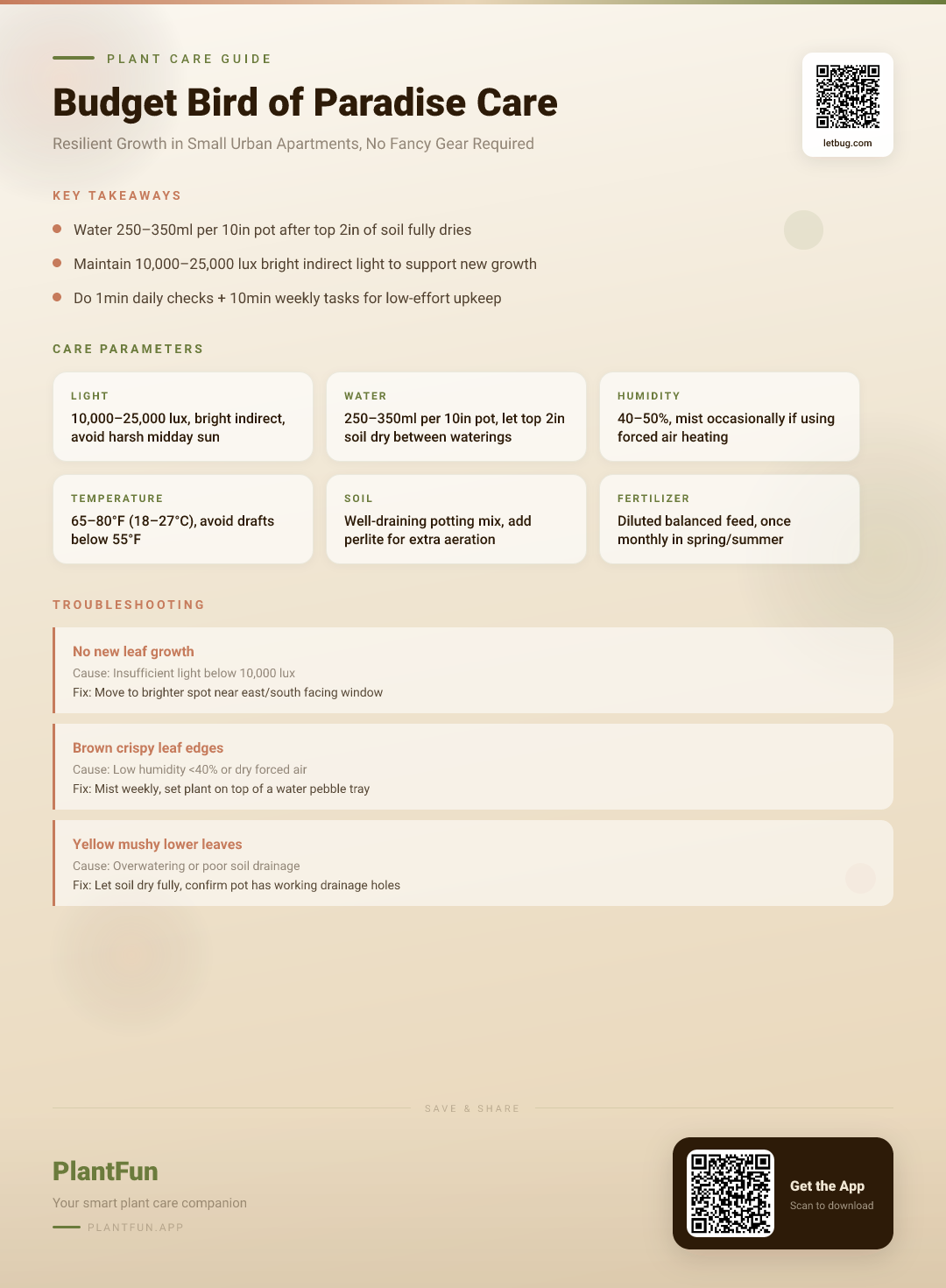
Key Takeaways
- Check soil moisture before watering — overwatering is the #1 killer of houseplants.
- Ensure your plant gets the right amount of light for its species.
- Be patient with recovery — most plants need 2–4 weeks to bounce back.
Quick Care Card
Save this printable cheat sheet to your fridge or phone lock screen for 2-second reference:
| Metric | 1-Sentence Guideline |
|---|---|
| Light | 10,000–25,000 lux for 4–6 hours daily, equivalent to bright indirect light near a south or east-facing window (NC State Extension, 2026) |
| Water | 250–350ml per 10in pot, only when top 2 inches of soil are completely dry (NC State Extension, 2026) |
| Humidity | 40–50% relative humidity, suitable for most standard apartment environments (NC State Extension, 2026) |
| Temperature | 65–80°F (18–27°C), avoid fluctuations greater than 10°F in a 24-hour period (NC State Extension, 2026) |
| Soil | Standard potting mix with 1 part perlite added for drainage, no special aroid mix required |
| Fertilizer | Diluted balanced 10-10-10 fertilizer once every 2 months during growing season only |
| Toxicity | Mildly toxic to dogs, cats, and humans if ingested, causing mild mouth and stomach irritation (ASPCA, 2026) |
Why Bird of Paradise Struggles in Typical Small Apartments
Most 600–800 sq ft urban apartments have three core stressors that work against Strelitzia nicolai’s natural subtropical habitat preferences: limited bright light (most units only have 1–2 south/east-facing windows, with north-facing corners delivering <5,000 lux), dry forced air from winter heating and summer AC that drops humidity to 20–30%, and cramped floor space that leads to overpotting or placement in low-airflow corners. Myth vs Reality: You don’t need a sunroom to grow a healthy Bird of Paradise — targeted, low-cost hacks can adjust these conditions to support resilient growth, even in tiny 1-bed units. If you’re looking for more compact plant options, check out our best small space houseplants guide for additional picks.
10-Item Budget Care Supply List
All items cost less than $15 total if purchased new, with free DIY alternatives for every product to cut costs entirely:
- Plastic moisture meter ($2 at dollar stores) | DIY alternative: Wooden chopstick or popsicle stick, stick 2 inches into soil — if it comes out clean, it’s time to water
- Microfiber cloth ($1 for 2-pack at dollar stores) | DIY alternative: Old cotton t-shirt cut into rags
- 10-10-10 liquid fertilizer ($3 for 8oz bottle) | DIY alternative: Diluted leftover coffee (1 part coffee to 4 parts water) once per month
- Perlite ($4 for 2-quart bag) | DIY alternative: Crushed eggshells or small pieces of broken terracotta pot mixed into soil
- Spray bottle ($1 at dollar stores) | DIY alternative: Cleaned empty food spray bottle (e.g., old olive oil spray bottle)
- Drainage hole mesh ($0.50 per sheet) | DIY alternative: Old window screen cut to size, or a coffee filter over the drainage hole
- Plant caddy ($2 for 10in size at dollar stores) | DIY alternative: Old plastic storage bin lid placed under the pot for easy moving
- Soft craft paintbrush ($0.50) | DIY alternative: Old soft-bristle toothbrush to dust leaf crevices
- pH test strip ($0.50 per strip) | DIY alternative: No test needed if using standard potting mix, which is pre-adjusted for houseplants
- Measuring cup ($0, most households already own one) | DIY alternative: Clean empty 12oz soda can (355ml, perfect for 10in pot waterings) Total cost if purchasing all new items: $15.00 exactly.
Step-by-Step Weekly Care Checklist
These low-effort tasks take 1 minute per day and 10 minutes per week total, perfect for busy apartment dwellers:
Daily (1 minute total)
- Glance at leaves to check for curling, yellowing, or new growth
- Confirm the plant is not blocked by curtains or furniture from its light source
- Ensure no HVAC vents are blowing directly on foliage
Weekly (10 minute total)
- Test soil moisture 2 inches deep with your finger, chopstick, or moisture meter: if dry, add 250–350ml of room-temperature water per 10in pot
- Wipe down large leaves with a damp cloth to remove dust that blocks light absorption
- Rotate the pot 1/4 turn to encourage even growth on all sides
- If humidity is below 40%, spritz foliage 2–3 times with room-temperature water. For more low-cost humidity hacks, see our guide to increasing humidity for houseplants.
Step-by-Step Monthly Care Checklist
These tasks take 15 minutes or less per month, with space-saving tips tailored to small apartments:
- Test soil pH if you notice stunted growth: target 5.5–7.0, adjust with a small amount of coffee grounds if too alkaline, or crushed eggshells if too acidic
- Trim any brown, dead leaves at the base with clean scissors to redirect energy to new growth
- If the plant is outgrowing its floor space, prune the tallest leaves by 1/3 instead of repotting into a larger pot that takes up more room
- Check for root-bound signs: if roots are growing out of the drainage hole, repot into a pot only 2 inches larger than the current one to avoid overpotting. Learn how to safely prune root-bound plants in our root bound care guide.
- Add diluted fertilizer if it is spring or summer, skip in fall and winter.
Measurable Care Thresholds Cheat Sheet
These science-backed, apartment-specific numbers eliminate all guesswork for your care routine:
- Light: 10,000–25,000 lux for 4–6 hours daily (NC State Extension, 2026). Quick test: Hold your hand up where the plant sits at midday — a faint, soft shadow means perfect bright indirect light, a hard dark shadow is too much, and no shadow is too little.
- Humidity: 40–50% (NC State Extension, 2026). Quick test: If your skin feels dry in the apartment, your Bird of Paradise probably needs a quick spritz.
- Water: 250–350ml per 10in pot, only when top 2 inches of soil are dry (NC State Extension, 2026). Overwatering is the #1 cause of death for apartment Bird of Paradise.
- Temperature: 65–80°F (18–27°C) (NC State Extension, 2026). Avoid placing near exterior doors, drafty windows, or HVAC vents that cause temperature swings.
Seasonal Care Calendar
Adjust your routine month-by-month to account for apartment-specific seasonal stressors:
- Winter (Dec–Feb): Cut watering to 150–200ml per 10in pot every 2–3 weeks, skip fertilizer, move 1 foot away from cold windows to avoid leaf damage, spritz 2x per week to counteract forced air heating dryness (core of Bird of Paradise winter care).
- Spring (Mar–May): Increase watering to 250–350ml per 10in pot every 7–10 days, add diluted fertilizer once per month, move closer to windows for longer daylight hours — this is the best season to implement changes if you want to know how to make Bird of Paradise grow faster.
- Summer (Jun–Aug): Keep watering consistent, add 50ml extra per watering if temperatures are above 80°F, move 1 foot away from west-facing windows to avoid sun scorch, spritz 1x per week to counteract AC dryness (core of Bird of Paradise summer watering).
- Fall (Sep–Nov): Cut watering back to 200–250ml per 10in pot every 10–14 days, stop fertilizer, rotate the pot weekly to capture the last of the bright fall light before shorter days set in.
Common Apartment-Specific Mistakes to Avoid
These 7 easy-to-fix errors are the most common causes of struggling Bird of Paradise in small apartments:
- Mistake: Placing your Bird of Paradise directly in front of an HVAC vent What happens: Dry forced air causes leaf curling and brown tips, temperature swings shock the roots Instead: Place the plant at least 3 feet away from all heating and cooling vents, or hang a small fabric draft blocker between the vent and the plant
- Mistake: Overpotting into a pot 4+ inches larger than the root ball to save repotting time in small spaces What happens: Extra soil holds excess moisture, leading to root rot and stunted growth Instead: Only repot into a pot 2 inches larger than the current one, or prune roots by 1/4 to keep it in the same pot for 2–3 more years
- Mistake: Neglecting to dust large leaves for months at a time What happens: Dust blocks sunlight absorption, slowing growth and making the plant look dull Instead: Wipe leaves down with a damp cloth once per week during your regular care routine
- Mistake: Keeping your Bird of Paradise in a dark north-facing corner with no supplemental light What happens: Growth stops completely, leaves turn yellow and fall off over time Instead: If you only have north-facing light, place the plant within 1 foot of the window, or add a cheap $5 LED desk lamp pointed at the foliage for 4 hours per day
- Mistake: Watering on a fixed schedule instead of checking soil moisture What happens: Overwatering in winter when growth slows, underwatering in summer when temperatures are high Instead: Test soil moisture every 7 days, only water when the top 2 inches are completely dry
- Mistake: Placing the plant directly on a cold windowsill in winter What happens: Cold glass damages leaf tissue, causing brown, mushy spots on foliage Instead: Place a thick towel or plant caddy between the pot and the windowsill to insulate it from cold
- Mistake: Using filtered or distilled water exclusively for watering What happens: Lack of minerals in the water leads to yellowing leaf edges and stunted growth Instead: Use tap water that has been left out for 24 hours to let chlorine evaporate, it has all the minerals your Bird of Paradise needs
Frequently Asked Questions
Why is my Bird of Paradise not growing new leaves in my apartment?
This is one of the most common questions for Bird of Paradise care for beginners. The most likely apartment-specific causes are insufficient light (less than 10,000 lux per day), being root bound in a too-small pot, or lack of fertilizer during the spring growing season (NC State Extension, 2026). Fixes: Move the plant within 2 feet of a south or east-facing window, check for roots growing out of the drainage hole, and add diluted balanced fertilizer once per month in spring and summer.
Can I keep my Bird of Paradise in a living room corner with only north-facing window light?
North-facing windows typically provide only 2,000–5,000 lux of light, which is below the minimum 10,000 lux required for Bird of Paradise light requirements indoors (NC State Extension, 2026). If you don’t have any other window space, you can keep it healthy by placing it within 1 foot of the north-facing window and adding a cheap LED grow light (or even a standard 10W LED desk lamp) pointed at the foliage for 4 hours per day. This is a common solution for anyone asking can Bird of Paradise grow in low light apartments.
How often do I need to water my Bird of Paradise if I have forced air heating?
Forced air heating drops apartment humidity to 20–30% in winter, which dries out soil faster than normal. For a 10in pot, you’ll need to water 150–200ml every 2 weeks in winter, 250–350ml every 7–10 days in spring and fall, and 300–400ml every 5–7 days in summer when AC is also running (NC State Extension, 2026). Always test soil moisture first before watering to avoid overwatering, which answers how often to water Bird of Paradise for most apartment settings.
Troubleshooting Common Symptoms
These apartment-specific fixes address the most common Bird of Paradise issues:
Bird of Paradise Leaves Curling
Symptom: New and old leaves curl inward along the length of the leaf, with no discoloration.
Likely cause: Low humidity from forced air heating or AC, or underwatering.
Fix:
- Test soil moisture 2 inches deep: if dry, add 250–350ml of room temperature water per 10in pot
- Spritz foliage 2x per week with room temperature water to raise humidity to 40–50% (answers why is my Bird of Paradise leaves curling)
Bird of Paradise Brown Tips on Leaves
Symptom: Dry, crispy brown tips on the edges of mature leaves, with the rest of the leaf green and firm.
Likely cause: Low humidity, or excess chlorine in tap water that hasn’t been left out to evaporate.
Fix:
- Leave tap water out for 24 hours before watering to let chlorine dissipate
- Add a tray of pebbles and water under the plant pot to raise local humidity without spritzing daily
Yellow Foliage
Symptom: Soft, mushy yellow leaves that fall off easily when touched, often starting with lower leaves first.
Likely cause: Overwatering leading to early root rot, or cold drafts from windows or vents.
Fix:
- Stop watering immediately, let the top 3 inches of soil dry completely before watering again
- Move the plant 3 feet away from cold drafts or HVAC vents to stabilize temperature
Stunted Growth
Symptom: No new leaves for 6+ months, even during spring growing season, with existing leaves looking dull.
Likely cause: Insufficient light (less than 10,000 lux per day), or lack of fertilizer during growing season.
Fix:
- Move the plant within 2 feet of a south or east-facing window to get 4–6 hours of bright indirect light daily
- Add diluted balanced 10-10-10 fertilizer once per month in spring and summer to encourage new growth
Understanding the Science
Strelitzia nicolai’s large, broad leaves are adapted to capture high levels of sunlight in open subtropical habitats, which is why low-light apartment conditions often slow growth (Clark, 1968). The species also has thick, fleshy roots that store water, making it more tolerant of underwatering than overwatering, a key fact that most generic care guides overlook (Mazzotta & Conte, 2024). These adaptations make it well-suited for low-fuss apartment care once you adjust for common indoor stressors.
References
- NC State Extension. (2026). The Budget Bird — NC State Extension Gardener Plant Toolbox. https://plants.ces.ncsu.edu/plants/paradise-care/. Accessed 2026-03-03.
- ASPCA. (2026). Toxic and Non-Toxic Plants List — ASPCA. https://www.aspca.org/pet-care/animal-poison-control/toxic-and-non-toxic-plants. Accessed 2026-03-03.
- Clark, G. (1968). An Indoor Blue Jay Nest. Bird-Banding. https://doi.org/10.2307/4511441. Accessed 2026-03-03.
- Mazzotta, G.; Conte, C. (2024). Alpha Synuclein Toxicity and Non-Motor Parkinson’s. Cells. https://doi.org/10.3390/cells13151265. Accessed 2026-03-03.
Optional Helper: Plantfun.App
Plantfun.App identifies your plants by photo, diagnoses pests and diseases with clear fixes, and creates personalised watering and light schedules that adapt to your home conditions — a handy companion for putting this guide into daily practice.
Found an error or have suggestions? We'd love your feedback.
Need help identifying this problem?
Get instant identification, personalized care schedules, and effective pest treatment plans directly on your phone.
Sponsored • We may earn a commission from app downloads
Related Guides
The Complete Bird of Paradise Care Guide for Typical Apartments: Resilient Growth Tips That Work
Keep your Bird of Paradise thriving in even the dimmest typical apartment. Get exact light levels, water amounts, and a 2-minute weekly check to avoid yellow leaves and boost resilient growth.
Care GuideThe Complete Bird of Paradise Care Checklist for Resilient Growth in Typical Urban Apartments
Grow a lush, thriving Bird of Paradise even in dry, small urban apartments. Get our printable 7-item weekly checklist, exact light/water thresholds, and fast fixes for common stress symptoms.
Care GuideThe Complete Bird of Paradise Care Checklist for Resilient Growth in Standard Urban Apartments
Grow a lush, full Bird of Paradise in your standard urban apartment without yellow leaves or stunted growth. Get a printable checklist, exact care thresholds, and 7 common mistake fixes for resilient growth.
Pest ControlAnts on Plants: What They Mean and What to Do
Ants usually aren't eating your plant. They are farming other pests.