
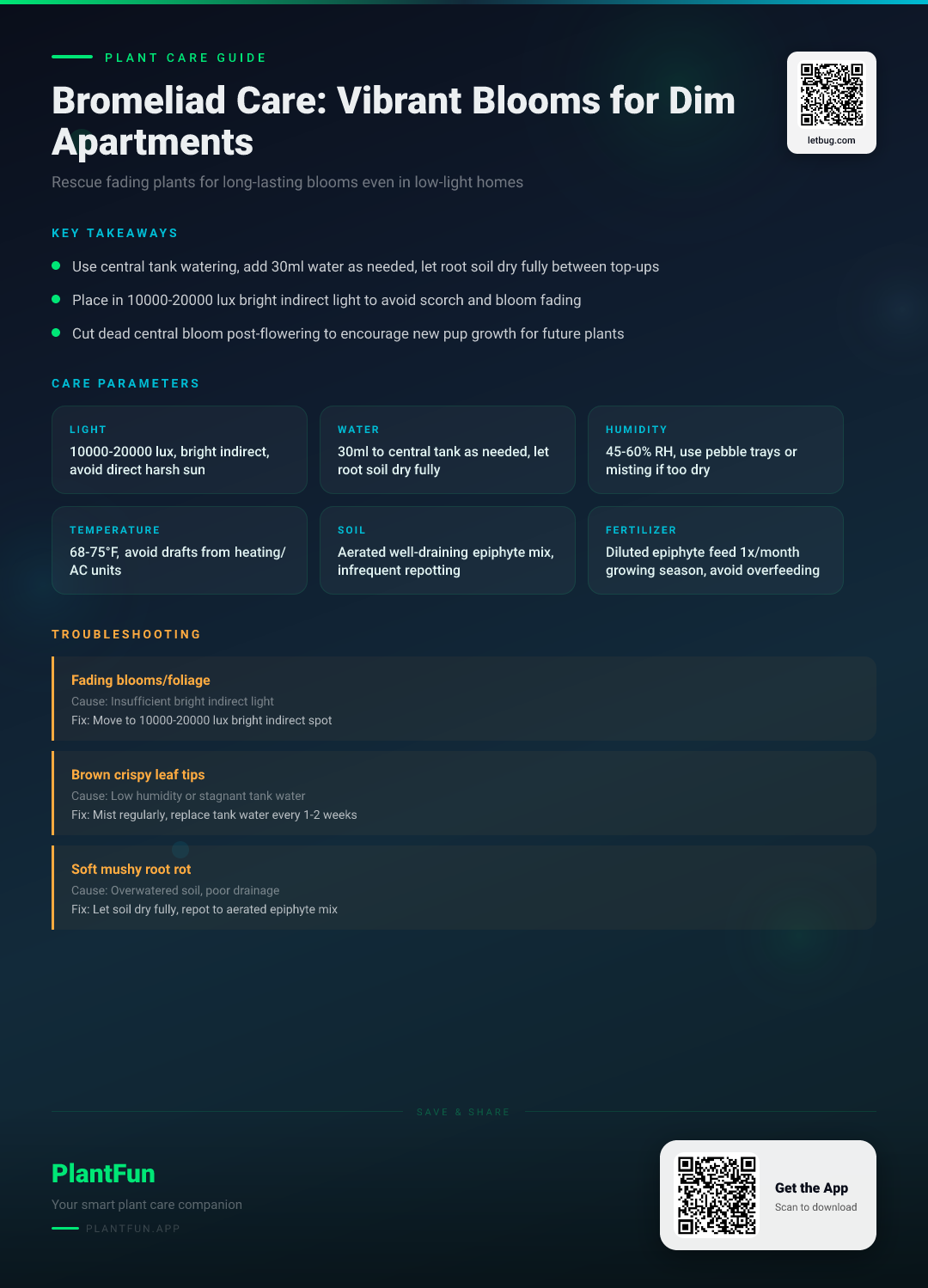
Key Takeaways
- Check soil moisture before watering — overwatering is the #1 killer of houseplants.
- Ensure your plant gets the right amount of light for its species.
- Be patient with recovery — most plants need 2–4 weeks to bounce back.
Quick Care Card: Essential Thresholds for Bromeliads
| Feature | Requirement |
|---|---|
| Light | 10,000–20,000 lux (Bright indirect) |
| Water | 30ml in central tank weekly |
| Humidity | 45–60% relative humidity |
| Temperature | 68–75°F (20–24°C) |
| Soil | Chunky, well-draining orchid mix |
| Fertilizer | Diluted balanced liquid (monthly) |
| Toxicity | Generally non-toxic (ASPCA, 2026) |
TL;DR: The Reality of Apartment Bromeliads
Bromeliads are specialized epiphytes that capture water through a central ‘tank’ rather than just their roots. In apartments, the most common killers are overwatering the soil and placing the plant in light levels below 10,000 lux. Keep the tank clean, ensure bright filtered light, and never let the soil sit in water (NC State Extension, 2026).
Why Your Bromeliad Fades: Decoding Your Apartment’s Environment
When I first brought home my debut Bromeliad, I made the classic rookie mistake: I planted it in dense potting soil and watered the base like a fern. Within a month, the crown began to rot, and the vibrant bract—the colorful structure people mistake for the flower—turned mushy.
Bromeliads in the wild are epiphytes, meaning they grow on trees, not in the ground (NC State Extension, 2026). In an apartment, your goal is to mimic that aerial lifestyle. If your plant is fading prematurely, your home likely has stagnant air or too little light, which prevents the plant from photosynthesizing efficiently enough to maintain its structural integrity.
Step 1: Mastering the Central Tank Watering Method
Your Bromeliad’s ‘tank’ (the central cup formed by leaf bases) is its primary hydration organ.
- Use room-temperature, filtered water.
- Add exactly 20–30ml of water into the central tank weekly.
- Flush the tank every 4 weeks to prevent mineral buildup and bacterial growth.
- Keep the soil only slightly damp; if you can squeeze moisture out of it with your fingers, it is too wet (NC State Extension, 2026).
Step 2: Calibrating Light Levels
Many apartment dwellers ask, “can bromeliads survive in low light?” The truth is, while they won’t die immediately, they will lose their color and stop producing offsets. You need at least 10,000 lux. If you don’t have a light meter, place your hand between the plant and the light source; if it casts a faint, soft shadow, the light is likely sufficient.
Step 3: Root Health: Why Drainage and Aeration Beat Frequent Repotting
Since these plants are epiphytic, their roots are primarily for anchorage (NC State Extension, 2026). Do not repot them into heavy, moisture-retentive soil. Use a chunky mix consisting of bark, perlite, and a small amount of coco coir to ensure oxygen reaches the root zone. High oxygen availability prevents root suffocation.
Step 4: Humidity Hacks for Urban Spaces
Apartments are notorious for low humidity, especially in winter.
- Pebble Trays: Place the pot on a tray of pebbles and water, but ensure the pot base sits above the waterline.
- Grouping: Place your Bromeliad near other plants to create a micro-climate with higher relative humidity (Stone, 2010).
Step 5: The Post-Bloom Lifecycle
Don’t panic when the bloom fades. Bromeliads are monocarpic—they flower once, then slowly decline while producing ‘pups’ (offsets) at the base. Snip the spent flower stalk to redirect energy to these pups. This is the natural cycle of the species (Diesel, 1992).
Yellowing Leaf Bases
Symptom: The leaves near the center are turning yellow or translucent.
Likely cause: Crown rot from stagnant water.
Fix:
- Remove the plant from the pot immediately.
- Inspect roots for mushy, black sections and trim them.
- Repot in fresh, dry orchid bark and withhold water for a week.
Brown Leaf Tips
Symptom: Crispy, brown tips on otherwise healthy leaves.
Likely cause: Low ambient humidity or chemical burn from tap water minerals.
Fix:
- Increase humidity via a nearby humidifier.
- Switch to distilled or rainwater to avoid mineral buildup.
Voice Search FAQ
How do I know if my Bromeliad is getting enough water? Check the central tank. If it’s bone dry, top it up. If the soil is soggy, you’ve overwatered; let the soil dry out to the top two inches before watering again (NC State Extension, 2026).
Can I really keep a Bromeliad in a dark apartment? While they tolerate lower light better than some tropicals, consistent light under 10,000 lux will cause the plant to etiolate (stretch) and lose its vibrancy. If you have no bright windows, consider a supplemental LED grow light.
Common Mistakes to Avoid
- Mistake: Filling the tank with tap water.
- What happens: Mineral deposits leave white, crusty marks.
- Instead: Use rainwater or distilled water.
- Mistake: Over-fertilizing.
- What happens: Leaf burn and weakened stems.
- Instead: Use a balanced 10-10-10 liquid fertilizer at 1/4 strength, once a month during the growing season.
Seasonal Care Calendar
- Summer: Increase airflow to prevent fungal growth as humidity rises.
- Winter: Keep away from drafty radiators; the dry heat will evaporate the tank water rapidly. Check the tank twice weekly (Stone, 2010).
References
- Diesel, R. (1992). Managing the offspring environment: brood care in the bromeliad crab, Metopaulias depressus. Behavioral Ecology and Sociobiology. https://doi.org/10.1007/bf00173948. Accessed 2026-03-15.
- Stone, T. (2010). Indoor gardening. Child Care. https://doi.org/10.12968/chca.2010.7.2.46139. Accessed 2026-03-15.
- ASPCA. (2026). Toxic and Non-Toxic Plants List — ASPCA. https://www.aspca.org/pet-care/animal-poison-control/toxic-and-non-toxic-plants. Accessed 2026-03-15.
- NC State Extension. (2026). Bromeliad Care — NC State Extension Gardener Plant Toolbox. https://plants.ces.ncsu.edu/plants/bromeliad-care/. Accessed 2026-03-15.
Optional Helper: Plantfun.App
Plantfun.App identifies your plants by photo, diagnoses pests and diseases with clear fixes, and creates personalised watering and light schedules that adapt to your home conditions — a handy companion for putting this guide into daily practice.
Found an error or have suggestions? We'd love your feedback.
Need help identifying this problem?
Get instant identification, personalized care schedules, and effective pest treatment plans directly on your phone.
Sponsored • We may earn a commission from app downloads
Related Guides
Guzmania Bromeliads in Low-Humidity Apartments: A Simple Care Guide for Lasting Blooms
Revive your fading Bromeliad with our precise tank-watering method. Learn the exact light and humidity needs to keep your Guzmania vibrant in any apartment.
Care GuideThe Complete Bromeliad Care Guide for Small Urban Apartments: Tips for Resilient Growth
Grow lush, long-blooming bromeliads even in tiny apartments with this science-backed guide. Get exact light levels, watering amounts, and space-saving hacks to keep your plant thriving for years.
Care GuideGuzmania Bromeliad in a Low-Light Apartment: The Complete Care Guide for Resilient Growth
Master your Guzmania bromeliad care with this budget-friendly guide. Learn the exact 50ml tank-filling method and light tricks to keep your plant thriving for years.
Pest ControlAnts on Plants: What They Mean and What to Do
Ants usually aren't eating your plant. They are farming other pests.