
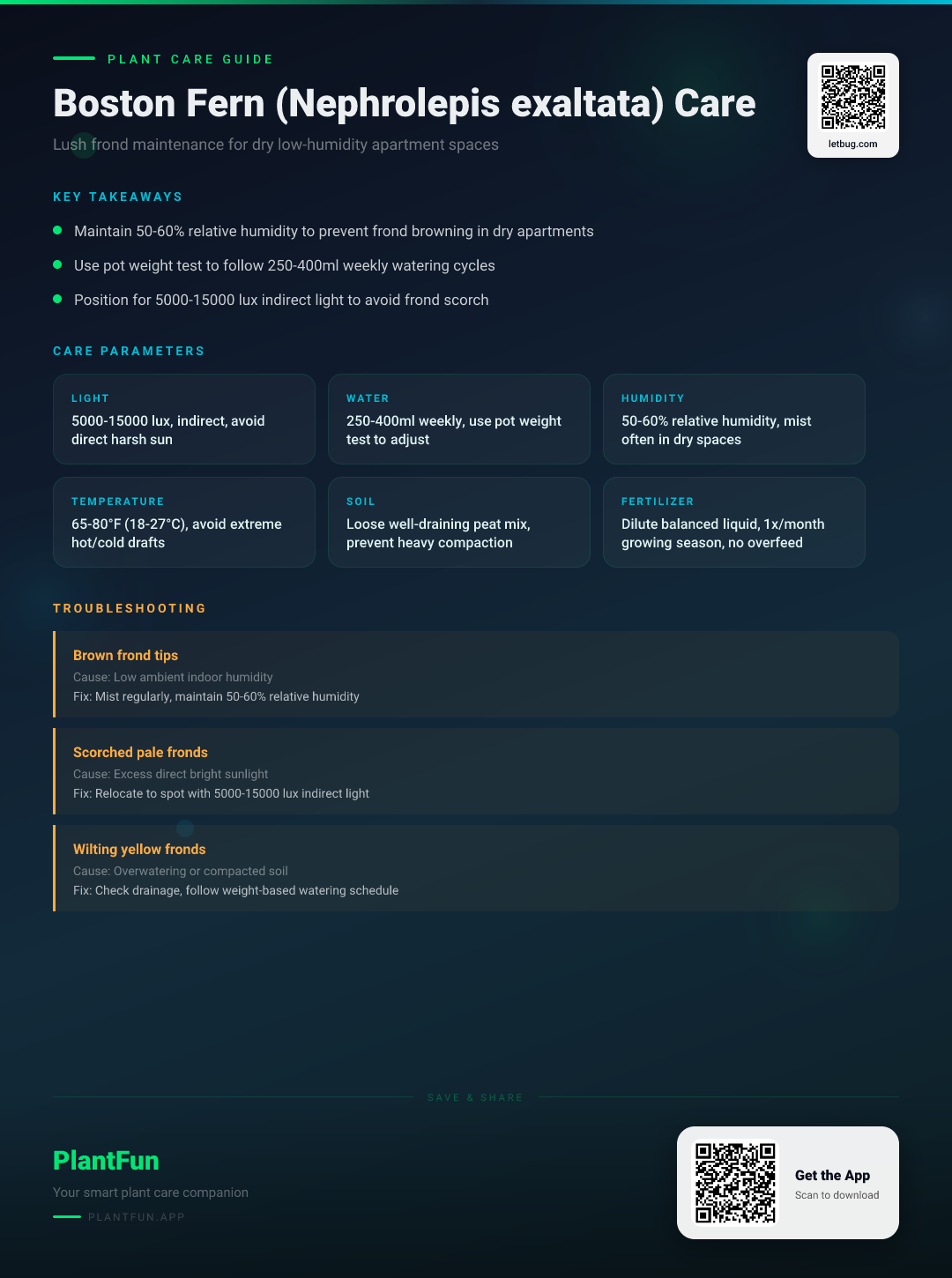
Key Takeaways
- Check soil moisture before watering — overwatering is the #1 killer of houseplants.
- Ensure your plant gets the right amount of light for its species.
- Be patient with recovery — most plants need 2–4 weeks to bounce back.
Quick Care Card: The Essential Metrics for Nephrolepis exaltata
| Metric | Requirement |
|---|---|
| Light | 5,000–15,000 Lux (Bright, indirect) |
| Water | Keep evenly moist; 250–400ml weekly |
| Humidity | 50%–60% Relative Humidity |
| Temperature | 65°F–80°F (18°C–27°C) |
| Soil | Peat-based, high drainage mix |
| Fertilizer | Balanced 20-20-20, diluted, monthly |
| Toxicity | Non-toxic to cats and dogs (ASPCA, 2026) |
TL;DR: Why Boston Ferns Struggle in Modern Apartment Air
Boston Ferns (Nephrolepis exaltata) fail in apartments because they are tropical epiphytes that thrive in high-humidity, dappled-light understories. Modern HVAC systems strip moisture from the air, causing fronds to desiccate rapidly. To keep yours lush, you must mimic an understory climate by maintaining >50% relative humidity and ensuring the soil never fully dries out between waterings. If you are struggling, it is likely a mismatch between your environment’s hydration levels and the plant’s high transpiration rate.
My Experience: The “Crispy Tip” Lesson
When I first got my Boston Fern, I treated it like my ZZ plant. I left it on a sunny windowsill and only watered it when I remembered. Within two weeks, the fronds were brown and crunchy. I realized I was ignoring its physiological need for consistent moisture. I moved it away from the direct sun and implemented a strict watering cycle. Learning to read the plant’s “thirst” through weight rather than a schedule was the turning point in my Boston Fern care routine.
Why This Matters: Understanding the Fern’s Natural Understory Habitat
In the wild, these ferns grow in the filtered light of canopy trees where humidity is consistently high (NC State Extension, 2026). When we bring them into a dry apartment, we force the plant to adapt to an environment that is effectively a desert compared to its native home. Understanding this helps you see that brown tips are not just a nuisance; they are a sign that the plant’s transpiration rate exceeds its ability to pull water from the soil (Langeland & Enloe, 2017).
Step-by-Step Guide: Managing 50-60% Relative Humidity in Dry Spaces
- Use a Hygrometer: Keep a small digital monitor near your plant. If the air is below 50%, you need intervention.
- Group Plants: Placing your fern near other houseplants increases the local micro-humidity through collective transpiration.
- Use a Pebble Tray: Fill a shallow tray with stones and water, then place the pot on top. Ensure the base of the pot never touches the water to avoid root rot.
- Humidifier Proximity: In winter, place your fern within 3 feet of a cool-mist humidifier to stabilize the ambient air (NC State Extension, 2026).
Watering Mastery: Using the ‘Weight Test’ for 250-400ml Weekly Cycles
Rather than using a calendar, I use the ‘Weight Test.’ Pick up your pot right after watering, then pick it up again three days later. You will notice a significant difference in weight. For a standard 6-inch pot, I generally find that 250-400ml of water is required weekly to keep the substrate damp but not saturated. If the surface soil feels dry to the touch, it is time to hydrate.
Lighting Strategies: Targeting 5,000-15,000 Lux Without Scorching Fronds
Nephrolepis exaltata requires bright, indirect light (NC State Extension, 2026). If you have a north-facing window, that is ideal. If you are in a high-rise with harsh, direct southern sun, use a sheer curtain to diffuse the light to the 5,000-15,000 lux range. Anything higher will cause foliar scorch, turning delicate fronds yellow or brown.
Temperature Control: Staying in the 65-80°F (18-27°C) Apartment Sweet Spot
Boston Ferns are sensitive to rapid temperature swings. Keep them away from heating vents or air conditioning drafts, which fluctuate rapidly and dry out the air. If you can maintain a steady 65-80°F (18-27°C) range, your plant will maintain consistent growth (NC State Extension, 2026).
Seasonal Care Calendar: Adjusting for Winter Heating vs. Summer Growth
- Spring/Summer: Growth phase. Increase water slightly and apply a balanced liquid fertilizer diluted to half-strength once per month (Gilliam et al., 1983).
- Autumn/Winter: Dormancy phase. Reduce fertilizer entirely. Monitor humidity closely as heating systems run. You may need to water less frequently, but never let the root ball completely dehydrate.
Voice Search FAQ: Why is my Boston Fern turning brown even though I water it?
Often, it is not the volume of water, but the humidity of the air. If the air is too dry, the plant loses moisture faster than the roots can supply it to the fronds, leading to browning. Check your ambient humidity first.
Voice Search FAQ: Can I keep my Boston Fern in a windowless bathroom?
While bathrooms offer great humidity, you must provide supplemental light. A standard light bulb is usually insufficient; use a full-spectrum LED grow light for 8-10 hours a day to mimic the dappled light it needs.
Common Mistakes: Avoiding Over-Fertilization and Heavy Soil Compaction
- Mistake: Using standard heavy potting soil.
- What happens: Roots suffocate due to lack of oxygen.
- Instead: Use a peat-based, high-drainage mix specifically for ferns.
- Mistake: Over-fertilizing.
- What happens: Salt buildup in the soil burns the root tips.
- Instead: Use a weak liquid solution only during active growth (Gilliam et al., 1983).
References
- Langeland, K.; Enloe, S. (2017). Natural Area Weeds: Distinguishing Native and Non-Native “Boston Ferns” and “Sword Ferns” (Nephrolepis spp.). https://doi.org/10.32473/edis-ag120-2001. Accessed 2026-03-18.
- Gilliam, C.; Evans, C.; Shumack, R. (1983). Lime requirements of Boston ferns: II. Foliar and medium analysis. Communications in Soil Science and Plant Analysis. https://doi.org/10.1080/00103628309367342. Accessed 2026-03-18.
- ASPCA. (2026). Toxic and Non-Toxic Plants List — ASPCA. https://www.aspca.org/pet-care/animal-poison-control/toxic-and-non-toxic-plants. Accessed 2026-03-18.
- NC State Extension. (2026). Boston Ferns — NC State Extension Gardener Plant Toolbox. https://plants.ces.ncsu.edu/plants/fern-care/. Accessed 2026-03-18.
Optional Helper: Plantfun.App
Plantfun.App identifies your plants by photo, diagnoses pests and diseases with clear fixes, and creates personalised watering and light schedules that adapt to your home conditions — a handy companion for putting this guide into daily practice.
Found an error or have suggestions? We'd love your feedback.
Need help identifying this problem?
Get instant identification, personalized care schedules, and effective pest treatment plans directly on your phone.
Sponsored • We may earn a commission from app downloads
Related Guides
Boston Fern in a Low-Humidity Apartment: The Ultimate Care Guide for Resilient Growth
Stop your Boston Fern from shedding brown needles. Learn the exact 50-60% humidity hacks, watering schedules, and light levels for a lush, thriving apartment.
Care GuideBoston Fern in a Low-Humidity Apartment: The Seasonal Care Guide for Lush Greenery
Transform your brittle Boston Fern into a lush, thriving display. Learn the exact humidity levels, watering cycles, and seasonal shifts needed for apartment life.
Care GuideBoston Ferns in Dry Apartments: A 5-Step Rescue Plan for Lush, Frond-Filled Growth
Transform your crisping Boston Fern into a lush centerpiece. Master the 4 key humidity and light variables that keep fronds vibrant in any dry apartment.
Pest ControlAnts on Plants: What They Mean and What to Do
Ants usually aren't eating your plant. They are farming other pests.