
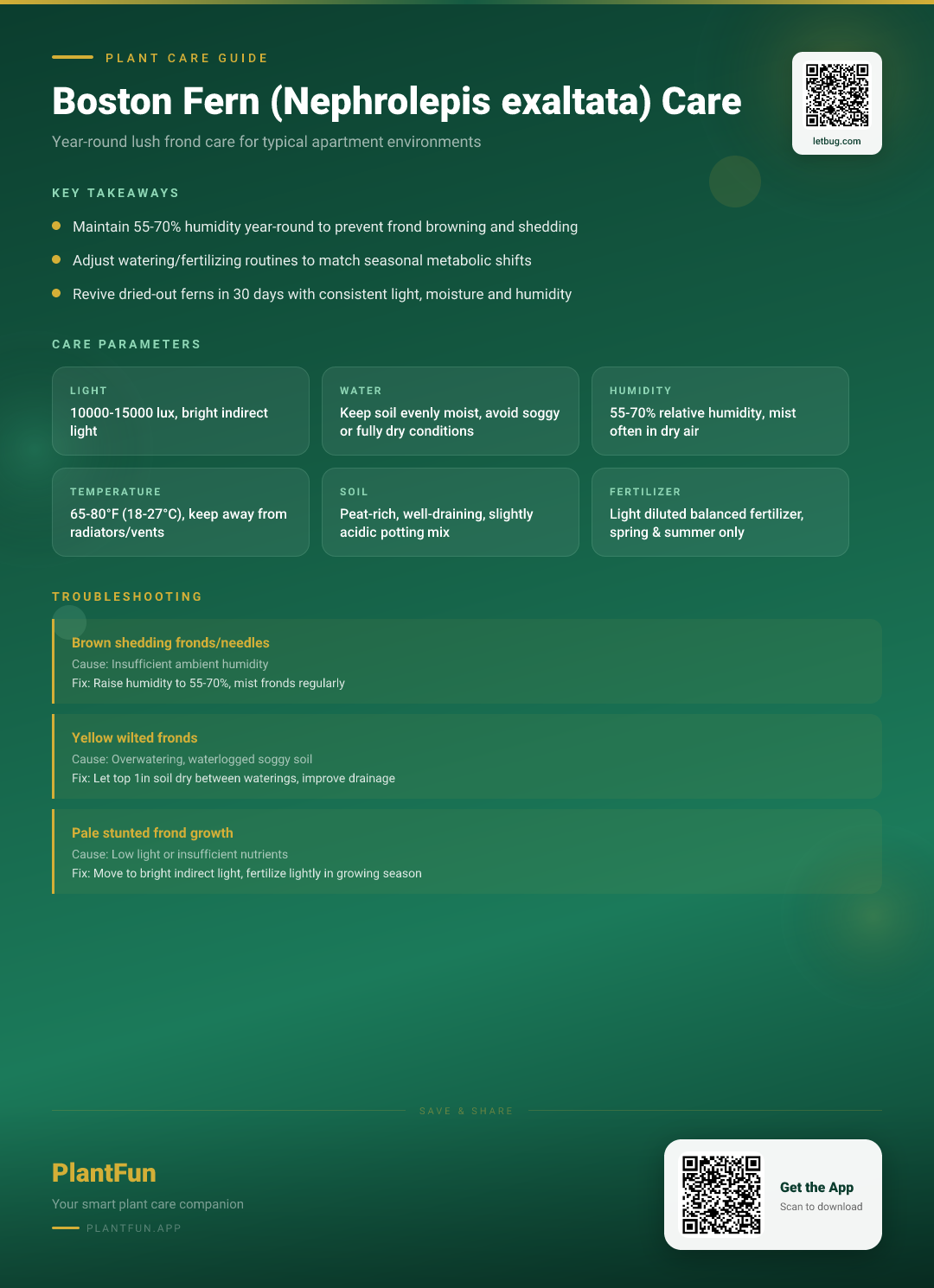
Key Takeaways
- Check soil moisture before watering — overwatering is the #1 killer of houseplants.
- Ensure your plant gets the right amount of light for its species.
- Be patient with recovery — most plants need 2–4 weeks to bounce back.
TL;DR: The secret to a thriving Nephrolepis exaltata is consistency. Keep it in bright, indirect light (10,000–15,000 lux), maintain soil moisture without saturation, and prioritize humidity levels between 55–70%. Avoid drafts and radiator heat at all costs. When in doubt, mist the fronds and check the soil depth daily.
Quick Care Card: Essential Data
| Feature | Requirement |
|---|---|
| Light | 10,000–15,000 lux (Bright, indirect) |
| Water | Keep evenly moist; never allow to dry out |
| Humidity | 55–70% (High) |
| Temperature | 65–80°F (18–27°C) |
| Soil | Peat-based, well-draining mix |
| Fertilizer | Balanced liquid (10-10-10) at half-strength |
| Toxicity | Non-toxic to pets (ASPCA, 2026) |
Why Your Boston Fern Struggles in Apartments: The Humidity Paradox
When I first brought my first Boston Fern home, I made the mistake of placing it on a bookshelf near my living room window. Within a week, the fronds were crisp and brown. The problem? Apartments are essentially deserts compared to the fern’s native environment. The ‘humidity paradox’ occurs because we want these lush plants for their aesthetic, but our HVAC systems constantly scrub moisture from the air to keep us comfortable. If you aren’t actively fighting that dryness, the plant will prioritize survival over beauty.
Understanding Nephrolepis exaltata: Natural Habitat vs. The Living Room
In the wild, the Boston Fern (or Sword Fern) thrives in humid, shaded forest floors where temperatures are stable and moisture is abundant (Gilman, 2007). Bringing Nephrolepis exaltata into an apartment requires mimicking this high-humidity microclimate. Unlike succulents, these plants lack a waxy cuticle to store water, meaning they lose moisture rapidly through their fronds (Benedict, 1921).
Measuring Your Environment: 10,000-15,000 lux light requirements explained
Ferns are often incorrectly labeled as ‘low-light’ plants. In my experience, they need consistent, bright, indirect light to maintain a dense habit. If you have a light meter, aim for 10,000–15,000 lux. If you don’t, place the plant near a north or east-facing window where it can ‘see’ the sky but not receive direct, scorching sun (NC State Extension, 2026).
The Watering Science: Why 150-200ml of water is not always the answer
Watering isn’t about a specific volume; it’s about soil saturation. I check my ferns by sticking my finger two inches deep into the substrate. If it feels like a wrung-out sponge, it’s perfect. If it feels dusty, it needs water immediately. Using a consistent watering schedule prevents the shock that leads to yellowing.
Mastering Humidity: Maintaining 55-70% levels in dry apartments
To hit that 55-70% sweet spot, a single misting isn’t enough. I use a pebble tray filled with water beneath the pot to create a local humidity bubble. For those serious about growth, an ultrasonic humidifier is the gold standard for indoor plant humidity tips.
Temperature Control: Keeping between 65-80°F (18-27°C) year-round
Ferns are sensitive to sudden shifts. Keep them away from drafty doors and air conditioning vents. According to the NC State Extension (2026), these plants perform best when temperatures stay between 65°F and 80°F. If you are comfortable in a light sweater, your fern is likely comfortable too.
Spring & Summer: Boosting growth with light fertilizer and frequent misting
During the active growing season, I provide a liquid fertilizer at half-strength every 4–6 weeks. I also increase my misting routine to ensure the fronds stay hydrated while temperatures fluctuate.
Fall & Winter: The seasonal shift to lower metabolic rates and soil maintenance
As the days shorten, the fern’s metabolism slows down. Reduce fertilization significantly. The biggest danger here is proximity to radiators. If your apartment heating is aggressive, keep the fern in a bathroom where the ambient moisture helps protect it from drying air.
Common Mistakes: Avoiding the ‘Damp but Not Soggy’ trap
- Mistake: Letting the plant sit in a saucer of standing water.
- What happens: Root rot and fungal pathogens.
- Instead: Ensure your pot has drainage holes and dump excess water after 30 minutes.
Troubleshooting Guide
[Brown Frond Tips]
Symptom: Leaf tips turn brown and brittle.
Likely cause: Low humidity or inconsistent watering.
Fix:
- Increase ambient humidity with a humidifier.
- Move the plant away from heat vents.
[Yellowing Fronds]
Symptom: Entire fronds turn yellow and drop.
Likely cause: Overwatering or poor drainage.
Fix:
- Inspect the soil for swampy conditions.
- Ensure the pot has proper drainage holes.
FAQ
- Why is my Boston Fern shedding brown needles on my floor? This is usually a sign of extreme dehydration. Once a frond dries out, it won’t re-hydrate; it will shed. Trim these back to encourage new growth.
- How do I know if my apartment has enough humidity for a Boston Fern? Use a simple digital hygrometer. If it reads below 50% consistently, you need to intervene with a humidifier or group the fern with other plants.
- Can I keep my fern near a radiator or heating vent? Absolutely not. Radiators create a microclimate of dry, hot air that will kill a fern within weeks.
Step-by-Step Recovery: Reviving a dried-out fern in 30 days
- Submerge: Place the entire pot in a basin of lukewarm water for 15 minutes to rehydrate the peat moss.
- Prune: Trim back all completely dead, brown fronds to the soil line to redirect energy.
- Isolate: Place the plant in a high-humidity area like a bathroom with a window.
- Monitor: Ensure the soil stays damp (not soggy) for the next 30 days.
References
- Benedict, R. (1921). The Boston Fern Show. American Fern Journal. https://doi.org/10.2307/1544193. Accessed 2026-03-14.
- Gilman, E. (2007). Nephrolepis exaltata Boston Fern, Sword Fern. EDIS. https://doi.org/10.32473/edis-fp427-1999. Accessed 2026-03-14.
- ASPCA. (2026). Toxic and Non-Toxic Plants List — ASPCA. https://www.aspca.org/pet-care/animal-poison-control/toxic-and-non-toxic-plants. Accessed 2026-03-14.
- NC State Extension. (2026). Boston Fern — NC State Extension Gardener Plant Toolbox. https://plants.ces.ncsu.edu/plants/fern-care/. Accessed 2026-03-14.
Optional Helper: Plantfun.App
Plantfun.App identifies your plants by photo, diagnoses pests and diseases with clear fixes, and creates personalised watering and light schedules that adapt to your home conditions — a handy companion for putting this guide into daily practice.
Found an error or have suggestions? We'd love your feedback.
Need help identifying this problem?
Get instant identification, personalized care schedules, and effective pest treatment plans directly on your phone.
Sponsored • We may earn a commission from app downloads
Related Guides
The Complete Boston Fern Care Checklist for Lush Growth in Small Urban Apartments
Stop watching your Boston Fern turn brown in your apartment. Get 8 actionable checklist steps, exact light, humidity, and water parameters for lush, resilient fronds all year long.
Care GuideThe Complete Boston Fern Care Checklist for Resilient Lush Growth in Typical Apartments
Stop losing your Boston Fern to crispy, yellowing fronds. Get a free printable checklist, exact light, water, and humidity thresholds for lush resilient growth in any standard apartment.
Care GuideThe Complete Boston Fern Care Checklist for Resilient Growth in Small Urban Apartments
Stop struggling with crispy Boston Fern fronds in your apartment. Get exact humidity, light, and watering thresholds, plus a printable checklist for lush, resilient growth all year round.
Pest ControlAnts on Plants: What They Mean and What to Do
Ants usually aren't eating your plant. They are farming other pests.