
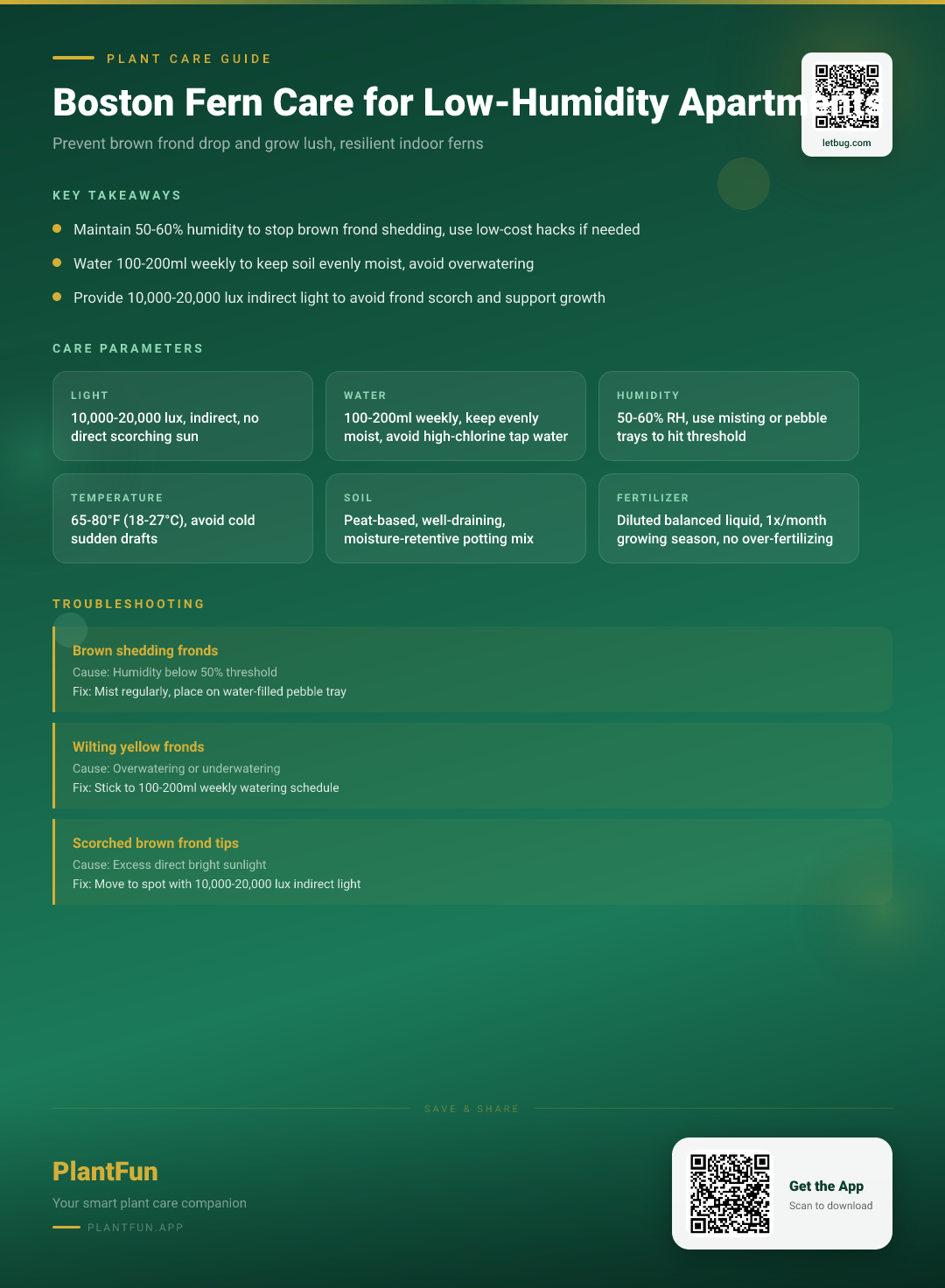
Key Takeaways
- Check soil moisture before watering — overwatering is the #1 killer of houseplants.
- Ensure your plant gets the right amount of light for its species.
- Be patient with recovery — most plants need 2–4 weeks to bounce back.
Quick Care Card: Essential Thresholds for Success
| Feature | Requirement |
|---|---|
| Light | 10,000–20,000 Lux (Bright, indirect) |
| Water | Maintain constant moisture (100–200ml weekly) |
| Humidity | 50–60% constant |
| Temperature | 65–80°F (18–27°C) |
| Soil | Peat-based, high drainage mix |
| Fertilizer | Diluted liquid (half-strength) monthly |
| Toxicity | Non-toxic to cats and dogs (ASPCA, 2026) |
TL;DR: Why Boston Ferns Struggle in Modern Apartments
Boston Ferns (Nephrolepis exaltata) struggle in modern apartments primarily due to low ambient humidity and irregular watering. They require a consistent environment mimicking their native humid, shaded forest floor. If your fern is shedding needles, it is likely reacting to a sudden drop in humidity below 50% or inconsistent soil moisture levels (NC State Extension, 2026). Stabilizing these two variables is the key to stopping frond drop.
Understanding Nephrolepis Exaltata: Natural Habitat vs. Living Room
When I first brought home my first Nephrolepis exaltata, I placed it on a radiator-adjacent bookshelf. Within three days, it looked like a shedding disaster. I learned quickly that these plants are adapted to high-moisture environments (Gilman, 2007). In nature, they thrive under dense forest canopies where humidity is stable and temperatures fluctuate minimally. Bringing them into a modern apartment—often characterized by forced-air heating and air conditioning—creates a physiological shock. Unlike many hardy houseplants, ferns have no mechanism to “shut down” to conserve moisture; they simply dehydrate and drop their delicate fronds.
Lighting Calibration: Achieving 10,000–20,000 Lux Without Scorching Fronds
Boston Ferns aren’t “low light” plants; they are “filtered light” plants. They require between 10,000 and 20,000 lux to maintain their lush, dense growth habit (Benedict, 1921). Direct sunlight will scorch the fronds within hours, causing them to turn yellow and crispy.
- The North-Facing Window Test: If you don’t have a light meter, place your plant near a north-facing window. If it’s too dim, the fronds will elongate and become “leggy.”
- The Shadow Test: Hold your hand 12 inches above the plant. If you see a faint, soft-edged shadow, the light level is likely ideal.
The Watering Protocol: Maintaining Soil Moisture (100–200ml Weekly Cycles)
Watering is the most common point of failure. You must avoid the “drench and drought” cycle. I recommend keeping the soil consistently damp but never waterlogged. For a standard 6-8 inch pot, start with 100–200ml of water weekly, adjusting based on your apartment’s specific temperature. Always use room-temperature water; cold water can shock the root system (NC State Extension, 2026). If you’re looking for more tips, read my guide on proper watering techniques for indoor plants to ensure you aren’t overdoing it.
Humidity Hacks: Reaching the 50-60% Threshold on a Budget
In an apartment, getting humidity to 50-60% is rarely achieved through misting alone. Misting only provides temporary surface moisture. Instead, use these steps:
- Group Plants: Placing your fern next to other plants creates a “micro-climate” that raises localized humidity.
- The Tray Method: Fill a wide, shallow tray with pebbles and water. Place the pot on the pebbles, ensuring the bottom of the pot never touches the water (to prevent root rot).
- Dedicated Humidifier: In winter months, a small ultrasonic humidifier set near the plant is the only foolproof way to prevent needle shed.
Temperature Ranges: Keeping Your Fern Between 65-80°F (18-27°C)
Keep your fern away from HVAC vents. Rapid shifts in temperature cause the plant to drop its fronds in an effort to reduce transpiration. Temperatures between 65-80°F are ideal. If your apartment drops below 60°F at night, consider moving the plant to a warmer interior room (Gilman, 2007).
Why is my Boston Fern turning brown and shedding leaves?
[Frond Desiccation]
Symptom: Leaf tips turn brown and brittle before falling off.
Likely cause: Low humidity or soil dryness.
Fix:
- Check soil moisture by sticking your finger 2 inches deep; if dry, water immediately.
- Increase local humidity using a tray or humidifier.
[Overwatering Stress]
Symptom: Yellowing of the entire frond, soft base.
Likely cause: Poor drainage leading to root suffocation.
Fix:
- Ensure your pot has drainage holes.
- Repot into a high-aeration mix with extra perlite.
How do I know if my Boston Fern needs more water?
Perform the “lift test.” A healthy, well-watered fern should feel surprisingly heavy for its size. If the pot feels light or the top inch of soil feels dusty, it is time for a hydration cycle. Learn more about choosing the right environment in my indoor plant placement guide.
Seasonal Care Calendar: Transitioning from Summer Growth to Winter Dormancy
- Spring/Summer: This is peak growth. Increase fertilizer to once every four weeks and ensure the soil remains moist.
- Autumn/Winter: Growth slows significantly. Reduce water by 20% and cease fertilization. Focus entirely on humidity, as heating systems drastically dry the air.
Common Mistakes to Avoid: From Tap Water Sensitivity to Over-Fertilizing
- Mistake: Using cold, chlorinated tap water. What happens: Tip burn and root shock. Instead: Use room-temperature, filtered, or distilled water.
- Mistake: Using high-nitrogen fertilizer in winter. What happens: Forcing growth that the plant cannot support in low light. Instead: Hold all fertilizers until the first day of spring.
Frequently Asked Questions
- Is my Boston Fern toxic to my pets? No, the ASPCA classifies Nephrolepis exaltata as non-toxic to cats and dogs (ASPCA, 2026).
- Can I put my Boston Fern in the bathroom? Yes, the bathroom is often the best room in an apartment due to the naturally higher humidity from showers.
- How do I revive a Boston Fern that has lost all its fronds? Cut back the dead stems, keep the root ball slightly moist but not saturated, and place it in bright, indirect light; new growth will often emerge within weeks if the rhizomes are still firm.
References
- ASPCA. (2026). Toxic and Non-Toxic Plants List — ASPCA. https://www.aspca.org/pet-care/animal-poison-control/toxic-and-non-toxic-plants. Accessed 2026-03-17.
- Benedict, R. (1921). The Boston Fern Show. American Fern Journal. https://doi.org/10.2307/1544193. Accessed 2026-03-17.
- Gilman, E. (2007). Nephrolepis exaltata Boston Fern, Sword Fern. EDIS. https://doi.org/10.32473/edis-fp427-1999. Accessed 2026-03-17.
- NC State Extension. (2026). Boston Fern — NC State Extension Gardener Plant Toolbox. https://plants.ces.ncsu.edu/plants/fern-care/. Accessed 2026-03-17.
Optional Helper: Plantfun.App
Plantfun.App identifies your plants by photo, diagnoses pests and diseases with clear fixes, and creates personalised watering and light schedules that adapt to your home conditions — a handy companion for putting this guide into daily practice.
Found an error or have suggestions? We'd love your feedback.
Need help identifying this problem?
Get instant identification, personalized care schedules, and effective pest treatment plans directly on your phone.
Sponsored • We may earn a commission from app downloads
Related Guides
Boston Fern in a Typical Apartment: The Complete Seasonal Care Guide for Lush Fronds
Transform your struggling Boston Fern into a lush, green centerpiece. Master exact watering, humidity, and seasonal adjustments for 365 days of vibrant growth.
Care GuideThe Complete Boston Fern Care Checklist for Resilient Lush Growth in Typical Apartments
Stop losing your Boston Fern to crispy, yellowing fronds. Get a free printable checklist, exact light, water, and humidity thresholds for lush resilient growth in any standard apartment.
Care GuideThe Complete Boston Fern Care Checklist for Lush Growth in Small Urban Apartments
Stop watching your Boston Fern turn brown in your apartment. Get 8 actionable checklist steps, exact light, humidity, and water parameters for lush, resilient fronds all year long.
Pest ControlAnts on Plants: What They Mean and What to Do
Ants usually aren't eating your plant. They are farming other pests.