
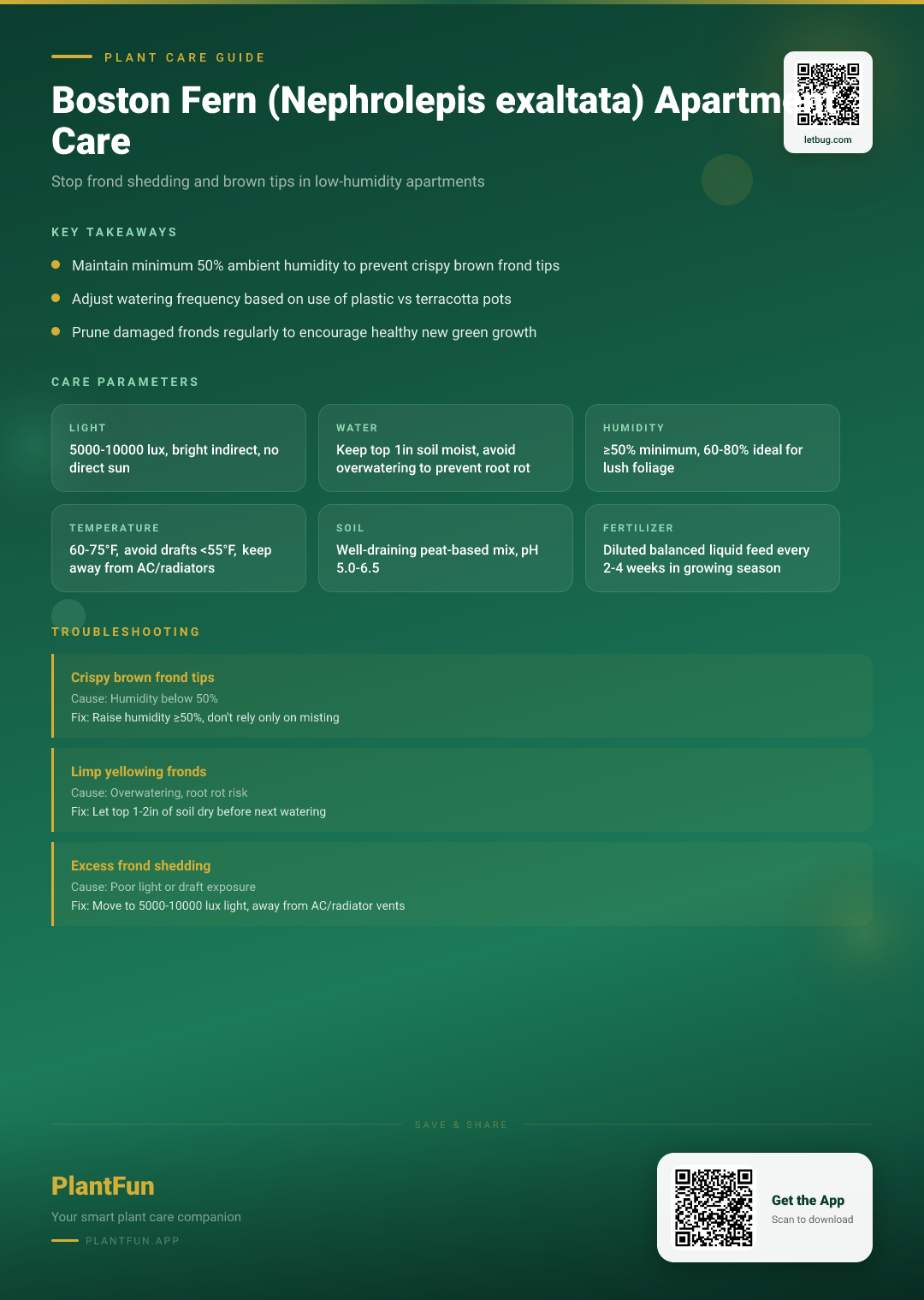
Key Takeaways
- Check soil moisture before watering — overwatering is the #1 killer of houseplants.
- Ensure your plant gets the right amount of light for its species.
- Be patient with recovery — most plants need 2–4 weeks to bounce back.
TL;DR: Your Boston Fern is shedding because its transpiration rate exceeds its moisture intake. To stop the decline, maintain ambient humidity above 50%, keep the soil consistently damp but never waterlogged, and place the plant in indirect light between 5,000–10,000 lux. Stop misting—it provides no long-term benefit. Use a pebble tray or humidifier to create a micro-climate instead.
My Experience: The “Diva” Reality Check
When I first brought home my Nephrolepis exaltata, I treated it like my succulents. I let it dry out, placed it in a sunny window, and expected it to thrive. Within two weeks, I was vacuuming piles of dried fronds off my floor. It wasn’t until I treated the plant as a humidity-dependent organism rather than a decorative object that I finally achieved that lush, cascading look. I learned the hard way that a Boston Fern in a modern, climate-controlled apartment is essentially living in a desert—and fixing it requires a shift in environment, not just more water.
Quick Care Card: Essential Thresholds for the Nephrolepis exaltata
| Feature | Requirement |
|---|---|
| Light | 5,000–10,000 Lux (Bright, indirect) |
| Water | Keep soil moisture at 70-80% capacity |
| Humidity | 50% minimum (60%+ ideal) |
| Temperature | 15°C–24°C (60°F–75°F) |
| Soil | Peat-based, well-draining mix |
| Fertilizer | Diluted liquid feed every 4–6 weeks |
| Toxicity | Non-toxic to cats and dogs (ASPCA, 2026) |
Why Your Apartment is Making Your Boston Fern Suffer
Boston Ferns are adapted to the forest floor, where transpiration is naturally regulated by high humidity (Gilman, 2007). Modern apartments, especially during winter, often drop below 30% relative humidity. This causes the foliage to lose water faster than the root system can replenish it. The result is systemic dehydration, which first shows as crispy tips and eventually leads to mass needle shed (Benedict, 1921).
Identifying the Warning Signs: Crispy Tips vs. Limp Stems
- Crispy, Brown Tips: A clear signal of low humidity or underwatering. The plant is sacrificing its extremities to save its core.
- Limp, Yellowing Stems: A symptom of root rot, usually caused by poor drainage or overwatering in a dense soil medium (NC State Extension, 2026).
The 50% Humidity Rule: Why Your Living Room Needs a Micro-Climate
To mimic their natural habitat, you must raise the humidity around the canopy. I use a hygrometer to track levels. If you cannot maintain 50% relative humidity, your fern will struggle regardless of your watering schedule.
How to Create a Micro-Climate
- Pebble Tray: Place the pot on a tray filled with pebbles and water. Ensure the base of the pot sits above the waterline to prevent root rot.
- Group Plants: Cluster your ferns with other moisture-loving plants to create a localized humid pocket.
- Humidifier: For the best results, use a cool-mist humidifier within 3 feet of the plant.
Watering Mastery: Avoiding Root Rot in Plastic vs. Terracotta Pots
Watering should be frequent but measured.
- Plastic Pots: Retain moisture longer. Check the soil every 3 days; if the top inch feels dry, add 100-200ml of water.
- Terracotta Pots: Allow for evaporation through the sides. These dry out faster, requiring more frequent checks. Quick Test: Stick your finger 2 inches into the soil. If it feels like a wrung-out sponge, the moisture level is perfect. If it feels dusty, water immediately.
Optimizing Light: Achieving 5,000–10,000 Lux for Steady Growth
While they are shade-tolerant, Nephrolepis exaltata thrives with bright, indirect light (NC State Extension, 2026). In my experience, north or east-facing windows provide the perfect 5,000–10,000 lux. Avoid direct, harsh afternoon sun, which will scorch the delicate fronds.
Step-by-Step Recovery: How to Prune and Rehydrate a Struggling Fern
- Prune: Using sterilized shears, cut away all dead, brown fronds at the base of the plant. This redirects energy to healthy growth.
- Flush: If the soil has become compacted and hydrophobic, submerge the pot in a basin of lukewarm water for 15 minutes.
- Relocate: Move the plant to the specified humidity zone (above 50% humidity).
- Monitor: Check the soil daily for the first week to ensure moisture remains consistent.
Voice Search FAQ
Why is my Boston Fern shedding needles everywhere?
This is typically a response to a sudden drop in humidity or extreme fluctuations in temperature (Gilman, 2007). It is the plant’s way of reducing its surface area to prevent further water loss.
How do I know if my fern needs more humidity right now?
Look at the tips. If they are curling inward and turning brown while the soil is still moist, the ambient air is far too dry for the plant’s transpiration requirements.
Can I leave my Boston Fern in an air-conditioned room?
Only if you can compensate for the dry, cold air. Air conditioning strips moisture from the room; place the fern away from direct vents and prioritize a humidifier to counteract the localized dry air.
Seasonal Care Adjustments for Winter Radiator Heat
Radiators create intense, dry heat. Move your fern at least 5 feet away from any heating source. During winter, reduce fertilizer to once every 8 weeks, as the plant’s growth slows in lower light conditions (NC State Extension, 2026).
Common Mistakes to Avoid: The ‘Mist-Only’ Myth
- Mistake: Misting the fronds daily.
What happens: It provides only 1-2 minutes of humidity and can actually encourage fungal growth if the leaves don’t dry quickly.
Instead: Use a humidifier or a pebble tray, which provides continuous atmospheric moisture.
References and Botanical Notes
- ASPCA. (2026). Toxic and Non-Toxic Plants List — ASPCA. https://www.aspca.org/pet-care/animal-poison-control/toxic-and-non-toxic-plants. Accessed 2026-03-10.
- Benedict, R. (1921). The Boston Fern Show. American Fern Journal. https://doi.org/10.2307/1544193. Accessed 2026-03-10.
- Gilman, E. (2007). Nephrolepis exaltata Boston Fern, Sword Fern. EDIS. https://doi.org/10.32473/edis-fp427-1999. Accessed 2026-03-10.
- NC State Extension. (2026). Boston Fern — NC State Extension Gardener Plant Toolbox. https://plants.ces.ncsu.edu/plants/fern-care/. Accessed 2026-03-10.
Optional Helper: Plantfun.App
Plantfun.App identifies your plants by photo, diagnoses pests and diseases with clear fixes, and creates personalised watering and light schedules that adapt to your home conditions — a handy companion for putting this guide into daily practice.
Found an error or have suggestions? We'd love your feedback.
Need help identifying this problem?
Get instant identification, personalized care schedules, and effective pest treatment plans directly on your phone.
Sponsored • We may earn a commission from app downloads
Related Guides
Boston Ferns in Dry Apartments: A 5-Step Rescue Plan for Lush, Frond-Filled Growth
Transform your crisping Boston Fern into a lush centerpiece. Master the 4 key humidity and light variables that keep fronds vibrant in any dry apartment.
Care GuideBoston Fern in a Dry Apartment: The 5-Step Rescue Plan for Lush, Frondy Growth
Stop dealing with brown, crunchy fronds. Follow our 5-step Boston Fern care guide to master humidity, light, and watering for a lush, thriving indoor fern today.
Care GuideThe Complete Boston Fern Care Checklist for Resilient Growth in Small Urban Apartments
Stop struggling with crispy Boston Fern fronds in your apartment. Get exact humidity, light, and watering thresholds, plus a printable checklist for lush, resilient growth all year round.
Pest ControlAnts on Plants: What They Mean and What to Do
Ants usually aren't eating your plant. They are farming other pests.