
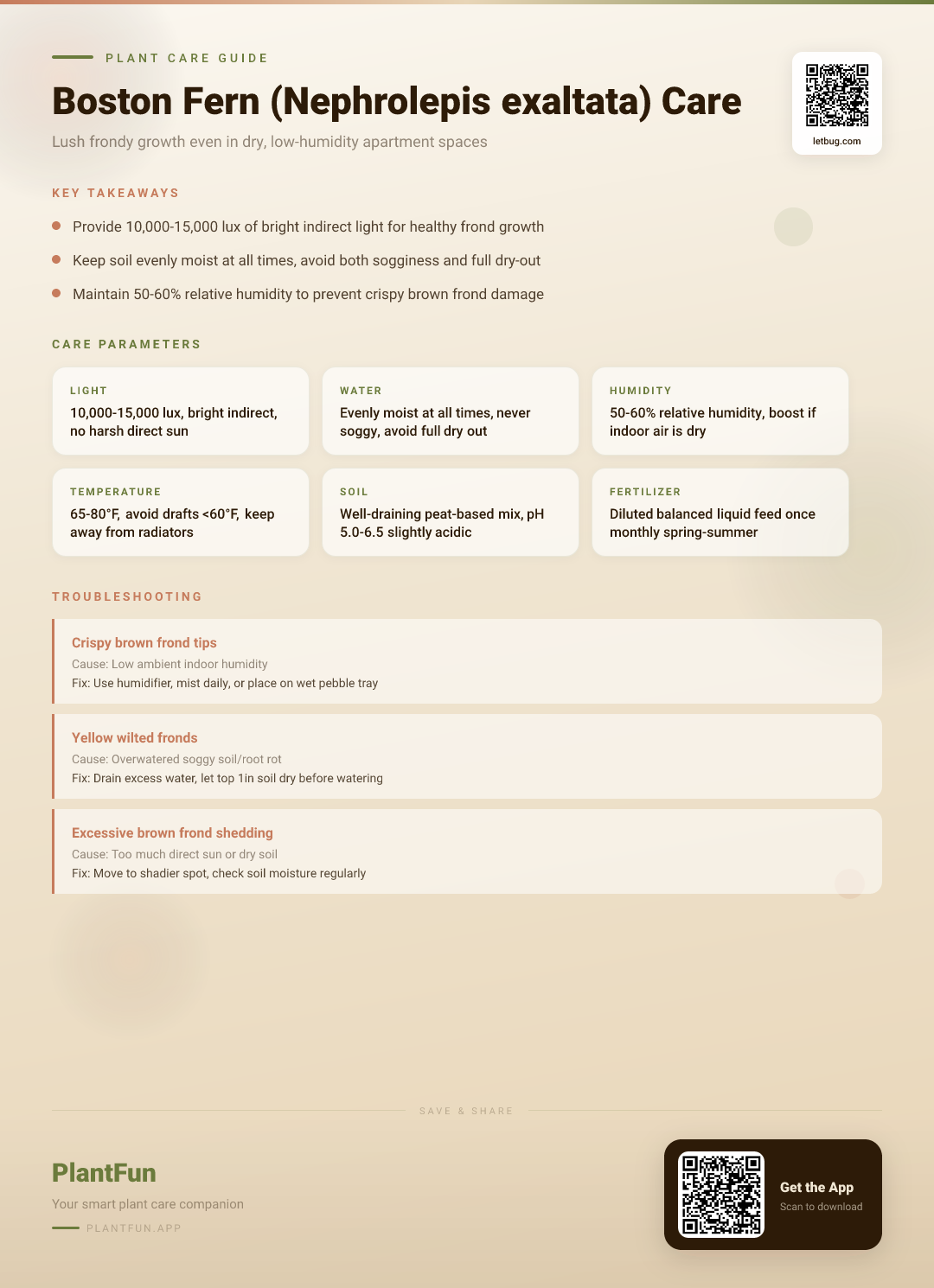
Key Takeaways
- Check soil moisture before watering — overwatering is the #1 killer of houseplants.
- Ensure your plant gets the right amount of light for its species.
- Be patient with recovery — most plants need 2–4 weeks to bounce back.
TL;DR: Quick Rescue
If your Boston Fern is crisping up, move it to a location with 50-60% humidity and bright, indirect light. Water as soon as the top half-inch of soil feels dry to the touch, ensuring the soil remains evenly moist but never waterlogged. Mist daily or group with other plants to increase local humidity, and keep away from heating vents.
Quick Care Card: Essential Thresholds for Nephrolepis exaltata
| Feature | Requirement |
|---|---|
| Light | Bright, indirect (10,000–15,000 lux) |
| Water | Evenly moist; never let dry out completely |
| Humidity | 50–60% relative humidity |
| Temperature | 65–80°F (18–27°C) |
| Soil | Peaty, well-draining, moisture-retentive mix |
| Fertilizer | Balanced liquid feed, half-strength, monthly in spring/summer |
| Toxicity | Non-toxic to cats and dogs (ASPCA, 2026) |
My Experience: The “Crispy” Reality
When I first bought my Nephrolepis exaltata, I placed it directly on a bookshelf near a drafty window. Within two weeks, I was vacuuming brown frond debris off my rug daily. I made the mistake of treating it like a standard succulent, waiting for the soil to dry out completely. I learned quickly that this fern is a thirsty, high-maintenance beauty that demands specific environmental boundaries to thrive. Since adopting a strict monitoring routine, my fern has stopped shedding and regained its signature lush, arching habit.
Why Your Apartment is a Desert for Boston Ferns
Most modern apartments maintain relative humidity levels between 20-30%, which is essentially a desert for a plant native to tropical forest floors (Gilman, 2007). Unlike tougher houseplants, the Boston Fern has thin, sensitive fronds that lose water to the air faster than the roots can uptake it in dry conditions. This rapid transpiration leads to the tell-tale “crunch” we all dread.
Identifying the Warning Signs: Crispy Tips vs. Root Rot
It is common to mistake one for the other, but the symptoms differ:
- Crispy Tips/Edges: Typically indicates low humidity or infrequent watering (NC State Extension, 2026).
- Yellowing/Mushy Fronds: Often points to overwatering or poor drainage leading to root rot (NC State Extension, 2026).
Step 1: Calibrating Your Light (10,000–15,000 lux)
Boston Ferns thrive in bright, indirect light. In my experience, if the light is too low, the plant becomes “leggy” and sparse. If it is too direct, the fronds will scorch. I use a simple light meter app to ensure my plant receives around 10,000–15,000 lux. If you don’t have a meter, place it near an east-facing window with a sheer curtain.
Step 2: The Watering Protocol
Check the soil moisture every 2-3 days by sticking your finger at least two inches into the potting medium. If it feels dry, it needs water. Do not wait for the plant to wilt. Use room-temperature, filtered water to avoid chlorine burn, which can manifest as dark spots on the fronds (Gilman, 2007).
Step 3: Humidity Management
To meet the 50-60% requirement, I group my ferns together. This creates a microclimate where the plants share moisture through transpiration. If your room remains below 40%, you may need a pebble tray or a small humidifier.
Step 4: Temperature Control (65–80°F)
Keep your fern away from temperature fluctuations. Sudden cold drafts or blasts of hot air from a vent will trigger leaf drop. Consistent temperatures between 65–80°F are ideal for healthy frond production (Benedict, 1921).
Step 5: Seasonal Adjustments for Winter Radiator Heat
Winter is the most dangerous time for a Boston Fern. Radiator heat creates localized dry zones. I move my plant to a cooler, more humid area like a bathroom or a north-facing kitchen window during the heating months to protect it from the drying effects of central heating.
Can I keep my Boston Fern in a room without a humidifier?
Yes, but you must be diligent. Frequent misting, grouping it with other plants, and using a pebble tray filled with water (ensuring the pot sits above the waterline) can help bridge the gap.
Why is my Boston Fern shedding brown needles all over the floor?
This is typically a response to a sudden drop in humidity or the plant being allowed to dry out entirely. Once a frond dries out, it rarely recovers; your best bet is to improve conditions for new growth and trim the dead, shedding parts.
Common Mistakes: Avoiding the ‘Drying Out’ Trap
- Mistake: Using standard potting soil. What happens: It packs too tightly, suffocating the roots. Instead: Use a mix of peat moss, perlite, and bark for aeration and moisture retention.
- Mistake: Placing in direct sun. What happens: Frond tissue burns and dries out rapidly. Instead: Use an east-facing window or a sheer curtain to diffuse light.
- Mistake: Letting the plant sit in standing water. What happens: Root rot develops quickly. Instead: Ensure the pot has drainage holes and dump any excess water from the saucer after 15 minutes.
References
- Benedict, R. (1921). The Boston Fern Show. American Fern Journal. https://doi.org/10.2307/1544193. Accessed 2026-03-10.
- Gilman, E. (2007). Nephrolepis exaltata Boston Fern, Sword Fern. EDIS. https://doi.org/10.32473/edis-fp427-1999. Accessed 2026-03-10.
- ASPCA. (2026). Toxic and Non-Toxic Plants List — ASPCA. https://www.aspca.org/pet-care/animal-poison-control/toxic-and-non-toxic-plants. Accessed 2026-03-10.
- NC State Extension. (2026). Boston Fern — NC State Extension Gardener Plant Toolbox. https://plants.ces.ncsu.edu/plants/fern-care/. Accessed 2026-03-10.
Optional Helper: Plantfun.App
Plantfun.App identifies your plants by photo, diagnoses pests and diseases with clear fixes, and creates personalised watering and light schedules that adapt to your home conditions — a handy companion for putting this guide into daily practice.
Found an error or have suggestions? We'd love your feedback.
Need help identifying this problem?
Get instant identification, personalized care schedules, and effective pest treatment plans directly on your phone.
Sponsored • We may earn a commission from app downloads
Related Guides
The Complete Boston Fern Care Checklist for Lush Growth in Small Urban Apartments
Stop watching your Boston Fern turn brown in your apartment. Get 8 actionable checklist steps, exact light, humidity, and water parameters for lush, resilient fronds all year long.
Care GuideThe Complete Boston Fern Care Checklist for Resilient Growth in Small Urban Apartments
Stop struggling with crispy Boston Fern fronds in your apartment. Get exact humidity, light, and watering thresholds, plus a printable checklist for lush, resilient growth all year round.
Care GuideBoston Ferns in Dry Apartments: A 5-Step Rescue Plan for Lush, Frond-Filled Growth
Transform your crisping Boston Fern into a lush centerpiece. Master the 4 key humidity and light variables that keep fronds vibrant in any dry apartment.
Pest ControlAnts on Plants: What They Mean and What to Do
Ants usually aren't eating your plant. They are farming other pests.