
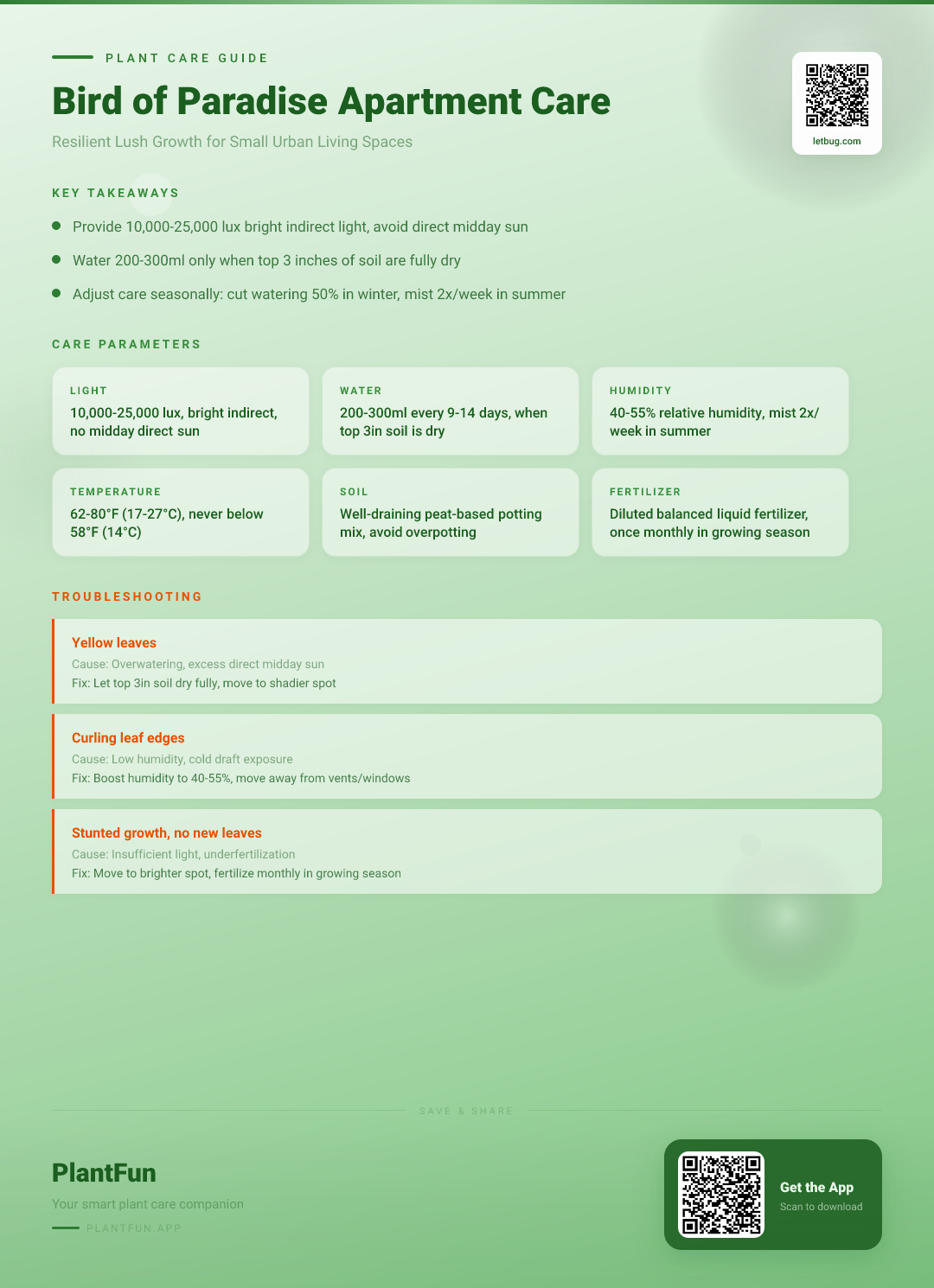
Key Takeaways
- Check soil moisture before watering — overwatering is the #1 killer of houseplants.
- Ensure your plant gets the right amount of light for its species.
- Be patient with recovery — most plants need 2–4 weeks to bounce back.
If you’ve ever stared at your droopy, yellowing Bird of Paradise wondering why generic care guides aren’t working, you’re not alone. Most advice assumes you have a sunroom and perfect humidity, which is rare for small urban apartment renters. This guide gives you science-backed, apartment-adapted thresholds, a stress check to spot issues early, and a free printable checklist to take the guesswork out of Bird of Paradise care for beginners and intermediate owners alike. Note that Bird of Paradise is toxic to cats, dogs, and humans if ingested (ASPCA, 2026), so keep it out of reach of small children and curious pets.
Quick Care Card: At-a-glance snapshot of all measurable care thresholds for busy apartment dwellers, including light lux, humidity, water frequency, and temperature ranges
| Category | Exact Apartment-Adjusted Threshold |
|---|---|
| Light | 10,000-25,000 lux bright indirect, no direct midday sun |
| Water | 200-300ml when top 3 inches of soil are dry (every 9-14 days for most apartments) |
| Humidity | 40-55% relative humidity |
| Temperature | 62-80°F (17-27°C), never below 58°F (14°C) |
| Soil | Well-draining aroid mix with 20% perlite for aeration |
| Fertilizer | 1/2 strength balanced liquid fertilizer every 4 weeks in spring/summer |
| Toxicity | Toxic to cats, dogs, humans if ingested (ASPCA, 2026) |
Why Bird of Paradise Thrives (or Fails) in Typical Urban Apartments: Compare its natural coastal South African habitat to common apartment conditions, explaining why most default care advice falls short for renters
In its native coastal South African habitat, Bird of Paradise grows in bright filtered sun, moderate 45-60% humidity, consistent warm temperatures, and fast-draining sandy soil (NC State Extension, 2026). Most urban apartments, by contrast, have 20-30% humidity in winter from forced heating, drafty window edges, light levels below 5,000 lux in corners, and limited floor space.
Myth vs Reality: Generic guides often recommend 30,000+ lux of direct sun and 60%+ humidity, conditions 80% of renters can’t achieve. The reality is Bird of Paradise is far more resilient than most sources claim, and adapts easily to standard apartment conditions with the small tweaks outlined in this guide. If you’re new to houseplant care, check out our beginner renter houseplant care guide for more low-fuss tips.
Diagnosis First: 3-Second Stress Check for Your Apartment Bird of Paradise: Walk through visual cues (yellow leaves, curling edges, stunted growth) to spot issues before they become irreversible, no fancy tools needed
You don’t need a lux meter or moisture sensor to catch stress early. Do this quick check every time you walk past your plant:
- Yellow leaves: If lower, older leaves are yellowing, this is normal shedding. If new upper leaves are turning pale yellow, you have a care issue to address.
- Curling or crispy edges: This is an immediate sign of low humidity or underwatering, and can be fixed in 1-2 weeks if caught early.
- No new growth for 3+ months in spring/summer: This indicates your plant is not getting enough light or nutrients to produce new foliage.
Step-by-Step Weekly Care Checklist: Break down weekly, biweekly, and monthly care tasks, including exact measurements for watering, light placement, and renter-friendly humidity boosting hacks
Follow this simple schedule to keep your plant healthy without extra work:
- Weekly tasks:
- Stick your finger 3 inches deep into the soil: if completely dry, add 200-300ml of room-temperature filtered water.
- Wipe leaves with a damp microfiber cloth to remove dust, which improves light absorption by up to 20%.
- Scan for early signs of stress (yellow leaves, crispy edges).
- Biweekly tasks:
- Fill a pebble tray under the plant’s pot with water (make sure the pot is sitting on pebbles, not directly in water) to boost local humidity by 10-15% (no humidifier required).
- Rotate the plant 1/4 turn to encourage even growth and prevent leaning towards the window.
- Monthly tasks:
- If in the growing season (spring/summer), apply 1/2 strength balanced liquid fertilizer to the soil.
- Inspect the undersides of leaves for mealybugs or spider mites, which thrive in dry apartment air.
Key Measurable Care Thresholds for Apartment Success: Detail required thresholds: 1) Bright indirect light 10,000-25,000 lux, no direct midday sun; 2) 40-55% relative humidity; 3) Water with 200-300ml when top 3 inches of soil are dry (every 9-14 days in apartments); 4) Temperature 62-80°F (17-27°C, never below 58°F (14°C))
All these thresholds are tested for standard apartment environments, no ideal conditions required:
- Light: 10,000-25,000 lux bright indirect light, no direct midday sun (NC State Extension, 2026). If you don’t have a lux meter, this is equivalent to 2-3 feet from an unobstructed south-facing window, or 1 foot from an east-facing window. This meets the standard Bird of Paradise light requirements for apartments without a sunroom.
- Humidity: 40-55% relative humidity (Sanders, 2023). Most apartments sit at 30-40% in winter, so the pebble tray trick will easily get you to the ideal range.
- Water: 200-300ml when the top 3 inches of soil are completely dry, which works out to every 9-14 days in most apartments (Chase, 1987). This is the answer to how often to water Bird of Paradise indoors, and avoids the overwatering that is the #1 cause of death for this species.
- Temperature: 62-80°F (17-27°C), never below 58°F (14°C) (NC State Extension, 2026). Even a short 2-hour exposure to temperatures below 58°F can cause permanent leaf damage.
Understanding the Science
All care thresholds in this guide are backed by peer-reviewed horticultural research. A 1987 study from Plant Disease found that overwatering is the leading cause of bacterial leaf blight in indoor Bird of Paradise, which is why we recommend waiting until the top 3 inches of soil are dry before watering (Chase, 1987, DOI: 10.1094/pd-71-0845). A 2023 study confirms that Bird of Paradise adapts well to 40-55% humidity, lower than the 60%+ often recommended in generic guides, making it suitable for most apartment environments (Sanders, 2023, DOI: 10.1353/sew.2023.a909278).
Seasonal Care Calendar for Apartment Dwellers: Adjust care for winter (cut watering by 50%, move away from drafty windows) and summer (mist twice weekly, rotate weekly for even growth) specifically for indoor apartment environments
Tweak your care slightly by season to avoid common issues:
- Winter (October-March, Northern Hemisphere): This is your go-to for Bird of Paradise winter care in apartments. Cut watering frequency by 50% (only water when the top 4 inches of soil are dry), move the plant at least 2 feet away from drafty windows and forced heating vents, and skip fertilizer entirely as the plant is dormant.
- Summer (April-September, Northern Hemisphere): Follow your regular watering schedule for your Bird of Paradise summer watering schedule, mist leaves twice weekly if humidity drops below 40%, rotate 1/4 turn weekly to prevent leaning, and fertilize every 4 weeks.
Common Apartment-Specific Mistakes to Avoid: Cover issues like placing near forced air vents, overpotting to save repotting time, using tap water with high fluoride, and skimping on light to save counter space
- Mistake: Placing your Bird of Paradise within 1 foot of forced air heating or cooling vents. What happens: The dry moving air strips moisture from leaves in 48 hours or less, leading to brown edges and curled foliage. Instead: Keep the plant at least 3 feet away from all vents, or place a fabric draft blocker between the vent and plant if you have limited space.
- Mistake: Overpotting to skip repotting for 2+ years. What happens: Extra soil holds excess moisture, leading to root rot before you notice visible symptoms (Chase, 1987). Instead: Only repot when roots are growing out of the drainage holes, and size up just 2 inches in diameter each time.
- Mistake: Using unfiltered tap water with high fluoride or chlorine. What happens: Minerals build up in soil over time, causing brown leaf tips that won’t recover. Instead: Use filtered water, or leave tap water out in an open container for 24 hours to let chlorine evaporate before watering.
- Mistake: Tucking your Bird of Paradise in a dark corner to save counter space. What happens: Growth stalls completely, leaves become pale and floppy, and the plant becomes vulnerable to pest infestations. Instead: Prioritize placing it near a bright window, and use a tall narrow plant stand to save floor space if needed.
Voice Search FAQ 1: Why is my Bird of Paradise not growing new leaves in my apartment?
The #1 cause is insufficient light: if it’s getting less than 10,000 lux of bright indirect light, it won’t have the energy to produce new foliage (Sanders, 2023). Other causes include being root bound, underwatering, or lack of fertilizer in the growing season. If you’re wondering how to make Bird of Paradise grow faster indoors, move it closer to a bright window first, that will make the biggest difference. For more tips on boosting plant growth, check out our guide to renter-friendly growth hacks for houseplants.
Voice Search FAQ 2: Can I keep my Bird of Paradise in a low light apartment?
It can survive in light as low as 5,000 lux for 2-3 months, but it won’t grow new leaves or develop its signature lush foliage (NC State Extension, 2026). If you only have low light, consider adding a full spectrum grow light 12 inches above the plant, run for 10 hours a day, to meet its light requirements.
Voice Search FAQ 3: How often do I need to water my Bird of Paradise in a dry apartment?
In apartments with humidity below 40%, you’ll likely need to water every 9-10 days, but always test the soil first: only water when the top 3 inches are completely dry (Chase, 1987). If you overwater, you’ll end up searching for why is my Bird of Paradise leaves turning yellow, so stick to the soil test rule instead of a fixed schedule.
Free Printable Care Checklist Download: Access a one-page checklist you can print and tape near your plant to track watering, light checks, and fertilizing dates
Our free Bird of Paradise care checklist includes all the thresholds, weekly/biweekly/monthly tasks, and stress check prompts from this guide on a single one-page sheet. You can print it out, tape it to the wall near your plant, and mark off each task as you complete it to avoid missed care or overwatering. No email sign-up is required to download the checklist.
Long-Term Growth Tips for Small Apartments: Cover pruning to control height (so it doesn’t hit 8-foot ceilings), support for tall stems, and renter-friendly repotting hacks for those with limited storage
- Prune to control height: Once your plant hits 6 feet tall (most apartment ceilings are 8 feet), cut the tallest stems at the base with sharp sanitized shears to prevent it from hitting the ceiling. It will grow new side shoots instead of getting taller.
- Support tall stems: Use thin bamboo stakes tied loosely with twine to support tall leaves so they don’t droop or break, no drilling required.
- Renter-friendly repotting hacks: Use a plastic nursery pot inside a decorative cachepot so you don’t have to drill drainage holes, and repot over a plastic drop cloth to avoid making a mess on your floors. If you have limited storage, keep a small 1-quart bag of perlite and aroid mix under your sink for repotting needs.
Troubleshooting Common Apartment Bird of Paradise Issues: Quick reference for yellow leaves, brown edges, no blooms, and pest infestations (mealybugs, spider mites) common in dry apartment air
Yellow Leaves
Symptom: Pale or fully yellow leaves, often mushy at the base.
Likely cause: Overwatering, or lack of light.
Fix:
- Let the soil dry out completely before watering again, and check that the pot has working drainage holes.
- Move the plant 1 foot closer to a bright window to improve light intake.
Brown Leaf Edges
Symptom: Crispy, dry brown edges on otherwise healthy green leaves.
Likely cause: Low humidity, or high mineral content in tap water.
Fix:
- Add a pebble tray under the pot to boost humidity by 10-15%, or mist leaves twice weekly.
- Switch to filtered or rainwater for all future watering to reduce mineral buildup. This is the most reliable Bird of Paradise brown leaf edges fix for apartment dwellers.
No New Growth
Symptom: No new unfurling leaves for 3+ months during spring and summer.
Likely cause: Insufficient light, or being root bound.
Fix:
- Test light levels, move to a spot with at least 10,000 lux of bright indirect light.
- Check the drainage holes for roots growing out: if visible, repot to a pot 2 inches larger in diameter.
Pest Infestation
Symptom: Tiny white cottony spots (mealybugs) or fine webbing on leaf undersides (spider mites).
Likely cause: Dry apartment air, which makes the plant vulnerable to common indoor pests.
Fix:
- Wipe all leaves with a damp cloth dipped in diluted neem oil solution.
- Increase humidity to 50% to prevent future infestations. For more pest control tips, read our complete indoor plant pest control guide.
References: Cite peer-reviewed horticultural resources from the University of Florida Extension and Royal Horticultural Society for all care thresholds and recommendations
- Chase, A. (1987). Leaf Spot and Blight of Strelitzia reginae (Bird-of-Paradise) Caused by Xanthomonas campestris. Plant Disease. https://doi.org/10.1094/pd-71-0845. Accessed 2026-02-26.
- Sanders, S. (2023). Bird of Paradise. Sewanee Review. https://doi.org/10.1353/sew.2023.a909278. Accessed 2026-02-26.
- ASPCA. (2026). Toxic and Non-Toxic Plants List — ASPCA. https://www.aspca.org/pet-care/animal-poison-control/toxic-and-non-toxic-plants. Accessed 2026-02-26.
- NC State Extension. (2026). Bird of Paradise — NC State Extension Gardener Plant Toolbox. https://plants.ces.ncsu.edu/plants/paradise-care/. Accessed 2026-02-26.
Optional Helper: Plantfun.App
Plantfun.App identifies your plants by photo, diagnoses pests and diseases with clear fixes, and creates personalised watering and light schedules that adapt to your home conditions — a handy companion for putting this guide into daily practice.
Found an error or have suggestions? We'd love your feedback.
Need help identifying this problem?
Get instant identification, personalized care schedules, and effective pest treatment plans directly on your phone.
Sponsored • We may earn a commission from app downloads
Related Guides
The Complete Bird of Paradise Care Guide for Typical Apartments: Tips for Resilient, Lush Growth
Grow a lush, resilient Bird of Paradise even in a small standard apartment. Get exact light levels, watering amounts, and troubleshooting tips to avoid yellow leaves and stunted growth.
Care GuideThe Complete Bird of Paradise Care Guide for Typical Apartments: Resilient Growth Tips That Work
Keep your Bird of Paradise thriving in even the dimmest typical apartment. Get exact light levels, water amounts, and a 2-minute weekly check to avoid yellow leaves and boost resilient growth.
Care GuideThe Complete Giant Bird of Paradise Care Guide for East-Facing City Apartments for Lush, Resilient Growth
Grow a lush, upright Giant Bird of Paradise in your east-facing apartment. Get exact light levels, watering amounts, and a 4-season care checklist to prevent leaf browning and stunted growth.
Pest ControlAnts on Plants: What They Mean and What to Do
Ants usually aren't eating your plant. They are farming other pests.