
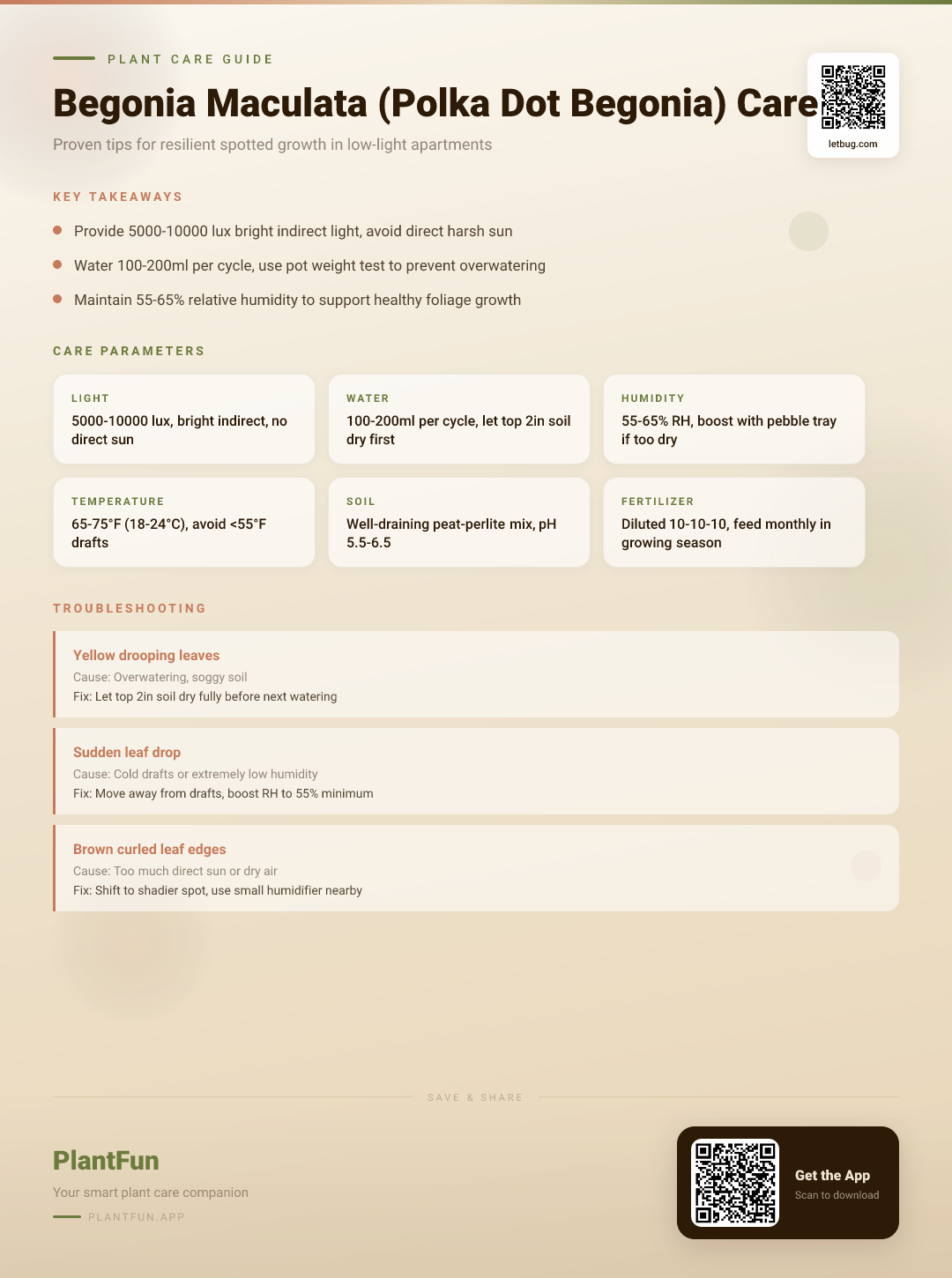
Key Takeaways
- Check soil moisture before watering — overwatering is the #1 killer of houseplants.
- Ensure your plant gets the right amount of light for its species.
- Be patient with recovery — most plants need 2–4 weeks to bounce back.
TL;DR: Quick Recovery for Your Polka Dot Begonia
If your Begonia Maculata is struggling, stop over-nurturing. These plants thrive on consistency, not constant attention. Move it to a spot with bright, indirect light (avoid direct afternoon sun), wait for the top 2 inches of soil to dry before watering with 100-200ml of room-temperature water, and maintain humidity above 50% using a pebble tray or humidifier.
My Experience
When I first brought home my own Begonia maculata, I made the classic mistake of placing it in a deep, north-facing corner and watering it on a rigid weekly schedule. Within a month, I was watching leaves drop like confetti. It taught me that these plants aren’t “fussy”; they are simply sensitive to environmental instability. Once I treated my apartment like a micro-climate—grouping it with other plants to increase humidity and tracking its light needs—it rewarded me with those iconic silver-spotted, crimson-backed leaves. You don’t need a greenhouse to grow a healthy specimen; you just need to manage the variables.
Quick Care Card: Essential Parameters for Apartment Success
| Parameter | Requirement |
|---|---|
| Light | 5,000–10,000 lux (Bright, indirect) |
| Watering | When top 2 inches of soil are dry (100-200ml) |
| Humidity | 55–65% RH (Relative Humidity) |
| Temperature | 65°F–75°F (18°C–24°C) |
| Soil | Well-draining, peat-based mix |
| Fertilizer | Balanced liquid feed, monthly in spring/summer |
| Toxicity | Toxic to cats and dogs (ASPCA, 2026) |
Why Your Polka Dot Begonia Struggles in Low-Light Apartments
Many apartment dwellers assume the Polka Dot Begonia is a “low-light” plant because it doesn’t tolerate direct, scorching sun. However, there is a difference between “low light” and “dark.” In nature, these plants often grow in the understory where they receive filtered light. In a dim apartment, the lack of photon flux density causes the plant to become “leggy,” as it stretches to find energy. Understanding these environmental constraints is the first step to successful indoor Begonia maintenance.
Light Requirements: Achieving 5,000-10,000 lux without Direct Sun
To keep your plant compact and vibrant, you need to provide sufficient light. Using a simple light meter app on your phone, aim for a reading between 5,000 and 10,000 lux. If you are in a north-facing kitchen or a dim room, place the plant directly on the windowsill. The glass filters the intensity, protecting the foliage while maximizing the limited available light (NC State Extension, 2026).
Watering Mastery: Using the ‘Weight Test’ and 100ml-200ml thresholds
Rather than a calendar, use your hands.
- The Weight Test: Lift your pot. If it feels surprisingly light, it is ready for water.
- The Finger Test: Insert your finger 2 inches into the soil. If it feels dry, proceed.
- The Application: Use 100ml to 200ml of room-temperature water. Avoid cold tap water, which can shock the roots. Pour slowly around the base, ensuring water exits the drainage holes.
Humidity & Airflow: Maintaining 55-65% RH in dry winter heating
Indoor heating systems significantly drop air moisture. To counter this, group your plants together to create a localized humid micro-climate. If your ambient humidity falls below 50%, consider a dedicated humidifier or a pebble tray beneath the pot to maintain the 55-65% range that keeps leaves supple (Hanum et al., 2021).
Temperature Calibration: Keeping the 65-75°F (18-24°C) sweet spot
Avoid placing your Begonia near drafty windows in winter or directly in the path of an AC vent in summer. Consistent temperatures between 65°F and 75°F prevent the metabolic stress that often leads to leaf drop.
Step-by-Step Recovery: What to do when leaves drop or curl
- Inspect for Pests: Check the undersides of leaves for spider mites, which thrive in dry apartment air.
- Adjust Water: If leaves are curling, your plant is signaling thirst or low humidity. Increase watering slightly.
- Relocate: Move the plant 1-2 feet closer to a light source.
- Monitor: Wait 14 days before changing anything else. Constant moving prevents the plant from acclimating.
Seasonal Adjustments: Managing growth cycles through city winters
During winter, your Begonia enters a semi-dormant state. Reduce your watering volume by 30% and pause all fertilization. This aligns the plant’s growth cycle with the reduced daylight hours common in urban environments.
FAQ: Troubleshooting Begonia Maculata
- Why is my Begonia Maculata dropping its leaves? Usually, this indicates a sudden shift in environment—a draft, a change in light, or over-watering (NC State Extension, 2026).
- Can I keep my Polka Dot Begonia in a north-facing kitchen? Yes, if the plant is placed directly on the windowsill to maximize exposure to the sky.
- Is it safe for my pets? No. According to the ASPCA (2026), this plant is toxic to cats and dogs and should be kept on a high shelf or in a room they cannot access.
Common Mistakes: Avoiding the ‘over-nurturing’ trap
- Mistake: Watering on a strict “every Sunday” schedule. What happens: Root rot from waterlogged soil. Instead: Use the weight/finger test.
- Mistake: Misting the leaves to increase humidity. What happens: Water droplets sit on the leaves, inviting fungal issues. Instead: Use a humidifier or pebble tray.
- Mistake: Repotting immediately upon purchase. What happens: The plant experiences transplant shock. Instead: Wait 4-6 weeks for it to settle into its new environment.
References and Further Reading
- ASPCA. (2026). Toxic and Non-Toxic Plants List — ASPCA. https://www.aspca.org/pet-care/animal-poison-control/toxic-and-non-toxic-plants. Accessed 2026-03-12.
- BURSALIOĞLU, E. (2020). Evaluation of antibacterial activity of Triticum monococcum seeds, Castanea sativa seeds and Begonia maculata leaves against several bacterial strains. Turkish Journal of Biodiversity. https://doi.org/10.38059/biodiversity.635270. Accessed 2026-03-12.
- Hanum, S.; Rahayu, A.; Darma, I. (2021). Begonia muricata Blume and Begonia serratipetala Irmsch durability as indoor pot plant in Eka Karya Bali Botanic Garden. Berkala Penelitian Hayati. https://doi.org/10.23869/bphjbr.26.2.20217. Accessed 2026-03-12.
- NC State Extension. (2026). Begonia Maculata — NC State Extension Gardener Plant Toolbox. https://plants.ces.ncsu.edu/plants/maculata-care/. Accessed 2026-03-12.
Optional Helper: Plantfun.App
Plantfun.App identifies your plants by photo, diagnoses pests and diseases with clear fixes, and creates personalised watering and light schedules that adapt to your home conditions — a handy companion for putting this guide into daily practice.
Found an error or have suggestions? We'd love your feedback.
Need help identifying this problem?
Get instant identification, personalized care schedules, and effective pest treatment plans directly on your phone.
Sponsored • We may earn a commission from app downloads
Related Guides
Begonia Maculata Care in Drafty Apartments: Resilient Growth and Lush Foliage Guaranteed
Stop losing leaves to apartment drafts. Master Begonia Maculata care with precise light thresholds, humidity hacks, and a seasonal schedule for lush growth.
Care GuideBegonia Maculata Care in Low-Humidity Apartments: 5 Steps to Prevent Leaf Drop
Save your Begonia maculata from leaf drop in dry apartments. Master the exact 50-60% humidity hacks, light levels, and soil moisture tips you need today.
Care GuideBegonia Maculata in a Dry Apartment: The 5-Step Resilience Strategy for Spotless Leaves
Revive your wilting Begonia Maculata with these 5 expert-backed steps. Learn the exact humidity and light thresholds needed for resilient, spot-free foliage.
Pest ControlAnts on Plants: What They Mean and What to Do
Ants usually aren't eating your plant. They are farming other pests.