
Key Takeaways
- Check soil moisture before watering — overwatering is the #1 killer of houseplants.
- Ensure your plant gets the right amount of light for its species.
- Be patient with recovery — most plants need 2–4 weeks to bounce back.
TL;DR: The Quick Rescue Plan
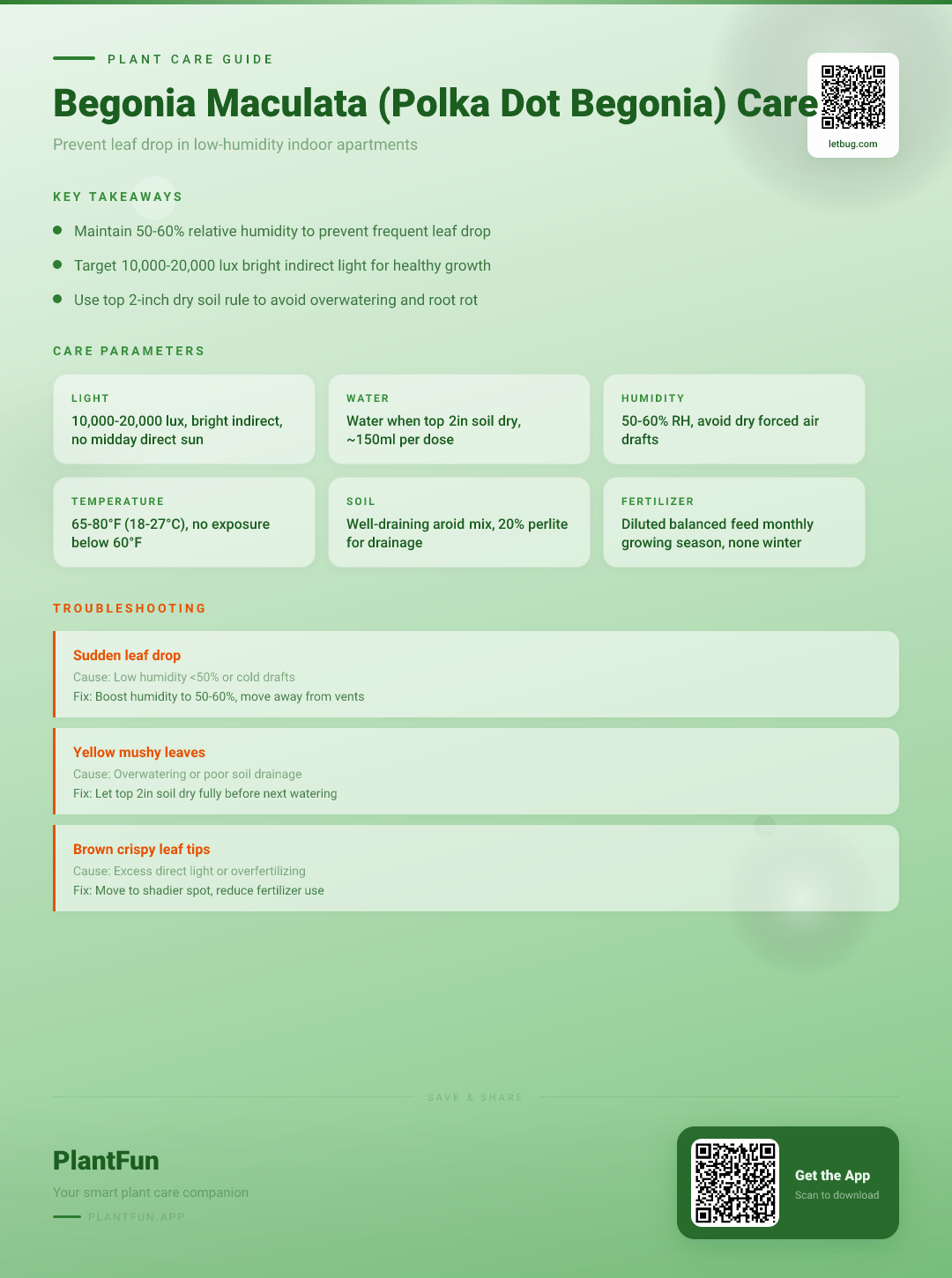
If your Polka Dot Begonia is dropping leaves, it is almost certainly struggling with the dry air of your apartment. To stop the decline, increase humidity to 50–60% using a dedicated humidifier, place it in bright, indirect light (10,000–20,000 lux), and only water when the top two inches of soil are dry. Avoid misting, which does nothing for long-term humidity and invites fungal issues.
Quick Care Card: Essential Thresholds for Your Begonia
| Feature | Requirement |
|---|---|
| Light | Bright, indirect (10k-20k lux) |
| Water | Allow top 2” to dry before soaking |
| Humidity | 50-60% (Crucial) |
| Temperature | 65-80°F (18-27°C) |
| Soil | Well-draining, airy mix |
| Fertilizer | Balanced liquid feed, monthly in summer |
| Toxicity | Toxic to cats/dogs (ASPCA, 2026) |
Understanding the Polka Dot Begonia: Why Dry Air Triggers Leaf Drop
When I first brought home my Begonia maculata, I placed it right next to my heater. Within two weeks, I was watching the leaves crisp at the edges and fall off in alarming numbers. I learned the hard way that this plant is a tropical native that struggles in the standard 30-40% humidity of a typical apartment. Its leaf drop is a survival mechanism: the plant sheds foliage to reduce the surface area through which it loses water to the dry air (NC State Extension, 2026).
The 5-Step Rescue Plan: Immediate Adjustments for Your Apartment
- Relocate to a Stable Zone: Move your plant away from AC vents, radiators, and drafty windows.
- Standardize Humidity: Aim for 50-60% relative humidity using a room humidifier rather than localized trays.
- Assess Light Exposure: Use a light meter app to ensure you hit the 10,000–20,000 lux range.
- Monitor Soil Saturation: Switch to a 2-inch depth test before watering to prevent root suffocation.
- Hold the Fertilizer: If the plant is actively losing leaves, skip feeding until you see new, healthy growth.
Measuring Light: How to Hit the 10,000-20,000 Lux Sweet Spot
Your Begonia maculata needs significant light to maintain its polka-dot patterns. If your apartment feels dim, the plant will become “leggy”—stretching for light—and eventually drop leaves. I use a simple light-meter app on my phone to check my shelf. Aim for 10,000 to 20,000 lux. If you have low natural light, a dedicated grow light on a 12-hour timer is your best indoor plant care investment.
Watering Mastery: When to Use the 2-Inch Rule vs. 150ml Dosing
Determining how often to water Begonia maculata is the most common point of failure. I don’t follow a schedule; I follow the soil. Stick your finger two inches into the soil. If it feels damp, wait. If it’s dry, water thoroughly until it drains out the bottom. If you use a pot without drainage, I recommend using a 150ml dosing method to ensure you don’t drown the root system, though drainage is highly preferred for long-term health.
Decoding Humidity: Practical Methods to Sustain 50-60% Relative Humidity
Humidity is non-negotiable. While some suggest misting, I have found that it only creates temporary dampness on the leaf surface, which can actually lead to spotting. Instead, use an ultrasonic humidifier to keep the ambient humidity between 50-60%. This is the gold standard for maintaining lush, healthy tropical growth.
Temperature Control: Why 65-80°F (18-27°C) is Your Plant’s Success Zone
This plant thrives in the same temperatures that humans find comfortable. However, be cautious with winter temperature swings. If the thermostat drops below 60°F at night, your Begonia will enter a stress state where its metabolism slows down, making it highly susceptible to root rot from overwatering.
Voice FAQ
Why is my Begonia maculata losing its bottom leaves?
This is typically a sign of either extreme dryness or soil that is being kept too wet, which suffocates the roots. Check the soil moisture first.
Can I use a pebble tray to increase humidity for my plant?
While a pebble tray can create a tiny micro-climate, it is usually insufficient for the needs of a Begonia maculata in a dry apartment. A room humidifier is significantly more effective.
How often should I fertilize my Polka Dot Begonia in winter?
During winter, the plant goes into a natural dormancy. I pause fertilization entirely from November to February to avoid burning the roots.
Seasonal Maintenance Calendar: From Summer Growth to Winter Dormancy
- Spring/Summer: Peak growth. Increase watering and apply a diluted liquid fertilizer once a month. Ensure the plant receives ample bright, filtered light.
- Fall: As light levels decrease, taper off watering and stop fertilizing.
- Winter: Watch for dry heat. Focus purely on maintaining humidity and keeping the soil just barely moist.
Common Mistakes to Avoid
- Mistake: Misting the leaves.
- What happens: Water sits on the foliage, encouraging fungal growth.
- Instead: Use a room humidifier to raise ambient humidity.
- Mistake: Using dense, garden-variety soil.
- What happens: The roots stay wet for too long, leading to rot.
- Instead: Use an airy potting mix amended with perlite or orchid bark.
References and Botanical Guidelines
- ASPCA. (2026). Toxic and Non-Toxic Plants List — ASPCA. https://www.aspca.org/pet-care/animal-poison-control/toxic-and-non-toxic-plants. Accessed 2026-03-13.
- BURSALIOĞLU, E. (2020). Evaluation of antibacterial activity of Triticum monococcum seeds, Castanea sativa seeds and Begonia maculata leaves against several bacterial strains. Turkish Journal of Biodiversity. https://doi.org/10.38059/biodiversity.635270. Accessed 2026-03-13.
- Hanum, S.; Rahayu, A.; Darma, I. (2021). Begonia muricata Blume and Begonia serratipetala Irmsch durability as indoor pot plant in Eka Karya Bali Botanic Garden. Berkala Penelitian Hayati. https://doi.org/10.23869/bphjbr.26.2.20217. Accessed 2026-03-13.
- NC State Extension. (2026). Begonia Maculata Care — NC State Extension Gardener Plant Toolbox. https://plants.ces.ncsu.edu/plants/begonia-maculata/. Accessed 2026-03-13.
Optional Helper: Plantfun.App
Plantfun.App identifies your plants by photo, diagnoses pests and diseases with clear fixes, and creates personalised watering and light schedules that adapt to your home conditions — a handy companion for putting this guide into daily practice.
Found an error or have suggestions? We'd love your feedback.
Need help identifying this problem?
Get instant identification, personalized care schedules, and effective pest treatment plans directly on your phone.
Sponsored • We may earn a commission from app downloads
Related Guides
Begonia Maculata in a Dim Apartment: The Complete Care Guide for Resilient Growth
Revive your struggling Begonia Maculata with these 4 proven apartment adjustments. Learn exact light, humidity, and watering cycles for lush, spotted growth now.
Care GuideBegonia Maculata Care in Apartment Living: How to Avoid Leaf Drop and Brown Edges
Stop your Begonia maculata from dropping leaves. Discover the exact 60% humidity threshold, light requirements, and watering cycles for lush, spotted foliage.
Care GuideBegonia Maculata Care in Drafty Apartments: Resilient Growth and Lush Foliage Guaranteed
Stop losing leaves to apartment drafts. Master Begonia Maculata care with precise light thresholds, humidity hacks, and a seasonal schedule for lush growth.
Pest ControlAnts on Plants: What They Mean and What to Do
Ants usually aren't eating your plant. They are farming other pests.