
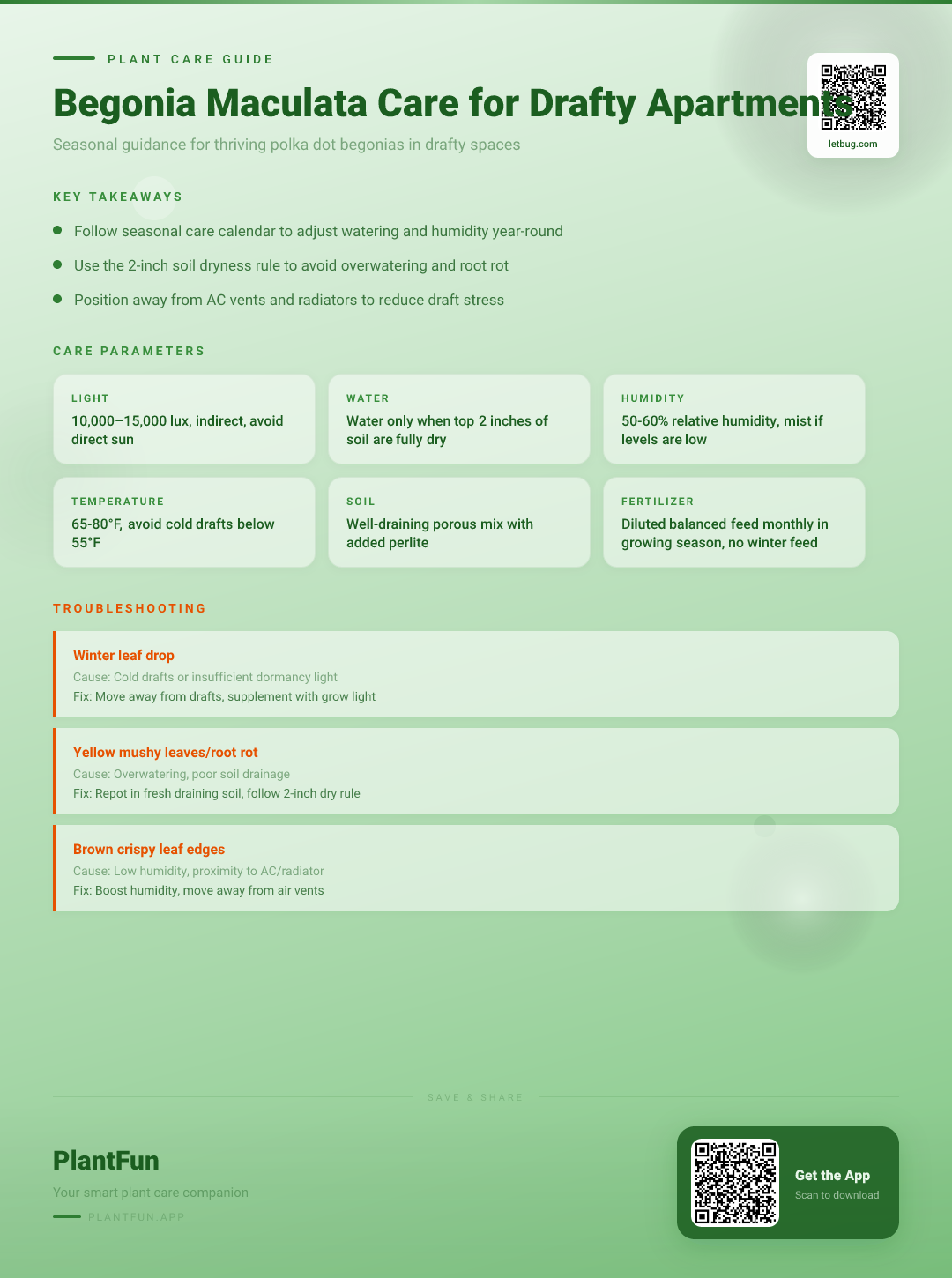
Key Takeaways
- Check soil moisture before watering — overwatering is the #1 killer of houseplants.
- Ensure your plant gets the right amount of light for its species.
- Be patient with recovery — most plants need 2–4 weeks to bounce back.
Quick Care Card: Essential Thresholds for Success
| Feature | Requirement |
|---|---|
| Light | 10,000–15,000 lux (bright, indirect) |
| Watering | Allow top 2 inches to dry between cycles |
| Humidity | 50–60% constant |
| Temperature | 65–80°F (18–27°C) |
| Soil | Well-draining, airy peat-based mix |
| Fertilizer | Balanced liquid feed, half-strength (Spring/Summer) |
| Toxicity | Toxic to cats and dogs (ASPCA, 2026) |
TL;DR: The Resilient Begonia Mindset
To keep your Polka Dot Begonia thriving in an urban apartment, focus on stabilizing its environment rather than chasing perfection. Keep it away from cold windows and air vents, maintain steady humidity above 50%, and adjust your watering to match the plant’s seasonal rhythm. If the plant feels “off,” check the root zone first—it is the single best indicator of long-term health.
Understanding the Polka Dot Begonia’s Habitat
Native to the tropical forests of Brazil, the Begonia maculata is a cane-stemmed beauty. In its natural environment, it exists under the canopy, meaning it thrives in dappled, shifting light and naturally humid, warm conditions. When we bring it into an apartment, we are essentially asking it to adapt to a much drier, static environment. Understanding that this plant is essentially an understory dweller helps explain why direct, scorching sun and bone-dry air are its primary enemies (NC State Extension, 2026).
Why Drafty Apartments Stress Your Begonia (And How to Fix It)
When I first got my Begonia maculata, I placed it right next to a beautiful, large window. I made the mistake of ignoring the winter chill seeping through the old frames. My plant dropped half its leaves in a week. Drafts create localized temperature drops that shock the plant’s cellular structure, leading to rapid transpiration loss. To fix this, I moved mine three feet away from the glass and placed a thermometer nearby to ensure it stays within the 65–80°F range (NC State Extension, 2026).
Seasonal Care Calendar: Spring & Summer Growth Cycles
During the longer days of spring and summer, your Begonia enters a period of active vegetation.
- Watering: Increase frequency. Check soil every 3-4 days.
- Fertilizer: Apply a balanced, water-soluble fertilizer at half-strength every 4-6 weeks.
- Rotation: Turn the pot 90 degrees every week to ensure even growth toward the light source.
Seasonal Care Calendar: Fall & Winter Dormancy Management
As light intensity decreases, so does the plant’s metabolism.
- Watering: Reduce significantly. The soil will stay moist for longer. Wait for the top 2-3 inches to dry.
- Feeding: Cease all fertilization. The plant is not actively pushing new growth and salt buildup can occur if you continue to feed.
- Cleaning: Wipe dust off leaves with a damp cloth to maximize light absorption.
Light Requirements: Maintaining 10,000–15,000 Lux Without Leaf Scorch
Light is often misunderstood. Many owners place their Begonia in a dark corner, thinking it’s a “low light plant.” In truth, to keep those signature silver spots vibrant, it needs about 10,000–15,000 lux (bright, indirect light). I use a simple light meter app to check my corners; if the reading drops below 5,000 lux for most of the day, the plant will become “leggy” or spindly as it searches for the sun.
Watering Mastery: Soil Moisture and The 2-Inch Rule
“How often to water Begonia maculata?” is the most frequent question I receive. Instead of a calendar, use the tactile method: stick your finger 2 inches deep into the substrate. If it feels dry, water thoroughly until you see liquid exiting the drainage holes. Never let it sit in a saucer of water, as this invites pathogens (Bursalıoğlu, 2020).
Humidity & Temperature: Keeping it 50–60% and 65–80°F
Humidity is the hardest variable to control in an apartment. Low humidity causes crispy edges on the foliage. I recommend a small humidifier nearby rather than misting, which provides only temporary relief and can lead to fungal issues if leaves stay wet too long.
Troubleshooting: Common Problems
Why is my Begonia maculata dropping leaves in winter?
Symptom: Leaves yellow and drop suddenly, usually starting from the bottom.
Likely cause: Cold stress or overwatering during the dormant period.
Fix:
- Move the plant away from drafty windows or doors.
- Decrease watering frequency significantly until new growth emerges in spring.
How do I know if my Begonia has root rot?
Symptom: The stems feel soft or mushy at the base, and leaves appear wilted despite moist soil.
Likely cause: Inadequate drainage or excessive water retention.
Fix:
- Remove the plant from the pot and inspect the roots; healthy roots are firm and white.
- Trim away blackened, mushy roots, repot in fresh, well-draining soil, and sterilize your tools.
Can I keep my Begonia near an AC vent or radiator?
Symptom: Rapid leaf curling, browning edges, and overall stunted growth.
Likely cause: Direct, dry airflow which strips moisture faster than the roots can replace it.
Fix:
- Relocate the plant to a spot with still, ambient air.
- Increase the distance from the vent to at least 6 feet.
Common Mistakes: Over-fertilizing and Inconsistent Drainage
- Mistake: Using full-strength fertilizer during winter.
- What happens: Fertilizer burn on the roots and yellowing foliage.
- Instead: Only feed during active growth (Spring/Summer) and always dilute to half-strength.
- Mistake: Using a decorative pot without a drainage hole.
- What happens: Water pools at the bottom, leading to root rot (Hanum et al., 2021).
- Instead: Use a nursery liner inside your decorative pot to ensure water drains away from the roots.
Optional Helper: Plantfun.App
Plantfun.App identifies your plants by photo, diagnoses pests and diseases with clear fixes, and creates personalised watering and light schedules that adapt to your home conditions — a handy companion for putting this guide into daily practice.
Summary: The 3-Step Routine for Long-term Growth
- Environment First: Ensure stable temperatures (65-80°F) and avoid air vents.
- Tactile Watering: Only water when the top 2 inches of soil are dry.
- Light Hygiene: Clean leaves monthly to ensure the plant can process light efficiently for photosynthesis.
References
- ASPCA. (2026). Toxic and Non-Toxic Plants List — ASPCA. https://www.aspca.org/pet-care/animal-poison-control/toxic-and-non-toxic-plants. Accessed 2026-03-17.
- BURSALIOĞLU, E. (2020). Evaluation of antibacterial activity of Triticum monococcum seeds, Castanea sativa seeds and Begonia maculata leaves against several bacterial strains. Turkish Journal of Biodiversity. https://doi.org/10.38059/biodiversity.635270. Accessed 2026-03-17.
- Hanum, S.; Rahayu, A.; Darma, I. (2021). Begonia muricata Blume and Begonia serratipetala Irmsch durability as indoor pot plant in Eka Karya Bali Botanic Garden. Berkala Penelitian Hayati. https://doi.org/10.23869/bphjbr.26.2.20217. Accessed 2026-03-17.
- NC State Extension. (2026). Begonia Maculata Care — NC State Extension Gardener Plant Toolbox. https://plants.ces.ncsu.edu/plants/begonia-maculata/. Accessed 2026-03-17.
Found an error or have suggestions? We'd love your feedback.
Need help identifying this problem?
Get instant identification, personalized care schedules, and effective pest treatment plans directly on your phone.
Sponsored • We may earn a commission from app downloads
Related Guides
Begonia Maculata in a Dim Apartment: The Complete Care Guide for Resilient Growth
Revive your struggling Begonia Maculata with these 4 proven apartment adjustments. Learn exact light, humidity, and watering cycles for lush, spotted growth now.
Care GuideBegonia Maculata Care in Drafty Apartments: Resilient Growth and Lush Foliage Guaranteed
Stop losing leaves to apartment drafts. Master Begonia Maculata care with precise light thresholds, humidity hacks, and a seasonal schedule for lush growth.
Care GuideBegonia Maculata Care in Apartment Living: How to Avoid Leaf Drop and Brown Edges
Stop your Begonia maculata from dropping leaves. Discover the exact 60% humidity threshold, light requirements, and watering cycles for lush, spotted foliage.
Pest ControlAnts on Plants: What They Mean and What to Do
Ants usually aren't eating your plant. They are farming other pests.