
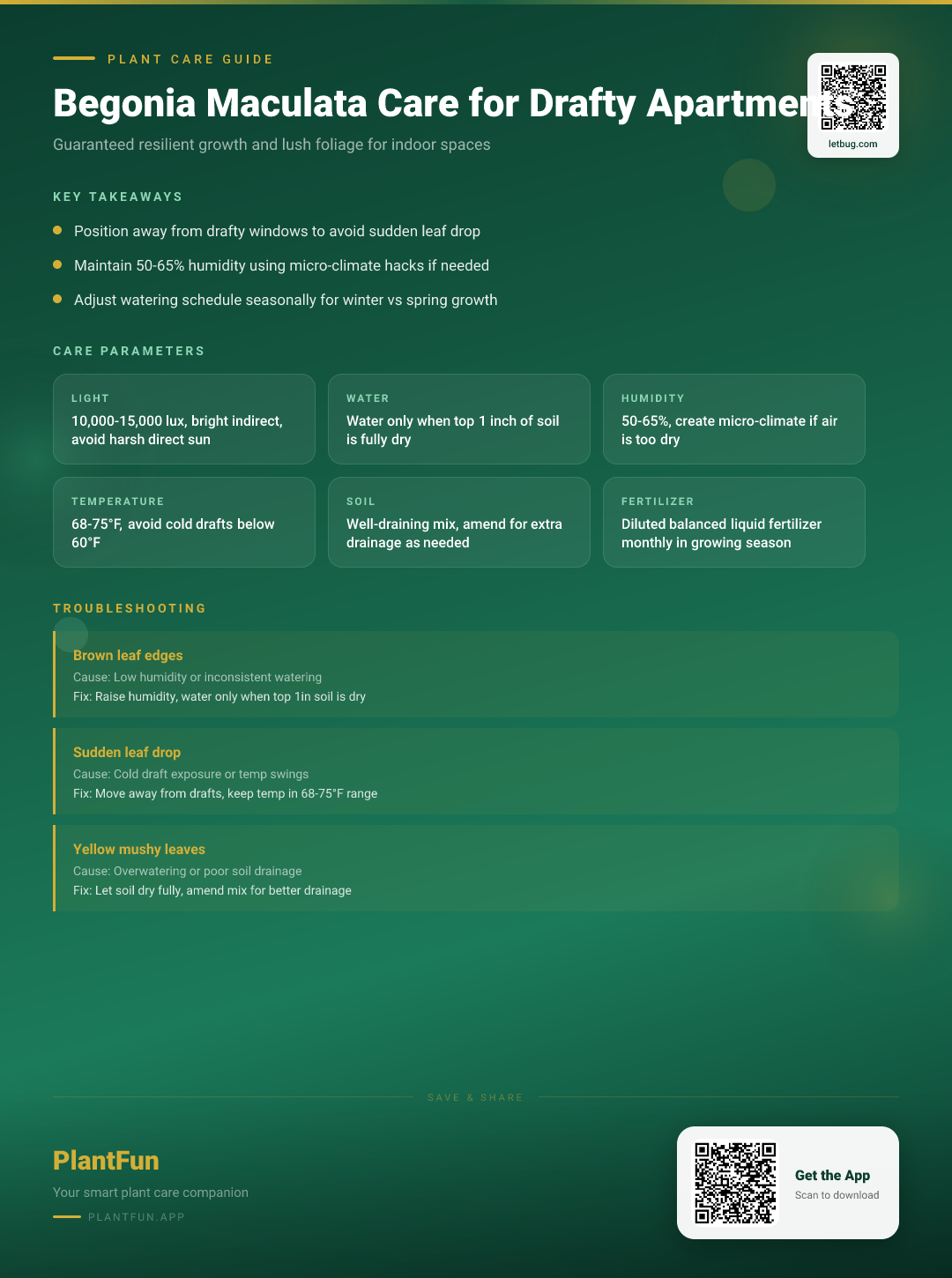
Key Takeaways
- Check soil moisture before watering — overwatering is the #1 killer of houseplants.
- Ensure your plant gets the right amount of light for its species.
- Be patient with recovery — most plants need 2–4 weeks to bounce back.
Quick Care Card: The Begonia Maculata Baseline
| Feature | Requirement |
|---|---|
| Light | 10,000–15,000 Lux (Bright, indirect) |
| Humidity | 50–65% |
| Temperature | 68–75°F (20–24°C) |
| Water | Top 1 inch dry |
| Soil | Airy, well-draining peat-based mix |
| Fertilizer | Balanced liquid feed, bi-weekly in growing season |
| Toxicity | Toxic to cats and dogs (ASPCA, 2026) |
TL;DR: The Reality of Keeping Begonia Maculata in Apartments
When I first brought home my Begonia maculata, I placed it right on a windowsill. It promptly dropped half its leaves. The reality? These plants despise sudden shifts in temperature. In an apartment, your greatest enemies are invisible: the cold draft from a poorly sealed window and the dry, fluctuating heat from radiators. To keep them thriving, you must prioritize stable ambient temperatures over maximum light exposure. A consistent 68–75°F is better than bright light interrupted by arctic gusts.
Why Drafty Windows Kill Your Polka Dot Begonia
As a gardener who has navigated many apartment setups, I’ve learned that Begonia maculata functions as a barometer for your home’s air quality. While they are resilient, their thin, patterned leaves are highly sensitive to transpiration stress. When cold air hits the foliage, the plant closes its stomata to protect itself. If this happens repeatedly, the plant suffers from localized cell damage, leading to the characteristic yellowing and dropping of leaves that many beginners find so frustrating (NC State Extension, 2026).
The Rescue Plan: Identifying Signs of Environmental Stress
- Acute Wilting: If the plant wilts even when soil is moist, it is likely suffering from a temperature shock rather than thirst.
- Crispy Leaf Margins: Brown edges that feel papery indicate humidity levels below 40%.
- Spotting: Small brown circles on the leaf surface often point to water droplets sitting on leaves in a cold room, which encourages fungal growth (Bursalioglu, 2020).
Root Cause Analysis: Why Your Soil Moisture Isn’t Matching Your Humidity
Often, we overwater because we see dry, curling leaves. However, if your apartment humidity is low, the soil may remain damp for weeks because the plant’s transpiration rate has plummeted. Before you water, stick your finger 2 inches into the soil. If it feels cool or damp, hold off. Using a moisture meter is not as reliable as the manual check, as the specific soil structure for Begonias requires constant, slight aeration (NC State Extension, 2026).
Immediate Rescue Steps: Moving, Pruning, and Stabilizing
- Relocate: Move the plant at least 3 feet away from any window that exhibits condensation or cold air flow.
- Prune: If leaves are more than 50% brown or yellow, use sterile shears to cut them at the petiole base to allow the plant to redirect energy to the nodes.
- Stabilize: Increase ambient humidity by grouping plants. If you keep it near a radiator, place a tray of pebbles and water beneath the pot to create a local micro-climate (ensure the pot is on a riser so it doesn’t sit in the water).
The Science of Humidity: How to Create Micro-Climates Without a Greenhouse
Research into indoor pot plant durability confirms that species like those in the Begonia genus rely heavily on stable atmospheric moisture to regulate internal pressures (Hanum et al., 2021). You don’t need a professional greenhouse. By simply placing your Begonia in a room with a humidifier set to 55%, you mimic the tropical conditions they crave.
Seasonal Care Calendar: Transitioning from Radiator Heat to Spring Growth
- Winter (Nov–Feb): Focus on light. Move the plant to the brightest spot available but monitor for drafts. Cut back fertilizer entirely.
- Spring (Mar–May): The plant enters its growth phase. Introduce a half-strength, balanced fertilizer every two weeks.
- Summer (Jun–Aug): Focus on hydration. Check moisture levels every 3 days; higher growth rates demand more water (NC State Extension, 2026).
Troubleshooting Guide: Why are the edges of my Begonia leaves turning brown?
Low Atmospheric Humidity
Symptom: Dry, papery brown edges on newer leaves.
Likely cause: Ambient air in the home is below 40% humidity.
Fix:
- Group plants together to create a localized humidity bubble.
- Place a room humidifier within 4 feet of the plant.
Overwatering in Low Light
Symptom: Soft, dark brown patches with a yellow halo.
Likely cause: The roots are suffocating due to stagnant moisture in the substrate.
Fix:
- Repot into a high-drainage mix using 30% perlite and 70% peat-free potting soil.
- Increase light exposure to help the plant ‘drink’ the soil moisture faster.
Voice Search FAQ
Can I keep my Begonia Maculata in a drafty bedroom? Only if you can block the draft. Use clear weather stripping on the window or move the plant to a dresser further inside the room to ensure it doesn’t experience temperature swings below 65°F.
How often should I actually water my Polka Dot Begonia in winter? In winter, the plant goes semi-dormant. I typically find that waiting until the top 2 inches of soil are dry is the safest bet, which usually equates to once every 10–14 days.
Why is my Begonia losing leaves suddenly? Sudden leaf drop is almost always a reaction to environmental instability. Check if you’ve recently moved the plant or if a nearby AC vent or radiator has kicked on.
Long-Term Prevention and Soil Amendments for Better Drainage
The secret to longevity is in the substrate. I always amend my soil with extra perlite or bark chips. This prevents the heavy, water-logged conditions that lead to root rot. Remember, the ASPCA identifies this plant as toxic to cats and dogs, so keep your Begonia on a high shelf or in a room where your pets cannot reach the foliage (ASPCA, 2026).
References
- ASPCA. (2026). Toxic and Non-Toxic Plants List — ASPCA. https://www.aspca.org/pet-care/animal-poison-control/toxic-and-non-toxic-plants. Accessed 2026-03-12.
- BURSALIOĞLU, E. (2020). Evaluation of antibacterial activity of Triticum monococcum seeds, Castanea sativa seeds and Begonia maculata leaves against several bacterial strains. Turkish Journal of Biodiversity. https://doi.org/10.38059/biodiversity.635270. Accessed 2026-03-12.
- Hanum, S.; Rahayu, A.; Darma, I. (2021). Begonia muricata Blume and Begonia serratipetala Irmsch durability as indoor pot plant in Eka Karya Bali Botanic Garden. Berkala Penelitian Hayati. https://doi.org/10.23869/bphjbr.26.2.20217. Accessed 2026-03-12.
- NC State Extension. (2026). Begonia Maculata Care — NC State Extension Gardener Plant Toolbox. https://plants.ces.ncsu.edu/plants/maculata-care/. Accessed 2026-03-12.
Optional Helper: Plantfun.App
Plantfun.App identifies your plants by photo, diagnoses pests and diseases with clear fixes, and creates personalised watering and light schedules that adapt to your home conditions — a handy companion for putting this guide into daily practice.
Found an error or have suggestions? We'd love your feedback.
Need help identifying this problem?
Get instant identification, personalized care schedules, and effective pest treatment plans directly on your phone.
Sponsored • We may earn a commission from app downloads
Related Guides
Begonia Maculata in a Dry Apartment: The 5-Step Resilience Strategy for Spotless Leaves
Revive your wilting Begonia Maculata with these 5 expert-backed steps. Learn the exact humidity and light thresholds needed for resilient, spot-free foliage.
Care GuideBegonia Maculata in a Dim Apartment: The Complete Care Guide for Resilient Growth
Revive your struggling Begonia Maculata with these 4 proven apartment adjustments. Learn exact light, humidity, and watering cycles for lush, spotted growth now.
Care GuideBegonia Maculata Care in Apartment Living: How to Avoid Leaf Drop and Brown Edges
Stop your Begonia maculata from dropping leaves. Discover the exact 60% humidity threshold, light requirements, and watering cycles for lush, spotted foliage.
Pest ControlAnts on Plants: What They Mean and What to Do
Ants usually aren't eating your plant. They are farming other pests.