
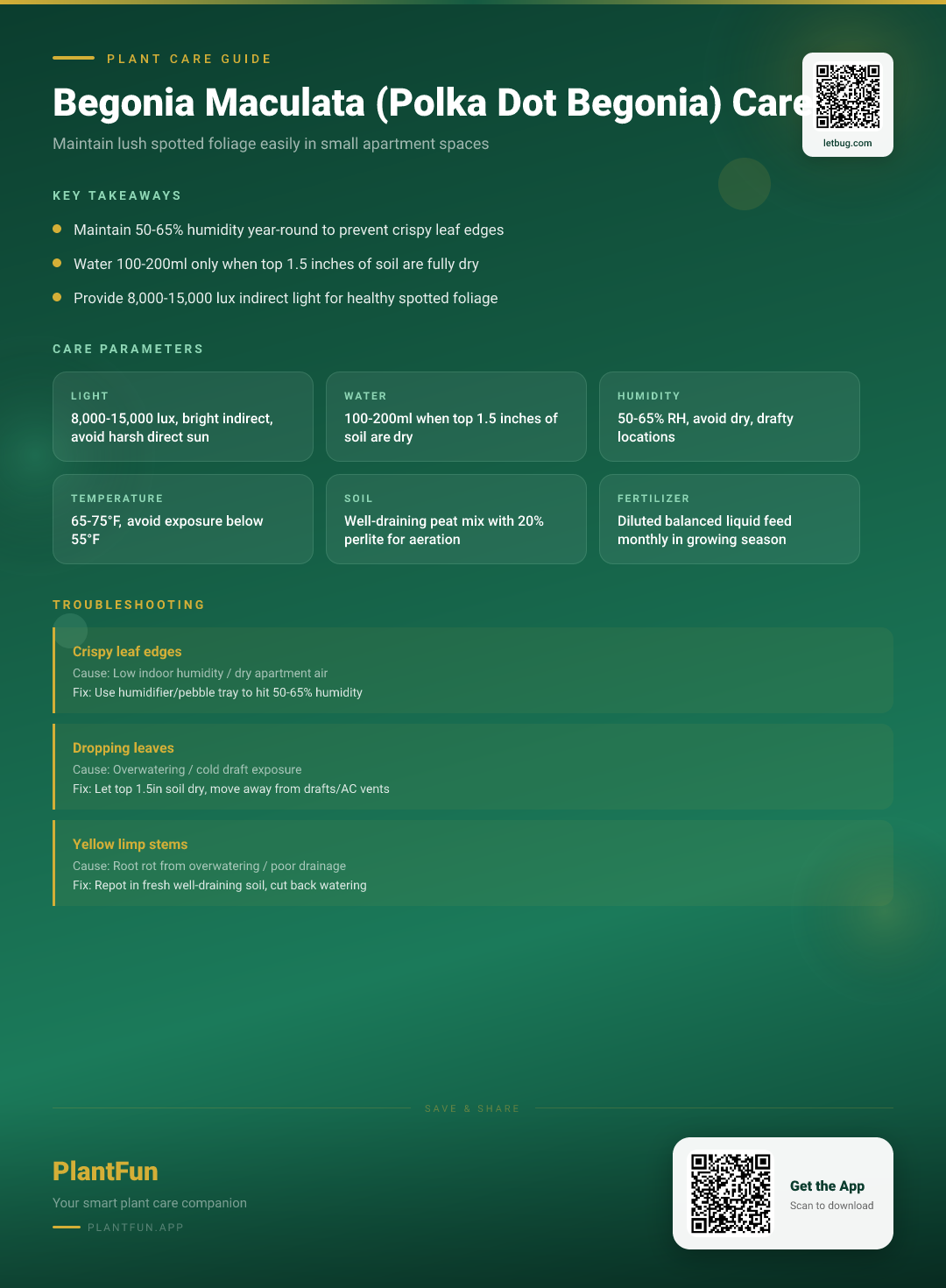
Key Takeaways
- Check soil moisture before watering — overwatering is the #1 killer of houseplants.
- Ensure your plant gets the right amount of light for its species.
- Be patient with recovery — most plants need 2–4 weeks to bounce back.
TL;DR: Quick Fixes for Your Begonia Maculata
If your Begonia maculata is struggling, you are likely facing an humidity mismatch. These plants require 50–65% relative humidity and bright, indirect light (8,000–15,000 lux) (NC State Extension, 2026). If you see crispy edges, increase your humidity immediately. If leaves are dropping, check your watering cycle—ensure the top 1.5 inches of soil dry out completely before you add 100-200ml of water. Avoid over-mistings that leave water on leaves, as this invites fungal issues.
Quick Care Card: Essential Data
| Feature | Requirement |
|---|---|
| Light | 8,000–15,000 lux (bright, indirect) |
| Humidity | 50–65% |
| Watering | 100-200ml when top 1.5 inches are dry |
| Temperature | 65–75°F (18–24°C) |
| Soil | Well-draining, airy aroid mix |
| Fertilizer | Balanced liquid feed at half-strength (monthly) |
| Toxicity | Toxic to cats and dogs (ASPCA, 2026) |
The Truth About Begonia Maculata in Small Apartments
When I first brought home my Begonia maculata, I placed it right in the center of my drafty living room. Within a week, the iconic silver-spotted leaves began to yellow. I learned the hard way that these plants aren’t just “decor”; they are living organisms that respond to the microclimate of your apartment. Unlike hardier pothos, a Begonia demands consistency. In small urban apartments, heating systems and lack of airflow can create “dead zones” that wreak havoc on delicate foliage.
Identifying the Warning Signs: Crispy Edges vs. Limp Stems
Crispy, Brown Edges
Symptom: Leaf margins curl and turn brittle/brown.
Likely cause: Atmospheric moisture is too low (below 40%) or the plant is suffering from salt buildup in the soil.
Fix:
- Place the pot on a humidity tray with pebbles and water, ensuring the bottom of the pot never touches the water.
- Use distilled or filtered water to prevent mineral accumulation.
Yellowing and Dropping Leaves
Symptom: Lower leaves yellow and drop suddenly.
Likely cause: Overwatering or “wet feet” (root rot) (NC State Extension, 2026).
Fix:
- Check the drainage holes immediately for any standing water.
- Repot into a high-quality, chunky potting mix if the soil is dense or compacted.
Root Cause Analysis: Why Apartment Air and Watering Cycles Clash
Many apartment owners fall into the trap of a rigid “every Monday” watering schedule. Because apartments have varying temperatures, your plant’s metabolic rate changes. If your home stays cool, the plant needs less water. If you water on a schedule rather than by moisture levels, you essentially suffocate the roots. Furthermore, central heating systems in winter can drop ambient humidity to sub-30% levels, which is far below the required 50–65% threshold (NC State Extension, 2026).
Step-by-Step Recovery: Adjusting Your Routine for Immediate Results
- The Finger Test: Before adding water, insert your finger 1.5 inches into the soil. If it feels damp, wait two more days.
- Calibration: Use a small measuring cup to apply 100-200ml of water. This prevents accidental over-saturation.
- Relocation: Move your plant to the brightest spot that doesn’t receive direct, scorching afternoon sun. A spot near a north or east-facing window is usually ideal.
- Hydration Boost: If the air is dry, cluster your Begonia with other plants to create a micro-environment that holds moisture better than a solitary plant ever could.
Long-Term Prevention: Mastering the 50-65% Humidity Threshold
The key to a happy Begonia maculata is stability. While I love the aesthetic of a standalone plant, my Begonias thrive when grouped together. This creates a canopy effect, trapping transpired moisture. If you live in an especially dry climate, consider a small, cool-mist humidifier running for a few hours a day near the plant stand.
Common Mistakes to Avoid
-
Mistake: Misting leaves to increase humidity.
-
What happens: Water sits on the leaf surface, creating a breeding ground for bacterial infections (Bursalioğlu, 2020).
-
Instead: Use a humidifier or a pebble tray to increase the ambient air moisture without wetting the foliage.
-
Mistake: Using dense, garden-variety soil.
-
What happens: The soil holds too much water, cutting off oxygen to the roots.
-
Instead: Mix perlite or orchid bark into your potting soil for better aeration.
FAQ
Why is my Begonia Maculata dropping leaves in winter? It is likely the plant is reacting to reduced light levels and the drop in indoor humidity due to heating. Try moving it closer to your best light source and increasing ambient humidity.
Can I keep my Begonia in an apartment with no south-facing windows? Yes. In fact, many people find that direct southern light burns the leaves. An east-facing window is often the best spot for Begonia in an apartment (NC State Extension, 2026).
How do I know if my Begonia has root rot? If the stems feel mushy at the base and the soil has a sour or “off” smell, your roots are likely decaying. You must unpot the plant and remove any black, slimy roots (NC State Extension, 2026).
Seasonal Maintenance Calendar for Indoor Begonias
- Spring: Increase fertilizer to once every four weeks as light levels rise.
- Summer: Monitor closely for spider mites; wipe leaves gently with a damp cloth.
- Autumn: Gradually decrease water as growth slows in response to lower light.
- Winter: Keep away from cold drafts and heat vents; maintain consistent, moderate temperatures (65–75°F) (NC State Extension, 2026).
References
- ASPCA. (2026). Toxic and Non-Toxic Plants List — ASPCA. https://www.aspca.org/pet-care/animal-poison-control/toxic-and-non-toxic-plants. Accessed 2026-03-19.
- BURSALIOĞLU, E. (2020). Evaluation of antibacterial activity of Triticum monococcum seeds, Castanea sativa seeds and Begonia maculata leaves against several bacterial strains. Turkish Journal of Biodiversity. https://doi.org/10.38059/biodiversity.635270. Accessed 2026-03-19.
- Hanum, S.; Rahayu, A.; Darma, I. (2021). Begonia muricata Blume and Begonia serratipetala Irmsch durability as indoor pot plant in Eka Karya Bali Botanic Garden. Berkala Penelitian Hayati. https://doi.org/10.23869/bphjbr.26.2.20217. Accessed 2026-03-19.
- NC State Extension. (2026). Begonia Maculata Care — NC State Extension Gardener Plant Toolbox. https://plants.ces.ncsu.edu/plants/maculata-care/. Accessed 2026-03-19.
Optional Helper: Plantfun.App
Plantfun.App identifies your plants by photo, diagnoses pests and diseases with clear fixes, and creates personalised watering and light schedules that adapt to your home conditions — a handy companion for putting this guide into daily practice.
Found an error or have suggestions? We'd love your feedback.
Need help identifying this problem?
Get instant identification, personalized care schedules, and effective pest treatment plans directly on your phone.
Sponsored • We may earn a commission from app downloads
Related Guides
Begonia Maculata Care in Low-Humidity Apartments: 5 Steps to Prevent Leaf Drop
Save your Begonia maculata from leaf drop in dry apartments. Master the exact 50-60% humidity hacks, light levels, and soil moisture tips you need today.
Care GuideBegonia Maculata in an Apartment with Low Humidity: A Resilient Care Strategy
Revive your wilting Begonia Maculata with a simple 3-step humidity hack. Learn precise light levels, watering schedules, and soil mixes for apartment living.
Care GuideBegonia Maculata Care in Apartment Living: How to Avoid Leaf Drop and Brown Edges
Stop your Begonia maculata from dropping leaves. Discover the exact 60% humidity threshold, light requirements, and watering cycles for lush, spotted foliage.
Pest ControlAnts on Plants: What They Mean and What to Do
Ants usually aren't eating your plant. They are farming other pests.