
Key Takeaways
- Check soil moisture before watering — overwatering is the #1 killer of houseplants.
- Ensure your plant gets the right amount of light for its species.
- Be patient with recovery — most plants need 2–4 weeks to bounce back.
TL;DR: The Apartment Care Quick-Fix
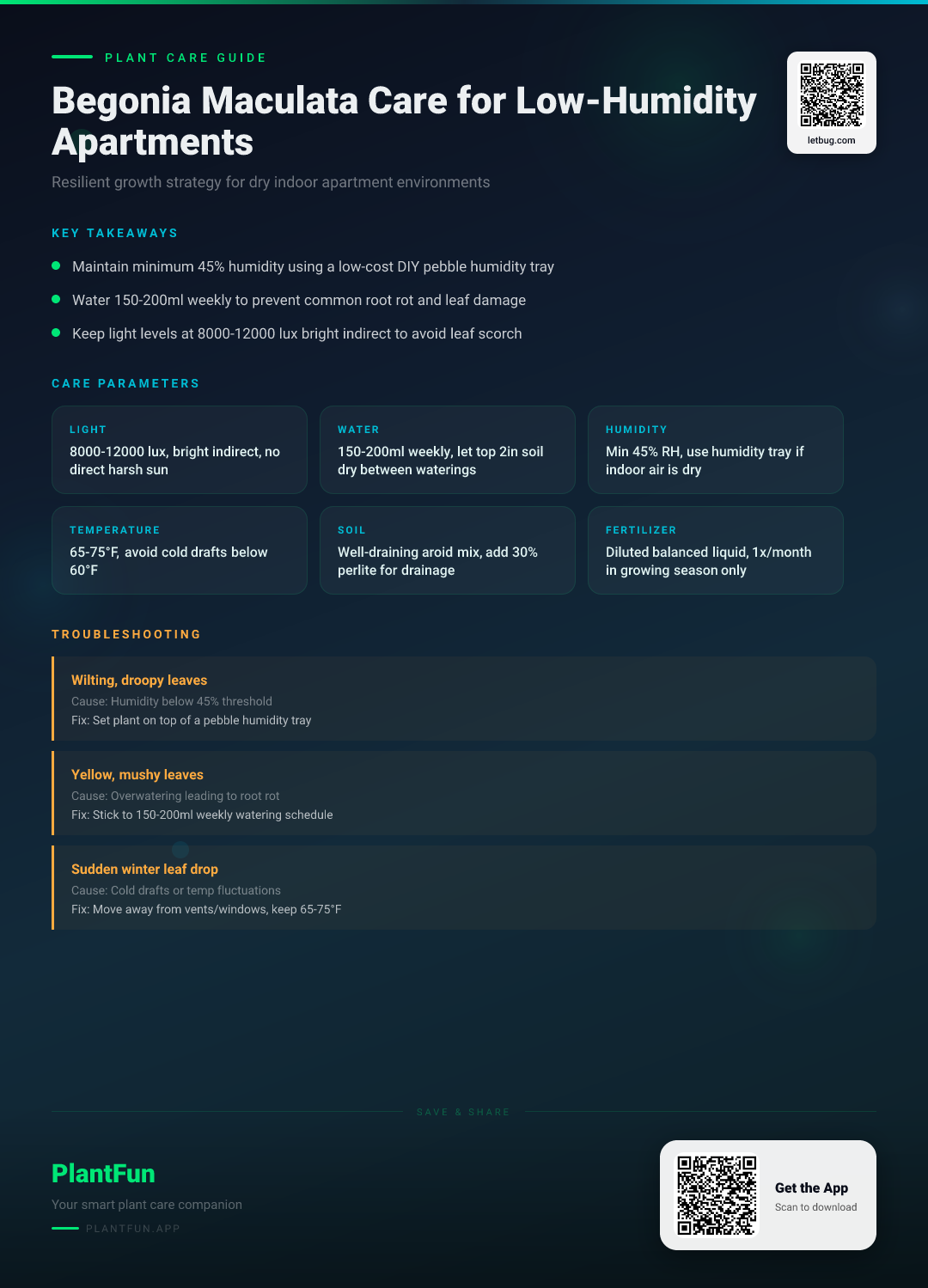
Your Begonia Maculata thrives in an apartment when you stabilize its environment. Focus on maintaining 45-55% humidity via a pebble tray, provide 8,000–12,000 lux of bright, indirect light, and water with exactly 150-200ml when the top inch of soil feels dry. Avoid cold drafts and erratic waterings, which are the leading causes of leaf drop (NC State Extension, 2026).
Quick Care Card: Essential Thresholds for Success
| Feature | Optimal Setting |
|---|---|
| Light | 8,000–12,000 Lux (Bright, Indirect) |
| Water | 150-200ml weekly (adjust by season) |
| Humidity | 45% - 60% |
| Temp | 65°F - 75°F (18°C - 24°C) |
| Soil | Well-draining, peat-based mix |
| Fertilizer | Balanced liquid 10-10-10 (diluted) |
| Toxicity | Toxic to cats and dogs (ASPCA, 2026) |
My Experience: The “Impossible Plant” Myth
When I first brought home my Polka Dot Begonia, I treated it like a standard pothos. I placed it in a dry corner and watered it whenever I remembered. Within two weeks, I watched in horror as leaves shriveled and dropped at the slightest touch. I assumed it was impossible to keep in my apartment. I learned the hard way that Begonia maculata is an environmental specialist. By pivoting to a disciplined, humidity-conscious schedule, I turned my “dying” specimen into a thriving centerpiece.
Why Your Apartment’s Air Is Tricking Your Begonia
Apartments are notorious for low-humidity cycles, especially when HVAC systems run. Your Begonia interprets this dry air as a signal to go dormant or drop foliage to minimize transpiration—the process of water movement through a plant (NC State Extension, 2026). If you notice brown, crispy edges, it’s not necessarily a lack of water; it’s an inability to maintain turgor pressure in the leaf cells due to the air being too parched.
Decoding Humidity: Why 45% is the Threshold for Resilient Growth
While many tropicals prefer 60%+, Begonia maculata can adapt to 45% if the light levels are consistent. Falling below 40% usually triggers the dreaded leaf drop. Keep a digital hygrometer nearby; if it dips, my humidity-hacking tray is your first line of defense.
Light Requirements: Balancing 8,000–12,000 Lux Without Scorching Leaves
This plant loves light, but hates direct sun. Think of the light filtering through a thin curtain. If you have a light meter, aim for 8,000–12,000 lux. In my experience, a North or East-facing window is ideal for consistent growth without the threat of leaf scorch.
The Watering Science: Why 150-200ml Weekly Prevents Root Rot
Overwatering is the fastest way to kill this plant. I measure my water: 150-200ml once a week is usually sufficient for a 6-inch pot. Always perform the “finger test”: push your finger two inches into the soil. If it’s damp, wait. If it’s dry, water. Improper drainage is a common failure point for indoor potted plants (Hanum et al., 2021).
Step-by-Step: Constructing a Budget-Friendly Humidity Tray
- Find a waterproof tray or saucer at least 2 inches deep.
- Fill it with a single layer of decorative gravel or pebbles.
- Add water until it sits just below the top of the pebbles.
- Place your pot on the pebbles, ensuring the bottom of the pot never touches the water, as this causes root rot.
Seasonal Shifts: How Temperature Fluctuations Between 65-75°F Affect Dormancy
In winter, the plant naturally slows down. If your apartment drops below 65°F at night, reduce watering by 30%. Fluctuations are stressful; keep them away from drafty windows or radiator vents.
Can I keep my Begonia Maculata in a drafty bedroom?
It is not ideal. Cold drafts (below 60°F) can shock the plant and cause sudden leaf drop. If you must keep it there, use a thermal curtain to buffer the temperature.
Why is my Polka Dot Begonia losing leaves in the winter?
Typically, this is due to a drop in ambient humidity caused by heating systems or insufficient light during shorter days (NC State Extension, 2026).
How do I know if my Begonia needs more light?
If the plant becomes “leggy” (long stems with large gaps between leaves), it is stretching to find light. Move it closer to your brightest available window.
Common Mistakes to Avoid
- Mistake: Using dense potting soil.
- What happens: Roots suffocate and rot.
- Instead: Use a mix of 50% peat moss and 50% perlite for maximum aeration.
- Mistake: Irregular watering.
- What happens: The plant experiences stress, leading to brown leaf edges.
- Instead: Maintain a consistent 7-day schedule, adjusting only for temperature changes.
When to Repot: Soil Drainage and Root Health Indicators
Repot in spring when roots emerge from the bottom drainage holes. Ensure your new pot has ample drainage; the health of the foliage often reflects the state of the root system (Bursalioglu, 2020).
References and Botanical Resources
- Bursalioglu, E. (2020). Evaluation of antibacterial activity of Triticum monococcum seeds, Castanea sativa seeds and Begonia maculata leaves against several bacterial strains. Turkish Journal of Biodiversity. https://doi.org/10.38059/biodiversity.635270. Accessed 2026-03-14.
- Hanum, S., Rahayu, A., & Darma, I. (2021). Begonia muricata Blume and Begonia serratipetala Irmsch durability as indoor pot plant in Eka Karya Bali Botanic Garden. Berkala Penelitian Hayati. https://doi.org/10.23869/bphjbr.26.2.20217. Accessed 2026-03-14.
- ASPCA. (2026). Toxic and Non-Toxic Plants List — ASPCA. https://www.aspca.org/pet-care/animal-poison-control/toxic-and-non-toxic-plants. Accessed 2026-03-14.
- NC State Extension. (2026). Begonia Maculata — NC State Extension Gardener Plant Toolbox. https://plants.ces.ncsu.edu/plants/maculata-care/. Accessed 2026-03-14.
Optional Helper: Plantfun.App
Plantfun.App identifies your plants by photo, diagnoses pests and diseases with clear fixes, and creates personalised watering and light schedules that adapt to your home conditions — a handy companion for putting this guide into daily practice.
Found an error or have suggestions? We'd love your feedback.
Need help identifying this problem?
Get instant identification, personalized care schedules, and effective pest treatment plans directly on your phone.
Sponsored • We may earn a commission from app downloads
Related Guides
Begonia Maculata in a Dry Apartment: The 5-Step Resilience Strategy for Spotless Leaves
Revive your wilting Begonia Maculata with these 5 expert-backed steps. Learn the exact humidity and light thresholds needed for resilient, spot-free foliage.
Care GuideBegonia Maculata in a Dim Apartment: The Complete Care Guide for Resilient Growth
Revive your struggling Begonia Maculata with these 4 proven apartment adjustments. Learn exact light, humidity, and watering cycles for lush, spotted growth now.
Care GuideBegonia Maculata Care in Drafty Apartments: Resilient Growth and Lush Foliage Guaranteed
Stop losing leaves to apartment drafts. Master Begonia Maculata care with precise light thresholds, humidity hacks, and a seasonal schedule for lush growth.
Pest ControlAnts on Plants: What They Mean and What to Do
Ants usually aren't eating your plant. They are farming other pests.