
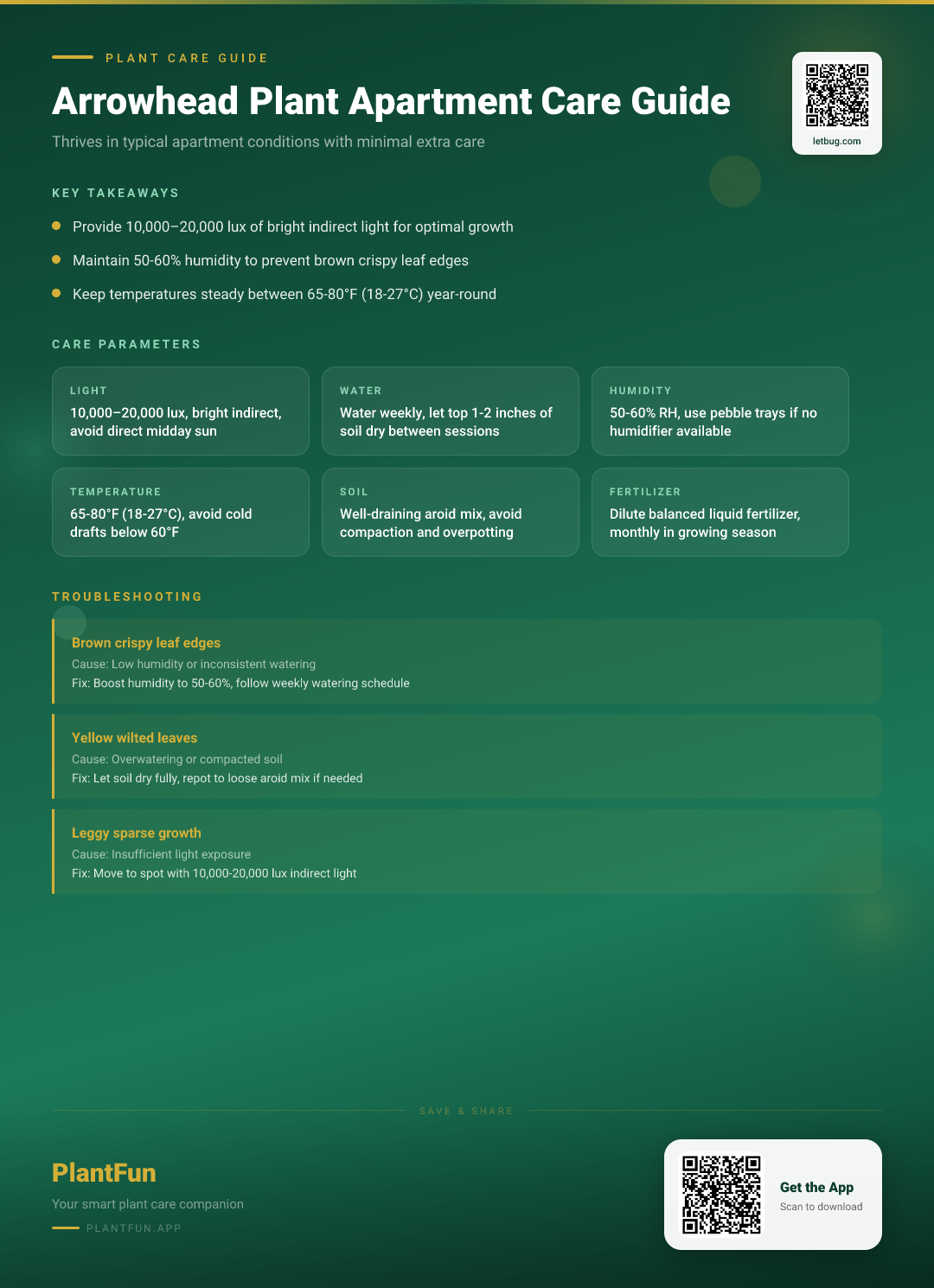
Key Takeaways
- Check soil moisture before watering — overwatering is the #1 killer of houseplants.
- Ensure your plant gets the right amount of light for its species.
- Be patient with recovery — most plants need 2–4 weeks to bounce back.
TL;DR: The Essentials
To keep a Syngonium podophyllum thriving in an apartment, maintain bright, indirect light (10,000–20,000 lux), water when the top 2 inches of soil are dry, and keep humidity above 50%. Avoid direct sun and cold drafts. Always remember that this plant is toxic to pets if ingested (ASPCA, 2026).
My Experience: The Greenhouse-to-Apartment Shock
When I first brought home my Syngonium podophyllum, I placed it in a dim corner of my living room, assuming it would tolerate the “low light” label. Within three weeks, the stems became “leggy” and the leaves lost their vibrant variegation. I realized then that my apartment’s airflow and light levels were vastly different from the greenhouse conditions where the plant originated. Through trial and error, I learned that Syngonium aren’t just “low light” plants—they are humidity-sensitive tropicals that demand consistency.
Quick Care Card: Essential Thresholds for Apartment Resiliency
| Feature | Requirement |
|---|---|
| Light | 10,000–20,000 Lux (Bright, Indirect) |
| Water | Allow top 2 inches of soil to dry |
| Humidity | 50% – 60% |
| Temperature | 65°F – 80°F (18°C – 27°C) |
| Soil | Well-draining, peat-based mix |
| Fertilizer | Balanced liquid feed, monthly in summer |
| Toxicity | Toxic to cats and dogs (ASPCA, 2026) |
Why Your Apartment Environment Challenges the Arrowhead Plant
Apartment living introduces two major stressors: low light and stagnant, dry air. Unlike a greenhouse, where optimal humidity is managed automatically, your apartment’s HVAC system fluctuates, causing the plant’s transpiration rate to spike. According to Sheeran and Rasmussen (2023), these Araceae species are highly responsive to humidity, and their health is intrinsically linked to the moisture content of the surrounding air.
Step 1: Mastering Light: Finding the Sweet Spot in Small Spaces (10,000–20,000 Lux)
Light is the primary engine for your plant’s growth. Gautam et al. (2021) demonstrate that while some indoor species can adapt to lower light, consistent performance is best achieved within specific artificial or natural light intensities.
- Placement: Position your plant within 3 feet of a north or east-facing window.
- Measurement: Use a light meter app to ensure the area receives 10,000–20,000 lux (Gautam et al., 2021).
- Adjustment: If leaves turn pale green, move the plant closer to the light source to improve photosynthesis rates.
Step 2: Hydration Science: Measuring Water Needs Based on Your Home’s VPD
Watering isn’t a schedule; it’s a response to your home’s Vapor Pressure Deficit (VPD).
- The Finger Test: Insert your index finger 2 inches into the potting media (NC State Extension, 2026). If it feels dry, it is time to water.
- The Soak: Water until liquid flows freely from the drainage holes to ensure the entire root ball is saturated, then discard the excess water from the saucer.
Step 3: Humidity Hacks: Creating a 50-60% Microclimate Without a Humidifier
- Grouping: Place your Syngonium near other foliage to create a localized humid zone.
- The Pebble Tray: Fill a tray with pebbles and water, placing the pot on top (ensure the roots never sit directly in the water).
- Bathroom Placement: The bathroom is often the most humid room in an apartment. Is it a good idea? Yes, provided there is enough light (Sheeran & Rasmussen, 2023).
Step 4: Temperature Control: Keeping it Between 65-80°F (18-27°C) Year-Round
Maintain a stable temperature to prevent shock. Avoid placing your plant near AC vents or radiators, which create extreme temperature swings. A steady environment minimizes leaf drop and keeps the plant in a steady growth cycle (NC State Extension, 2026).
Seasonal Care Calendar: Adapting to Apartment Heating and Cooling Cycles
- Spring/Summer: Increase watering as temperatures rise. This is the prime time to apply a balanced fertilizer (NC State Extension, 2026).
- Autumn/Winter: Growth slows as light levels drop. Reduce watering frequency and cease fertilization to prevent root salt buildup.
Troubleshooting Arrowhead Plant
Brown, Crispy Leaf Edges
Symptom: The tips of the leaves are dry, brown, and brittle.
Likely cause: Low humidity or inconsistent watering schedules.
Fix:
- Increase ambient humidity using a pebble tray.
- Check your watering consistency; never let the soil bone-dry out completely.
Yellowing Leaves
Symptom: Older leaves are turning yellow and dropping.
Likely cause: Overwatering leading to root suffocation.
Fix:
- Check for soil compaction.
- Reduce watering frequency and ensure your best soil for houseplants mix has adequate perlite for drainage.
Frequently Asked Questions
- Can I keep my Arrowhead plant on a bookshelf far from a window? No. Unless you provide a high-quality grow light, your plant will eventually lose variegation and become stunted (Gautam et al., 2021).
- How do I know if my Arrowhead plant is getting enough water? Look at the leaves. If they feel firm and upright, your hydration is correct. If they droop noticeably, the plant needs water.
- Is it safe for my pets? The ASPCA lists Syngonium podophyllum as toxic to dogs and cats, as it contains insoluble calcium oxalates (ASPCA, 2026).
Common Mistakes to Avoid
- Mistake: Using a pot without drainage. What happens: Water pools at the bottom, leading to root rot. Instead: Always use a pot with drainage holes and a saucer.
- Mistake: Compressing soil during repotting. What happens: Lack of oxygen to the roots inhibits growth. Instead: Use a light, airy, peat-based potting mix (NC State Extension, 2026).
References and Botanical Best Practices
- ASPCA. (2026). Toxic and Non-Toxic Plants List — ASPCA. https://www.aspca.org/pet-care/animal-poison-control/toxic-and-non-toxic-plants. Accessed 2026-03-09.
- Gautam, B., Dubey, R., & Kaur, N. (2021). GROWTH RESPONSE OF INDOOR ORNAMENTAL PLANT SPECIES TO VARIOUS ARTIFICIAL LIGHT INTENSITIES (LED) IN AN INDOOR VERTICAL GARDEN. Plant Archives. https://doi.org/10.51470/plantarchives.2021.v21.no1.096. Accessed 2026-03-09.
- NC State Extension. (2026). Arrowhead Plant — NC State Extension Gardener Plant Toolbox. https://plants.ces.ncsu.edu/plants/arrowhead-plant/. Accessed 2026-03-09.
- Sheeran, L., & Rasmussen, A. (2023). Aerial roots elevate indoor plant health: Physiological and morphological responses of three high‐humidity adapted Araceae species to indoor humidity levels. Plant, Cell & Environment. https://doi.org/10.1111/pce.14568. Accessed 2026-03-09.
Optional Helper: Plantfun.App
Plantfun.App identifies your plants by photo, diagnoses pests and diseases with clear fixes, and creates personalised watering and light schedules that adapt to your home conditions — a handy companion for putting this guide into daily practice.
Found an error or have suggestions? We'd love your feedback.
Need help identifying this problem?
Get instant identification, personalized care schedules, and effective pest treatment plans directly on your phone.
Sponsored • We may earn a commission from app downloads
Related Guides
Arrowhead Plant Care in Typical Apartments: A Resilient Seasonal Growth Checklist for Success
Stop your Arrowhead plant from becoming leggy. Master exact light levels, hydration, and a seasonal routine to keep your Syngonium thriving in any apartment.
Care GuideThe Complete Arrowhead Plant Care Checklist for Resilient Growth in Typical Apartments
Stop guessing at Arrowhead Plant care. Get a tailored checklist, exact light, water, and humidity parameters to grow lush, resilient vines even in typical low-light city apartments.
Care GuideThe Complete Arrowhead Plant Care Guide for Typical Apartments: Seasonal Tips For Resilient Growth
Grow a lush, trailing arrowhead plant even in a basic urban apartment. Get exact light levels, watering amounts, and a seasonal care calendar to avoid yellow leaves and leggy growth.
Pest ControlAnts on Plants: What They Mean and What to Do
Ants usually aren't eating your plant. They are farming other pests.