
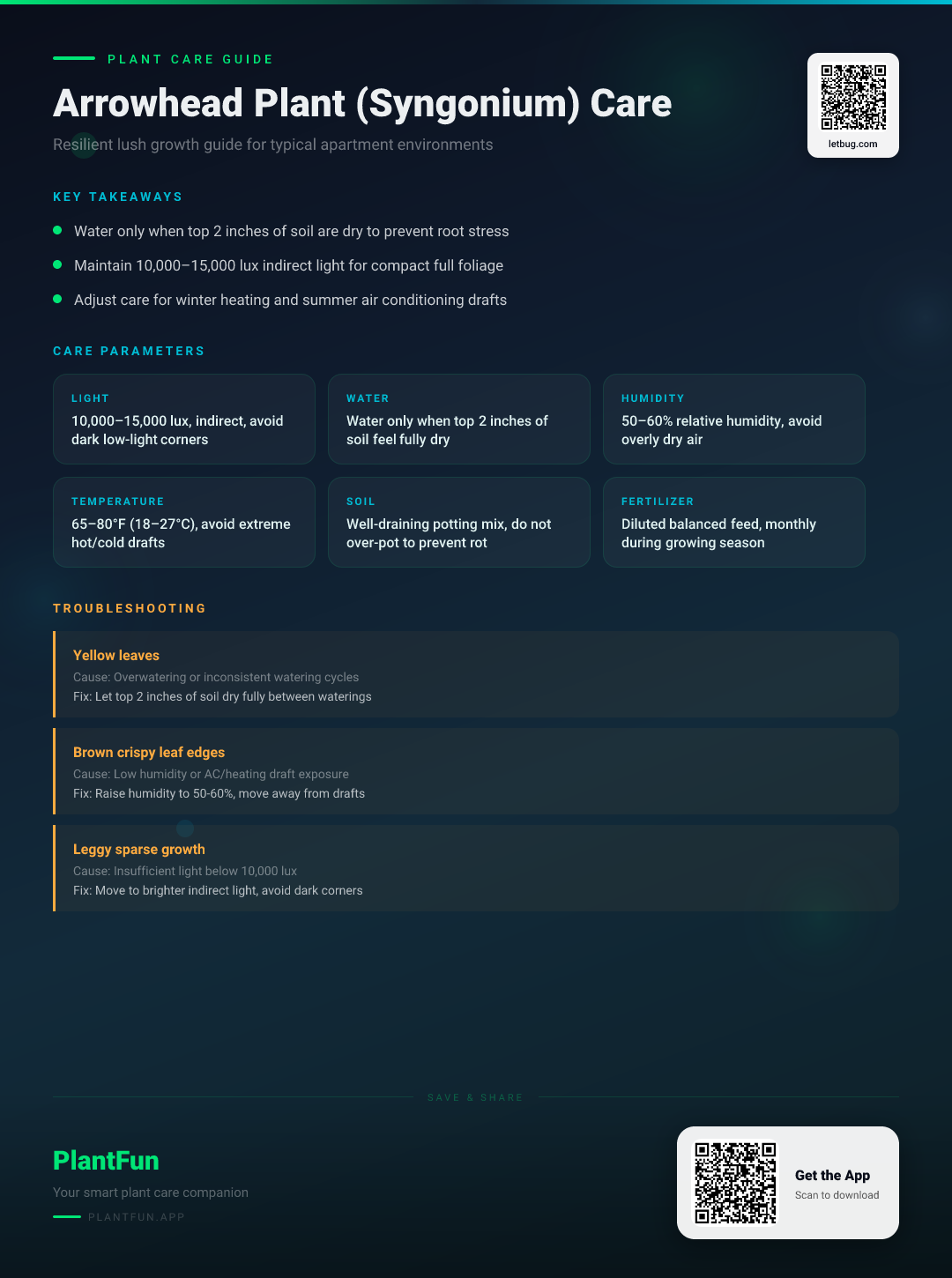
Key Takeaways
- Check soil moisture before watering — overwatering is the #1 killer of houseplants.
- Ensure your plant gets the right amount of light for its species.
- Be patient with recovery — most plants need 2–4 weeks to bounce back.
Quick Care Card: Essential Thresholds for Success
| Feature | Requirement |
|---|---|
| Light | 10,000–15,000 Lux (Bright, Indirect) |
| Water | When top 2 inches of soil are dry |
| Humidity | 50–60% Relative Humidity |
| Temperature | 65–80°F (18–27°C) |
| Soil | Well-draining, peat-based mix |
| Fertilizer | Balanced liquid feed, monthly (Spring/Summer) |
| Toxicity | Toxic to cats and dogs (ASPCA, 2026) |
TL;DR: The Reality of Keeping Syngonium in Modern Apartments
To keep your Syngonium podophyllum thriving, mimic its tropical origins by providing bright, indirect light and maintaining consistent moisture. The secret to success in an apartment is avoiding the “boom and bust” cycle of watering and keeping humidity levels above 50%. If you catch the soil just as the top 2 inches dry out, you will prevent both root rot and the common frustration of crispy leaf tips. This is a forgiving plant once you align your routine with the seasonal shifts of your living space.
Why Your Apartment Environment Challenges the Arrowhead Plant
When I first started keeping Arrowhead plants in my studio, I made the mistake of placing one directly above a radiator. Within two weeks, the foliage turned yellow and brittle. My experience taught me that apartments often have “micro-climates” that shift drastically. Unlike a greenhouse, our homes deal with forced-air heating in winter—which strips the air of moisture—and AC drafts in summer. Understanding Syngonium podophyllum care means acknowledging that this plant is a moisture-seeking organism (Sheeran & Rasmussen, 2023) that needs a stable environment to thrive.
Light Requirements: Targeting 10,000–15,000 Lux for Compact Foliage
Light intensity is the primary driver of compact, healthy growth. Based on research regarding artificial light intensities, providing consistent, bright indirect light is superior to fluctuating low-light conditions (Gautam et al., 2021).
- The Sweet Spot: Place your plant within 3 feet of an east-facing window.
- The Lux Test: If you don’t have a light meter, use a free smartphone lux meter app. Aim for 10,000 to 15,000 lux.
- Warning: Direct sun through glass will scorch the leaves, leading to bleached, papery patches. If your leaves are stretching (leggy growth), they are “reaching” for more light.
Hydration Science: Why You Should Water When the Top 2 Inches of Soil Feel Dry
Overwatering is the number one killer of indoor plants. Instead of a calendar, use the “finger test.” Push your index finger 2 inches into the potting mix. If it feels damp, wait. If it is dry, irrigate until water flows from the drainage holes. This method prevents the root system from suffocating in anaerobic conditions (NC State Extension, 2026).
Humidity & Temperature: Maintaining 50–60% Relative Humidity and 65–80°F (18–27°C)
These plants have adapted to high-humidity environments through the development of specialized roots (Sheeran & Rasmussen, 2023). In an apartment, keeping a humidity tray (a shallow dish of pebbles and water) beneath the pot helps, but a dedicated humidifier is better. Keep the ambient temperature between 65–80°F to ensure the plant remains in its active metabolic range.
The Seasonal Care Calendar: Adjusting for Winter Heating and Summer Air-Conditioning
- Winter: Heating systems lower humidity. Group your plants together to create a micro-climate of higher humidity. Reduce water frequency as growth slows.
- Summer: Air conditioning causes rapid drying. Check soil moisture twice a week, as indoor air may be drier than expected despite the external humidity.
Why is my Arrowhead plant getting brown crispy edges on its leaves?
This is a classic sign of low humidity. The plant is losing water through its leaves faster than it can pull it up from the roots. Increase the ambient humidity to 50% or more to resolve this.
How often should I water my Syngonium during the winter months?
Water only when the top 2 inches are dry. In winter, this might mean every 10–14 days instead of every 7 days. Always ensure you discard excess water from the decorative cache pot to prevent root rot.
Can I keep my Arrowhead plant in a low-light corner of my apartment?
While the Syngonium is known for being tolerant, long-term exposure to very low light will lead to sparse, elongated stems. If you lack natural light, invest in a full-spectrum LED grow light (Gautam et al., 2021).
Step-by-Step: Managing Soil Moisture and Fertilizer Applications
- Check Moisture: Perform the 2-inch finger test weekly.
- Watering: Use room-temperature water. Apply slowly until 50–100ml drains from the bottom.
- Drainage: Empty the saucer 15 minutes after watering.
- Fertilizer: During the growing season (April–August), use a balanced 10-10-10 liquid fertilizer at half-strength every 4–6 weeks.
Common Apartment Mistakes: Over-Potting and Inconsistent Watering Cycles
- Mistake: Using a pot that is too large. What happens: Excess soil holds too much water, leading to root rot. Instead: Only size up by 1-2 inches.
- Mistake: Inconsistent watering. What happens: The plant experiences “osmotic shock.” Instead: Use a consistent schedule to check the soil.
Troubleshooting: Recognizing Early Signs of Root Stress
Yellowing Leaves
Symptom: Lower leaves turn yellow and drop prematurely.
Likely cause: Overwatering or poor drainage.
Fix:
- Check the soil for sogginess.
- Repot into fresh, chunky aroid mix with extra perlite.
Drooping Stems
Symptom: The entire plant looks wilted despite the soil feeling dry.
Likely cause: Severe underwatering.
Fix:
- Submerge the inner pot in a bowl of water for 20 minutes.
- Drain thoroughly and return to its spot.
Pests (Spider Mites)
Symptom: Tiny webbing between stems and mottled leaves.
Likely cause: Dry apartment air.
Fix:
- Wipe leaves with a damp cloth.
- Increase humidity levels.
References
- Gautam, B.; Dubey, R.; Kaur, N. (2021). GROWTH RESPONSE OF INDOOR ORNAMENTAL PLANT SPECIES TO VARIOUS ARTIFICIAL LIGHT INTENSITIES (LED) IN AN INDOOR VERTICAL GARDEN. Plant Archives. https://doi.org/10.51470/plantarchives.2021.v21.no1.096. Accessed 2026-03-16.
- Sheeran, L.; Rasmussen, A. (2023). Aerial roots elevate indoor plant health: Physiological and morphological responses of three high‐humidity adapted Araceae species to indoor humidity levels. Plant, Cell & Environment. https://doi.org/10.1111/pce.14568. Accessed 2026-03-16.
- ASPCA. (2026). Toxic and Non-Toxic Plants List — ASPCA. https://www.aspca.org/pet-care/animal-poison-control/toxic-and-non-toxic-plants. Accessed 2026-03-16.
- NC State Extension. (2026). Arrowhead Plant — NC State Extension Gardener Plant Toolbox. https://plants.ces.ncsu.edu/plants/arrowhead-plant/. Accessed 2026-03-16.
Optional Helper: Plantfun.App
Plantfun.App identifies your plants by photo, diagnoses pests and diseases with clear fixes, and creates personalised watering and light schedules that adapt to your home conditions — a handy companion for putting this guide into daily practice.
Found an error or have suggestions? We'd love your feedback.
Need help identifying this problem?
Get instant identification, personalized care schedules, and effective pest treatment plans directly on your phone.
Sponsored • We may earn a commission from app downloads
Related Guides
The Complete Arrowhead Plant Care Checklist for Resilient Growth in Typical Apartments
Stop guessing at Arrowhead Plant care. Get a tailored checklist, exact light, water, and humidity parameters to grow lush, resilient vines even in typical low-light city apartments.
Care GuideThe Complete Arrowhead Plant Care Guide for Typical Apartments: Seasonal Tips For Resilient Growth
Grow a lush, trailing arrowhead plant even in a basic urban apartment. Get exact light levels, watering amounts, and a seasonal care calendar to avoid yellow leaves and leggy growth.
Care GuideThe Complete Arrowhead Plant Care Guide for Typical Apartments: Grow Resilient Lush Foliage
Stop struggling to keep your arrowhead plant thriving in your apartment. Get exact lux levels, watering amounts, and 7 actionable tips for thick, lush, resilient growth all year.
Pest ControlAnts on Plants: What They Mean and What to Do
Ants usually aren't eating your plant. They are farming other pests.