
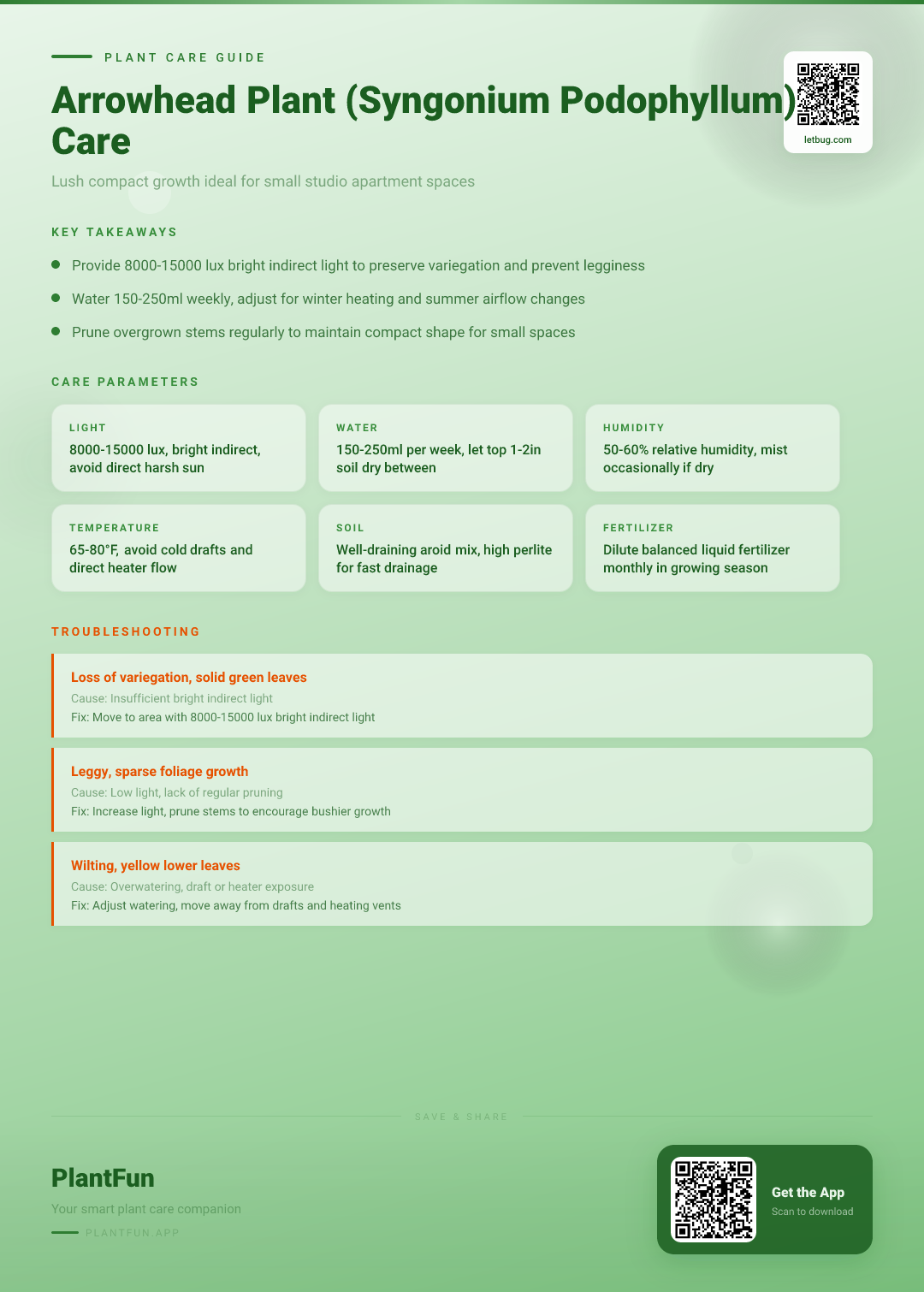
Key Takeaways
- Check soil moisture before watering — overwatering is the #1 killer of houseplants.
- Ensure your plant gets the right amount of light for its species.
- Be patient with recovery — most plants need 2–4 weeks to bounce back.
TL;DR: The Essentials for Your Studio
The Syngonium podophyllum is a master of adaptation, but in a studio apartment, it demands precision. To keep yours lush, provide bright, indirect light (8,000–15,000 lux), maintain 50–60% humidity, and water when the top two inches of soil are dry. Avoid placing your plant near heating vents or drafty windows, as fluctuations in temperature cause rapid leaf drop. Because the plant is toxic to pets, place it on a high shelf or hanging planter to maximize space and safety (ASPCA, 2026).
Quick Care Card: Essential Thresholds for Studio Living
| Feature | Optimal Range |
|---|---|
| Light (Lux) | 8,000 – 15,000 |
| Humidity | 50% – 60% |
| Water | 150 – 250ml per week |
| Temperature | 65°F – 80°F |
| Soil | Aroid mix (bark, peat, perlite) |
| Fertilizer | Balanced 10-10-10, monthly |
| Toxicity | Toxic to cats and dogs (ASPCA, 2026) |
Why Arrowhead Plants Thrive (or Fail) in Small Apartments
When I first brought my Syngonium into my 400-square-foot studio, I made the mistake of placing it in a dark corner. Within weeks, the stems stretched, reaching for light—a condition known as etiolation. My experience has taught me that the Arrowhead plant is not a “low light” plant; it is a “low light tolerant” plant. In tight quarters, we must prioritize verticality and light access to mimic its native tropical canopy habitat (NC State Extension, 2026).
Decoding the Light Needs: Placing Your Syngonium for Compact Foliage
Light intensity dictates your plant’s architecture. Artificial light intensities in vertical gardens show that consistent, diffused light supports morphological density (Gautam et al., 2021). Place your plant within three feet of an east-facing window. If you only have north-facing light, consider a small, full-spectrum LED grow light to maintain the 8,000-lux threshold necessary for compact, bushy growth.
Format A: The Complete Scenario Guide - Your Step-by-Step Care Roadmap
- Placement: Select a spot with constant ambient light. Avoid radiators, which dry the plant out.
- Hydration: Apply 150-250ml of filtered water once the top 5cm of soil feels dry to the touch.
- Verticality: Install a moss pole if you want larger leaves, or allow it to trail from a high-mounted shelf to save floor space.
- Pruning: Snip leggy runners just above a node to encourage branching.
Watering Logic: Why ‘Every Sunday’ Isn’t Enough in an Apartment Environment
Apartment air is often drier than house air due to centralized heating. Relying on a rigid schedule often leads to root rot or underwatering. Instead, perform the “finger test”: push your index finger two inches into the substrate. If it’s damp, wait. If it’s dry, water thoroughly until the liquid runs from the drainage holes (NC State Extension, 2026).
Soil Science: The Custom Mix for Rapid Drainage and Nutrient Density
Standard potting soil is often too dense. I mix 50% high-quality potting soil with 30% perlite and 20% orchid bark. This mimics the loose, airy forest floor and prevents the “wet feet” that lead to yellowing leaves.
Seasonal Calendar: Adjusting for Winter Heating and Summer Airflow
- Summer: High growth period. Increase watering frequency and use a balanced fertilizer monthly.
- Winter: Dormancy period. Reduce watering by 30% and move the plant away from drafty window panes (NC State Extension, 2026).
Can I help my Arrowhead plant climb a moss pole in a tiny apartment?
Yes! Aerial roots thrive in higher humidity, which actually promotes larger, more mature leaves (Sheeran & Rasmussen, 2023). A slim, cedar plank or a slim coco-coir pole is a great space-saving hack for vertical growth.
Why is my Arrowhead plant losing its variegation and turning solid green?
Variegated varieties require more light to maintain their color patterns. If your plant is turning green, it is photosynthetically adapting to low light. Move it closer to a window or add a grow light.
How do I prune my Syngonium to keep it from looking leggy and sparse?
Don’t fear the shears. Pruning triggers the plant to redirect energy into lateral buds. Cut just above a leaf node; you will often see two new stems emerge from that point, creating a fuller look.
Common Apartment Mistakes: The Drafty Window and Heater Hazard
- Mistake: Placing the plant directly on a radiator shelf. What happens: Rapid moisture loss leads to crispy edges. Instead: Use a humidity tray with pebbles and water beneath the pot.
- Mistake: Ignoring leaf yellowing. What happens: This is often a sign of overwatering or poor drainage. Instead: Check root health and ensure the pot has drainage holes.
Yellowing Leaves
Symptom: Lower leaves turn yellow and drop.
Likely cause: Overwatering or poor drainage.
Fix:
- Check that the soil is not waterlogged.
- Ensure the pot has adequate drainage holes.
Leggy Stems
Symptom: Long, bare stems with large gaps between leaves.
Likely cause: Insufficient light.
Fix:
- Move the plant closer to a light source.
- Prune the leggy stems to encourage new growth.
FAQ: Voice-Search Optimized Troubleshooting
- Can I put my Arrowhead plant in the bathroom? Absolutely, the increased humidity is excellent for this species (Sheeran & Rasmussen, 2023).
- How often to water Arrowhead plant in winter? Only when the top two inches are completely dry, which may be every 10–14 days.
- Is the Arrowhead plant toxic to cats? Yes, it contains insoluble calcium oxalates, making it toxic to both cats and dogs (ASPCA, 2026).
Conclusion: Scaling Your Small-Space Sanctuary
Mastering the Syngonium in a studio is about balancing light, vertical space, and consistent moisture. By treating this plant as a climbing companion rather than a static object, you can enjoy lush, tropical foliage regardless of your square footage.
References
- ASPCA. (2026). Toxic and Non-Toxic Plants List — ASPCA. https://www.aspca.org/pet-care/animal-poison-control/toxic-and-non-toxic-plants. Accessed 2026-03-15.
- Gautam, B.; Dubey, R.; Kaur, N. (2021). GROWTH RESPONSE OF INDOOR ORNAMENTAL PLANT SPECIES TO VARIOUS ARTIFICIAL LIGHT INTENSITIES (LED) IN AN INDOOR VERTICAL GARDEN. Plant Archives. https://doi.org/10.51470/plantarchives.2021.v21.no1.096. Accessed 2026-03-15.
- NC State Extension. (2026). Arrowhead Plant — NC State Extension Gardener Plant Toolbox. https://plants.ces.ncsu.edu/plants/arrowhead-plant/. Accessed 2026-03-15.
- Sheeran, L.; Rasmussen, A. (2023). Aerial roots elevate indoor plant health: Physiological and morphological responses of three high‐humidity adapted Araceae species to indoor humidity levels. Plant, Cell & Environment. https://doi.org/10.1111/pce.14568. Accessed 2026-03-15.
Optional Helper: Plantfun.App
Plantfun.App identifies your plants by photo, diagnoses pests and diseases with clear fixes, and creates personalised watering and light schedules that adapt to your home conditions — a handy companion for putting this guide into daily practice.
Found an error or have suggestions? We'd love your feedback.
Need help identifying this problem?
Get instant identification, personalized care schedules, and effective pest treatment plans directly on your phone.
Sponsored • We may earn a commission from app downloads
Related Guides
Syngonium Podophyllum Care: Growing Healthy Arrowhead Plants in Compact, Low-Light Apartment Spaces
Transform your leggy Arrowhead Plant into a lush, compact masterpiece. Learn specific light levels, water ratios, and pruning hacks for thriving in small homes.
Care GuideArrowhead Plant Care in Typical Apartments: A Resilient Seasonal Growth Checklist for Success
Stop your Arrowhead plant from becoming leggy. Master exact light levels, hydration, and a seasonal routine to keep your Syngonium thriving in any apartment.
Care GuideThe Complete Arrowhead Plant Care Checklist for Thriving Growth in Small Urban Apartments
Grow a lush arrowhead plant even in a cramped apartment. Get exact light, water, and humidity thresholds, plus space-saving hacks and a free printable care checklist you can reference fast.
Pest ControlAnts on Plants: What They Mean and What to Do
Ants usually aren't eating your plant. They are farming other pests.