
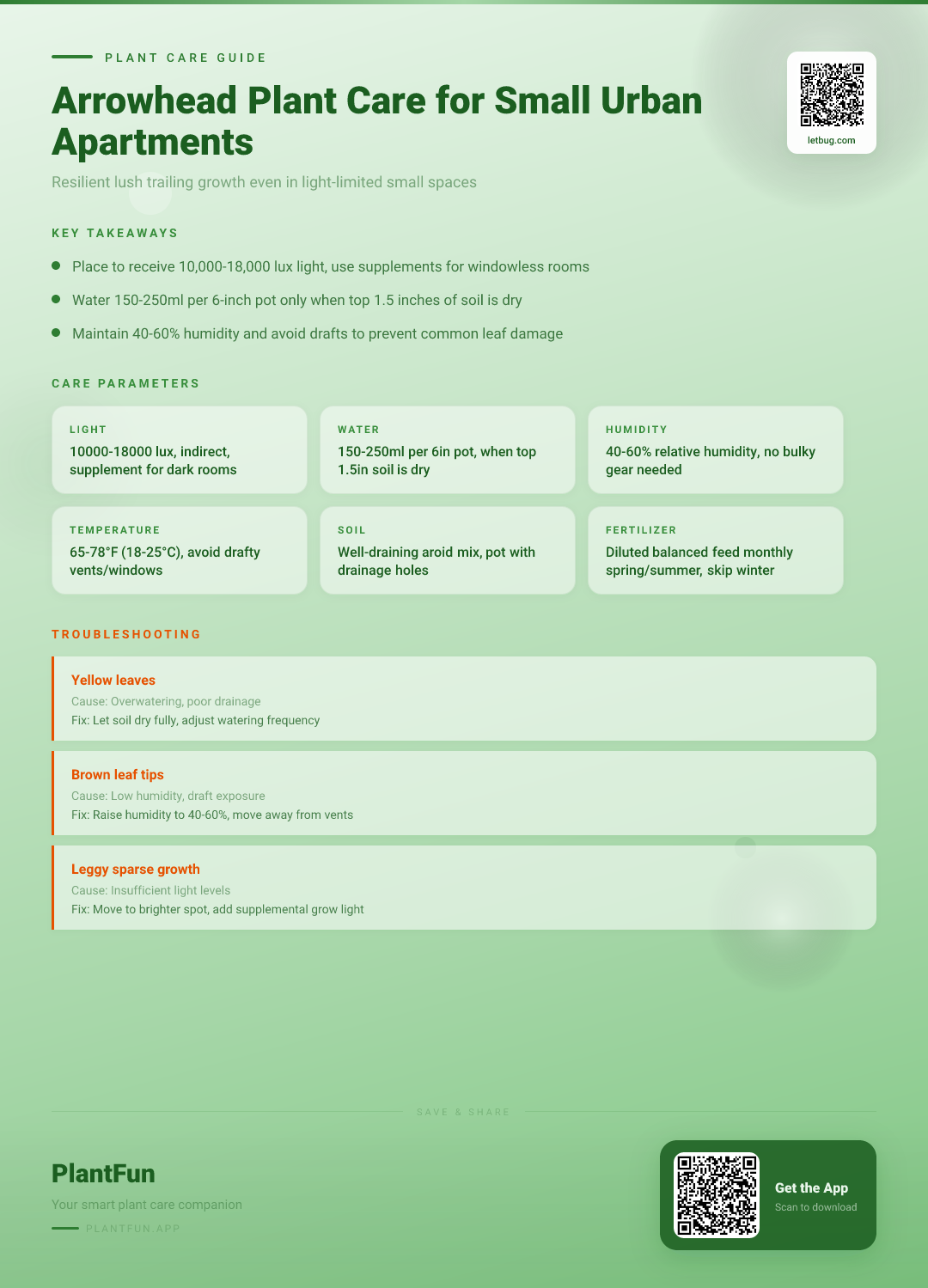
Key Takeaways
- Check soil moisture before watering — overwatering is the #1 killer of houseplants.
- Ensure your plant gets the right amount of light for its species.
- Be patient with recovery — most plants need 2–4 weeks to bounce back.
Quick Care Card
| Parameter | Measurable Threshold for Apartment Growth |
|---|---|
| Light | 10,000-18,000 lux (bright indirect light) |
| Water | 150-250ml per 6-inch pot when top 1.5 inches of soil is dry |
| Humidity | 40-60% relative humidity |
| Temperature | 65-78°F (18-25°C) |
| Soil | 3 parts general potting mix + 1 part perlite + 1 part orchid bark |
| Fertilizer | Half-strength balanced liquid fertilizer, once monthly spring-summer |
| Toxicity | Toxic to cats, dogs, and humans if ingested (ASPCA, 2026) |
Why This Guide Works for Apartments
Generic Arrowhead Plant care advice is designed for ideal greenhouse or free-standing home conditions, but small urban apartments introduce unique stressors that derail even resilient plants: low natural light, forced air heating/cooling, drafty windows, and limited space for bulky care equipment. Arrowhead Plants (Syngonium podophyllum) are tropical Araceae species adapted to rainforest understories (NC State Extension, 2026), so apartment conditions impact them very differently than non-tropical houseplants.
Myth vs Reality:
- Myth: Arrowhead Plants thrive on neglect no matter where you place them.
- Reality: They are forgiving, but cold drafts from AC vents or 8 hours of dim light will cause leaf damage far faster in an apartment than in a spacious home with consistent conditions.
This guide ties every care parameter directly to apartment-specific stressors, so you can troubleshoot issues in seconds without guesswork. Note that according to the ASPCA (2026), this plant is toxic to pets and children if ingested, so keep it out of reach of small household members.
Step 1: Light Placement for Any Apartment Unit
Arrowhead Plant light requirements indoors fall between 10,000 and 18,000 lux (Gautam et al., 2021), a range that avoids leggy growth from too little light and leaf burn from too much direct sun.
Best apartment placement options:
- East-facing window, 2-3 feet away from the glass (gets soft morning sun, no harsh midday rays)
- West-facing window, with a sheer curtain to block intense afternoon sun
- North-facing window, if it receives consistent bright indirect light for 6+ hours a day
Quick test: Hold your hand at the planned placement spot at midday. If you see a faint, soft shadow, the light level is perfect. No shadow means the spot is too dim, a sharp dark shadow means the light is too intense.
For windowless rooms: Use a 10W full-spectrum LED grow light placed 6-12 inches above the plant, run for 12-14 hours a day. See our roundup of affordable grow lights for small apartments for budget-friendly options that fit even tiny spaces.
Step 2: Exact Watering Rules for Apartment Conditions
How often to water Arrowhead Plants depends entirely on your apartment’s heating and cooling setup: use 150-250ml of room temperature water per 6-inch pot only when the top 1.5 inches of soil feels completely dry (NC State Extension, 2026).
Quick test: Stick your index finger 1.5 inches into the soil. If it feels dry to the touch, it’s time to water. If any moisture remains, wait 2-3 days and check again.
Apartment-specific adjustments:
- Summer (AC running): Soil dries 1-2 days faster, check moisture every 5 days for Arrowhead Plant summer watering
- Winter (forced air heating): Soil dries slower, check moisture every 10-14 days
- High-humidity units with no AC: Check moisture every 7-9 days
Overwatering is the #1 cause of death for apartment Arrowhead Plants. If you notice mushy yellow leaves, see our guide to fixing root rot in indoor plants for immediate steps.
Step 3: Humidity & Temperature Tuning for Small Spaces
Arrowhead Plant humidity needs fall between 40-60% relative humidity, with a consistent temperature range of 65-78°F (18-25°C) (Sheeran et al., 2023). Most urban apartments fall between 30-40% RH when heating or AC is running, so small adjustments make a huge difference.
No-fuss apartment humidity hacks (no bulky humidifiers required):
- Group your Arrowhead Plant with 2-3 other tropical plants to create a natural moisture-trapping microclimate
- Place a pebble tray (shallow tray filled with pebbles and water) under the pot, making sure the pot is not sitting directly in standing water
- Mist the leaves 2-3 times a week with room temperature water
Keep your plant at least 3 feet away from drafty windows, AC vents, and heater vents, which can cause sudden 10+ degree temperature swings that damage leaves.
Step 4: Soil & Potting for Low-Maintenance Apartment Care
The best Arrowhead Plant potting mix for apartments is a well-draining blend: 3 parts general purpose potting mix, 1 part perlite, 1 part orchid bark (NC State Extension, 2026). This blend drains fast enough to prevent root rot even if you forget to empty your saucer occasionally.
Apartment potting tips:
- Choose a pot only 1-2 inches larger than the root ball, with at least one drainage hole. Oversized pots hold excess moisture that causes root rot
- Add a 1-inch layer of perlite to the bottom of the pot for extra drainage if you often forget to empty saucers
- Terracotta pots are ideal for apartments, as they wick away excess moisture and reduce overwatering risk for beginners
Seasonal Care Calendar for Apartments
Adjust your care routine for apartment-specific seasonal changes:
- Winter (Dec-Feb): Reduce watering volume by 30%, stop fertilizing completely, add 2 hours of supplemental light per day to make up for shorter days (core of Arrowhead Plant winter care)
- Spring (Mar-May): Resume monthly fertilization, return to standard watering amounts, check for root bound signs and repot if needed
- Summer (Jun-Aug): Move plants 1 foot further from west-facing windows to avoid midday sun burn, check soil moisture every 5 days if AC is running
- Fall (Sep-Nov): Gradually reduce watering frequency, stop fertilizing at the end of October, move plants away from drafty windows as outdoor temperatures drop
- Holiday travel (7-10 day absences): Water thoroughly before leaving, place the pot on a water-filled pebble tray, and move to a slightly shadier spot to reduce water loss
Symptom-to-Action Troubleshooting Cheat Sheet
Yellow Leaves
Symptom: Lower leaves turn pale yellow, sometimes mushy at the base.
Likely cause: Overwatering from a fixed watering schedule, or a pot without drainage holes.
Fix:
- Allow the top 2 inches of soil to dry completely before watering again
- If soil is waterlogged, repot immediately into fresh, dry potting mix
Brown Tips
Symptom: Crispy, dry brown tips on the edges of mature and new leaves.
Likely cause: Low humidity from forced air heating/AC, or salt buildup from overfertilizing.
Fix:
- Mist leaves 2-3 times a week or add a pebble tray to raise humidity by 10-15%
- Flush soil with 3x the pot volume of water once every 3 months to remove salt buildup
Leggy Growth
Symptom: Long, thin stems with widely spaced leaves, no new foliage growth at the base of the plant.
Likely cause: Insufficient light below the 10,000 lux minimum requirement.
Fix:
- Move the plant 1-2 feet closer to a bright window, or add a full-spectrum grow light for 12 hours a day
- Prune leggy stems back to 2-3 inches above the soil line to encourage bushier growth. Follow our pruning guide for tropical indoor plants for step-by-step instructions.
Droopy Leaves
Symptom: Soft, wilted leaves that hang downward, even if the soil feels moist.
Likely cause: Cold drafts from AC vents or open winter windows, or advanced root rot.
Fix:
- Move the plant to a spot with consistent temperature away from drafts
- Check roots for mushy, brown spots, and trim away damaged roots before repotting if root rot is present
Common Apartment Care Mistakes to Avoid
- Mistake: Placing your Arrowhead Plant within 1 foot of drafty AC, heater vents, or open winter windows What happens: Sudden temperature swings of 10°F or more cause leaf drop and brown tips within 2-3 days Instead: Keep plants at least 3 feet away from vents and drafty windows, and use a small thermometer to monitor temperature near the plant if you’re unsure
- Mistake: Overfertilizing in winter when the plant is dormant What happens: Salt buildup in the soil burns root tips, leading to brown tips and stunted growth Instead: Only fertilize once per month in spring and summer with half-strength balanced liquid fertilizer, and stop completely in fall and winter
- Mistake: Ignoring hidden root bound signs, like roots growing out of the drainage hole or water running straight through the pot when you water What happens: The plant can’t absorb water or nutrients, leading to stunted growth and yellow leaves Instead: Repot your plant into a pot 1-2 inches larger than the root ball every 1-2 years, preferably in spring when new growth starts
- Mistake: Watering on a fixed weekly schedule instead of checking soil moisture What happens: Overwatering leads to root rot, the #1 cause of death for apartment-grown Arrowhead Plants Instead: Check the top 1.5 inches of soil every 5-7 days, and only water when it feels completely dry to the touch
- Mistake: Using a pot without drainage holes to avoid mess on apartment surfaces What happens: Excess water gets trapped in the soil, leading to root rot even if you water correctly Instead: Use a pot with drainage holes, and place a waterproof saucer under it to catch excess water, emptying the saucer within 30 minutes of watering if you remember. Follow our mess-free repotting guide for small apartments for tips to keep your surfaces clean.
FAQ (Voice Search Optimized)
Why is my Arrowhead Plant getting brown tips in my apartment?
The most common cause of Arrowhead Plant brown tips in apartments is low humidity from forced air heating or AC, which dries out the delicate leaf edges (Sheeran et al., 2023). Salt buildup from overfertilizing is another frequent cause. Fix it by misting leaves 2-3 times a week or using a pebble tray to raise humidity, and flushing the soil with 3x the pot volume of water every 3 months to remove excess salt.
Can I keep my Arrowhead Plant in a windowless apartment room?
Yes, you can! While Arrowhead Plants prefer bright indirect light, they can grow well in windowless rooms with a full-spectrum LED grow light placed 6-12 inches above the plant, run for 12-14 hours a day (Gautam et al., 2021). Make sure the light provides at least 10,000 lux of intensity to prevent leggy growth.
How often do I need to repot my Arrowhead Plant in a small apartment?
Most apartment-grown Arrowhead Plants need repotting every 1-2 years, or when you see roots growing out of the drainage hole, or water runs straight through the pot when you water (NC State Extension, 2026). Choose a pot only 1-2 inches larger than the current root ball to avoid overwatering from excess soil, a common issue in small apartment spaces.
Understanding the Science
All care recommendations in this guide are backed by peer-reviewed horticultural research:
- A 2021 study by Gautam et al. tested light levels for indoor ornamental plants, finding that 10,000-18,000 lux produces the most compact, lush growth for Syngonium species, avoiding leggy growth while preventing leaf burn.
- A 2023 study by Sheeran et al. found that Araceae species including Arrowhead Plants have significantly better root health and fewer leaf defects when kept in 40-60% relative humidity, matching the parameters we recommend for apartment environments.
References
- NC State Extension. (2026). Arrowhead Plant — NC State Extension Gardener Plant Toolbox. https://plants.ces.ncsu.edu/plants/plant-care/. Accessed 2026-02-28.
- Gautam, B.; Dubey, R.; Kaur, N. (2021). GROWTH RESPONSE OF INDOOR ORNAMENTAL PLANT SPECIES TO VARIOUS ARTIFICIAL LIGHT INTENSITIES (LED) IN AN INDOOR VERTICAL GARDEN. PLANT ARCHIVES. https://doi.org/10.51470/plantarchives.2021.v21.no1.096. Accessed 2026-02-28.
- Sheeran, L.; Rasmussen, A. (2023). Aerial roots elevate indoor plant health: Physiological and morphological responses of three high‐humidity adapted Araceae species to indoor humidity levels. Plant, Cell & Environment. https://doi.org/10.1111/pce.14568. Accessed 2026-02-28.
- ASPCA. (2026). Toxic and Non-Toxic Plants List — ASPCA. https://www.aspca.org/pet-care/animal-poison-control/toxic-and-non-toxic-plants. Accessed 2026-02-28.
Optional Helper: Plantfun.App
Plantfun.App identifies your plants by photo, diagnoses pests and diseases with clear fixes, and creates personalised watering and light schedules that adapt to your home conditions — a handy companion for putting this guide into daily practice.
Found an error or have suggestions? We'd love your feedback.
Need help identifying this problem?
Get instant identification, personalized care schedules, and effective pest treatment plans directly on your phone.
Sponsored • We may earn a commission from app downloads
Related Guides
The Complete Arrowhead Plant Care Checklist for Lush, Resilient Growth in Small Urban Apartments
Keep your Arrowhead Plant thriving in your small urban apartment. Get exact light levels, watering amounts, and a weekly checklist to prevent yellow leaves and grow full, trailing vines.
Care GuideThe Complete Arrowhead Plant Care Guide for Typical Apartments: Grow Resilient Lush Foliage
Stop struggling to keep your arrowhead plant thriving in your apartment. Get exact lux levels, watering amounts, and 7 actionable tips for thick, lush, resilient growth all year.
Care GuideThe Complete Arrowhead Plant Care Checklist for Thriving Growth in Small Urban Apartments
Grow a lush arrowhead plant even in a cramped apartment. Get exact light, water, and humidity thresholds, plus space-saving hacks and a free printable care checklist you can reference fast.
Pest ControlAnts on Plants: What They Mean and What to Do
Ants usually aren't eating your plant. They are farming other pests.