
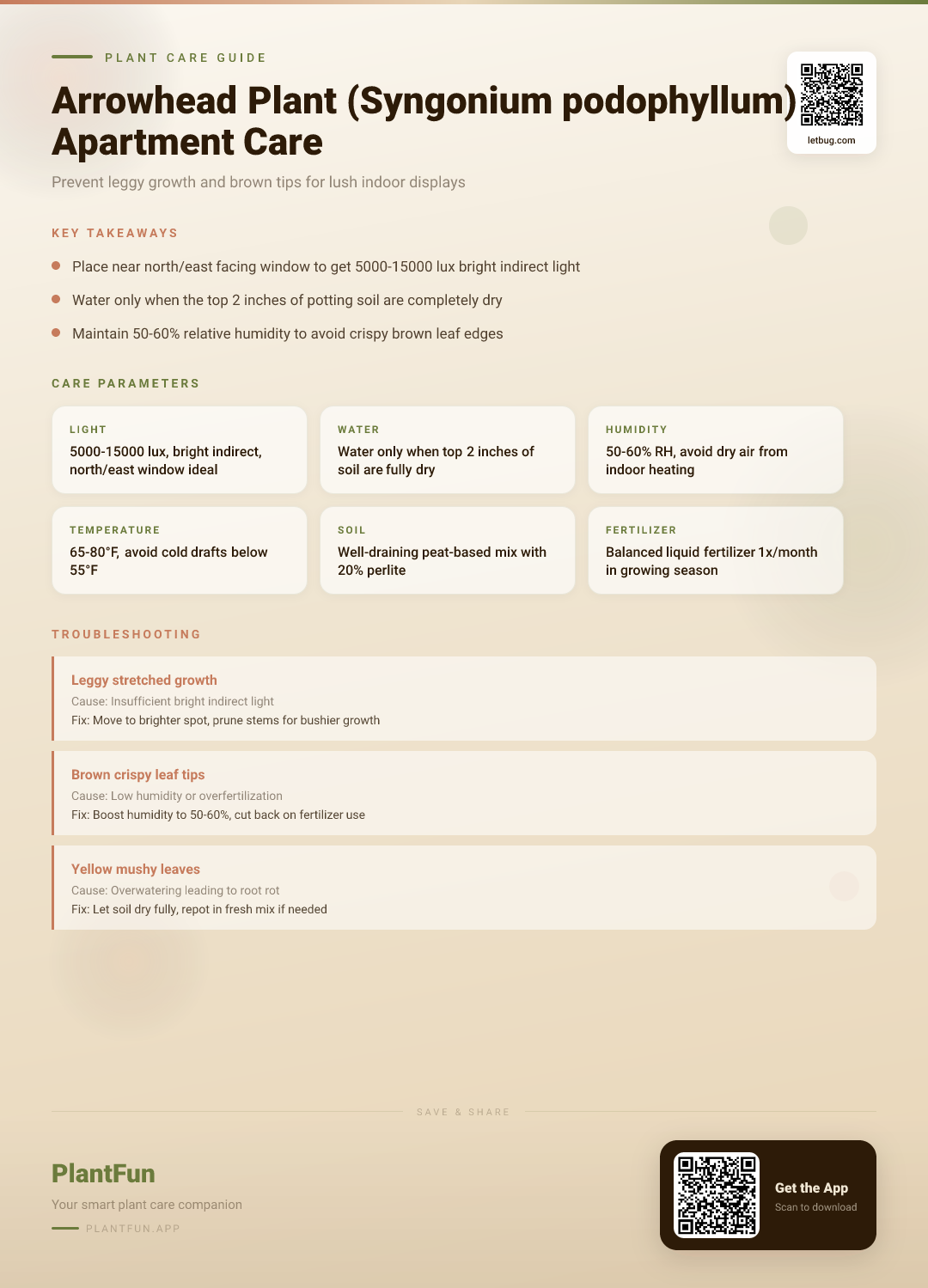
Key Takeaways
- Check soil moisture before watering — overwatering is the #1 killer of houseplants.
- Ensure your plant gets the right amount of light for its species.
- Be patient with recovery — most plants need 2–4 weeks to bounce back.
Quick Care Card: Essential Data
| Feature | Requirement |
|---|---|
| Light | 5,000–15,000 Lux (Bright, indirect) |
| Water | Allow top 2 inches of soil to dry |
| Humidity | 50–60% (Moderate to High) |
| Temperature | 65–80°F (18–27°C) |
| Soil | Well-draining aroid mix |
| Fertilizer | Balanced liquid 20-20-20, monthly in spring/summer |
| Toxicity | Toxic to cats and dogs (ASPCA, 2026) |
TL;DR: The Apartment Reality of Syngonium podophyllum
To keep your Syngonium podophyllum thriving in an apartment, prioritize bright, indirect light and maintain a consistent watering routine where the top 2 inches of soil dry out between waterings. Leggy growth is almost always a sign of insufficient light. Combat brown tips by stabilizing ambient humidity around 50-60%. Keep this plant away from pets as it is toxic (ASPCA, 2026).
My Experience: The “Leggy” Lesson
When I first brought home my Syngonium, I placed it in a dim corner of my living room, assuming its reputation as a “low-light plant” meant it could survive anywhere. Within a month, the stems were stretching six inches between leaves—a classic sign of etiolation. I learned the hard way that while these plants are resilient, they crave consistency. My recovery process involved moving it closer to an east-facing window and pruning the stems back to encourage lateral growth.
Understanding the ‘Leggy’ Phenomenon: Why Apartments Cause Growth Stretches
“Leggy” growth, scientifically known as etiolation, occurs when a plant stretches its internodes (the stem space between leaves) in a desperate search for a higher light threshold. In apartment environments, light is often directional rather than ambient. When the plant cannot access enough solar energy, it prioritizes height over foliage density to reach a perceived light source. Managing this requires a shift in positioning (NC State Extension, 2026).
The Light Thresholds: Managing Indirect Brightness in North or East-Facing Windows
Your Syngonium performs best with 5,000 to 15,000 lux (NC State Extension, 2026). In an apartment, an east-facing window is ideal because it provides gentle morning sun. If you only have north-facing windows, you may need to place the plant directly on the windowsill. If your plant is leaning significantly, it is signaling that the current light intensity is inadequate for its photosynthetic needs (Ravindran & Thomas, 2025).
Precision Watering: Exactly How Many Milliliters Your Pot Needs Based on Size
Avoid the “one cup a week” myth. Instead, use a weight-based or finger-test method. For a 6-inch pot, I typically use 150ml to 200ml of water, but only after checking that the top 2 inches are dry. Smart systems often monitor soil moisture to prevent root hypoxia (Halawa & Aisuwarya, 2023).
- Small (4-inch pot): ~80ml
- Medium (6-inch pot): ~180ml
- Large (8-inch pot): ~350ml
Humidity Hack: Reaching 50% Relative Humidity in Dry Urban Living Spaces
Apartment heating systems, especially in winter, plummet indoor humidity to below 30%, which is the primary cause of crispy, brown leaf tips. To reach the required 50-60% range, I group my Syngoniums with other foliage plants to create a micro-climate or use a pebble tray with water beneath the pot.
Myth-Busting: Do Arrowheads Actually Need Daily Misting?
Daily misting is a common but ineffective practice. It only provides transient humidity for a few minutes and can encourage fungal pathogens on the leaves. Focus instead on ambient humidity or a dedicated humidifier if your living space remains consistently dry.
Seasonal Care Calendar: Adjusting for Winter Heating and Summer Growth
- Spring/Summer: This is the peak growth phase. Fertilize monthly and keep soil consistently moist but never waterlogged.
- Fall/Winter: Growth slows as light levels drop. Reduce watering frequency by 30% and stop fertilization until early spring.
Common Mistakes to Avoid: The #1 Error That Causes Root Rot
- Mistake: Letting the plant sit in a decorative pot without drainage.
- What happens: Water accumulates at the bottom, leading to anaerobic conditions and root decay.
- Instead: Ensure your nursery pot has drainage holes and dump the saucer 15 minutes after watering.
Troubleshooting Guide: Identifying Yellowing Leaves vs. Natural Aging
[Lower Leaf Yellowing]
Symptom: Older leaves turn yellow and mushy at the base.
Likely cause: Overwatering leading to initial root distress.
Fix:
- Stop watering immediately.
- Check for root rot; trim any dark, slimy roots with sterilized shears.
[Crispy Brown Tips]
Symptom: Brown, crunchy margins on the leaf edges.
Likely cause: Low humidity or salt buildup from tap water.
Fix:
- Increase ambient humidity to 50%.
- Use filtered or distilled water to flush out mineral accumulation.
FAQ
Why is my Arrowhead plant leaning toward the window? This is called phototropism. Your plant is physically moving its cells to maximize light capture. Rotate your pot 90 degrees every week to ensure even, symmetrical growth.
Can I keep my Syngonium in a room without windows? No. While they are hardy, they cannot photosynthesize without a light source. Without natural light, they will eventually decline and die unless provided with supplemental full-spectrum LEDs.
How do I prune my plant to make it look bushier? Don’t be afraid to snip! Pruning the growing tips triggers the plant to send out side shoots from the nodes, which creates a fuller, bushier aesthetic over time.
References
- Halawa, H., & Aisuwarya, R. (2023). Smart Plant Pot Robot with IoT Integration for Indoor Ornamental Plants Care. JITCE (Journal of Information Technology and Computer Engineering). https://doi.org/10.25077/jitce.7.2.97-106.2023. Accessed 2026-03-14.
- Ravindran, A., & Thomas, P. (2025). Flora Care: A Smart AI-Based System for Plant Disease Diagnosis and Plant Growth Identification. International Journal of Science and Research (IJSR). https://doi.org/10.21275/mr25425182032. Accessed 2026-03-14.
- ASPCA. (2026). Toxic and Non-Toxic Plants List — ASPCA. https://www.aspca.org/pet-care/animal-poison-control/toxic-and-non-toxic-plants. Accessed 2026-03-14.
- NC State Extension. (2026). Arrowhead Plant Care — NC State Extension Gardener Plant Toolbox. https://plants.ces.ncsu.edu/plants/arrowhead-plant/. Accessed 2026-03-14.
Optional Helper: Plantfun.App
Plantfun.App identifies your plants by photo, diagnoses pests and diseases with clear fixes, and creates personalised watering and light schedules that adapt to your home conditions — a handy companion for putting this guide into daily practice.
Found an error or have suggestions? We'd love your feedback.
Need help identifying this problem?
Get instant identification, personalized care schedules, and effective pest treatment plans directly on your phone.
Sponsored • We may earn a commission from app downloads
Related Guides
The Complete Arrowhead Plant Care Checklist for Resilient Growth in Typical Apartments
Stop guessing at Arrowhead Plant care. Get a tailored checklist, exact light, water, and humidity parameters to grow lush, resilient vines even in typical low-light city apartments.
Care GuideThe Complete Arrowhead Plant Care Checklist for Thriving Growth in Small Urban Apartments
Grow a lush arrowhead plant even in a cramped apartment. Get exact light, water, and humidity thresholds, plus space-saving hacks and a free printable care checklist you can reference fast.
Care GuideArrowhead Plant in a Studio Apartment: The Ultimate Care Guide for Lush Growth
Maximize your small-space jungle with the Syngonium podophyllum. Get exact lux, humidity, and watering metrics to keep your Arrowhead plant compact and vibrant.
Pest ControlAnts on Plants: What They Mean and What to Do
Ants usually aren't eating your plant. They are farming other pests.