
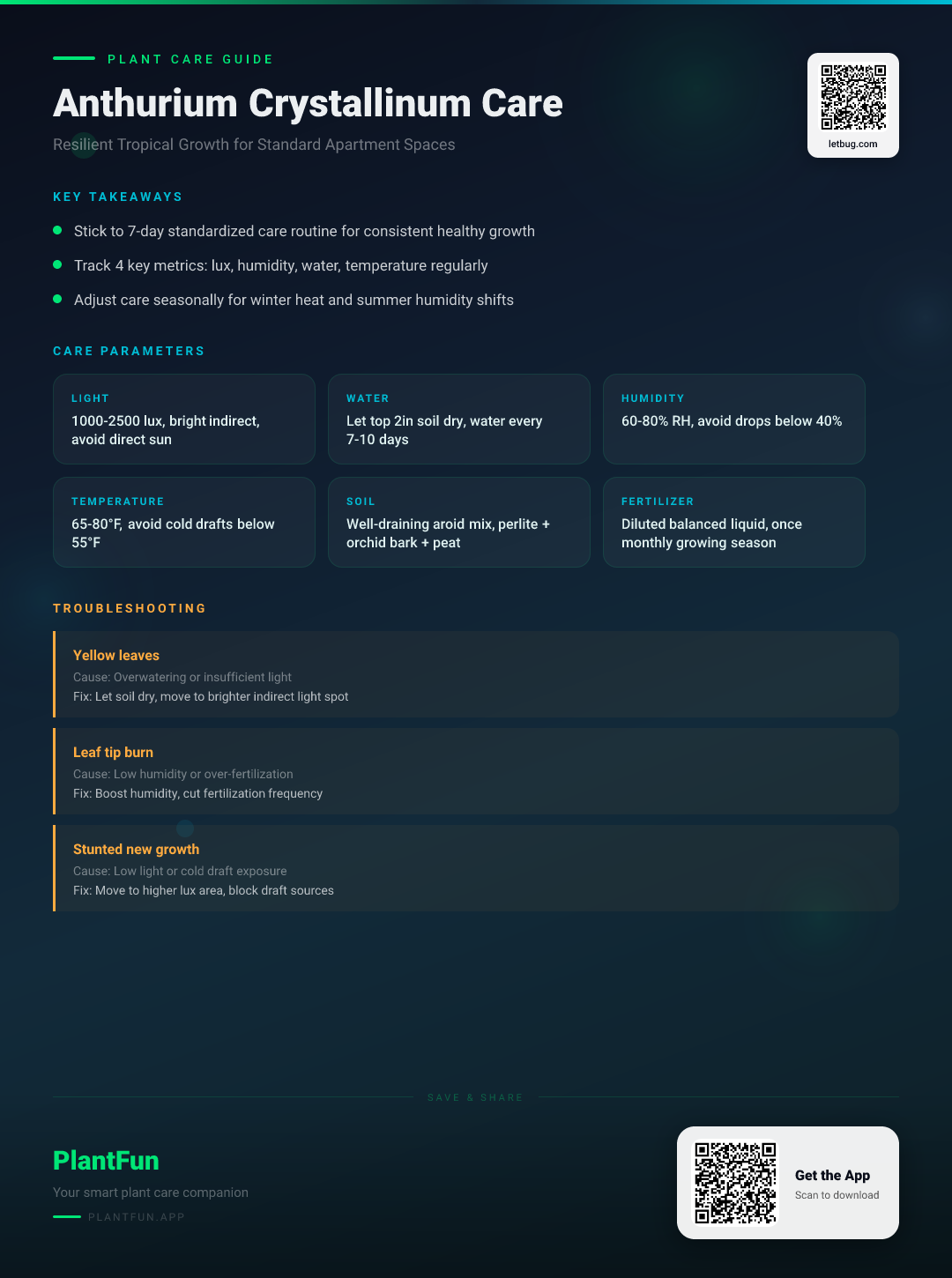
Key Takeaways
- Check soil moisture before watering — overwatering is the #1 killer of houseplants.
- Ensure your plant gets the right amount of light for its species.
- Be patient with recovery — most plants need 2–4 weeks to bounce back.
Quick Care Card: Essential Metrics for Anthurium Crystallinum
| Metric | Requirement |
|---|---|
| Light | 10,000–15,000 lux (Bright, indirect) |
| Humidity | 60%–70% constant |
| Water | Allow top 2 inches to dry; never bone dry |
| Temperature | 68°F–80°F (20°C–27°C) |
| Soil | Aroid mix (bark, perlite, coco coir) |
| Fertilizer | Balanced liquid feed at half-strength monthly |
| Toxicity | Toxic to cats and dogs (ASPCA, 2026) |
TL;DR: The Reality of Keeping Anthurium in Apartments
Growing Anthurium crystallinum in an apartment requires manipulating your microclimate. You cannot rely on ambient room humidity, which usually hovers around 30-40%. Success hinges on maintaining 60%+ humidity, providing bright, filtered light (10,000-15,000 lux), and using a coarse, well-draining substrate. If your space is too dry, this plant will show stress through necrotic, crispy edges.
Why Your Apartment Environment Challenges Your Anthurium
When I first brought home my Anthurium crystallinum, I made the mistake of placing it on a sunny windowsill near a radiator. Within two weeks, the velvet leaves began curling at the tips. The reality is that our climate-controlled homes are designed for human comfort, which is typically too arid for a plant adapted to the high-moisture, dappled light of the jungle floor (NC State Extension, 2026). Apartments fluctuate in temperature due to HVAC cycles, creating a “stop-start” growth pattern that prevents your Anthurium from maturing its iconic, vein-patterned leaves.
Decoding the Habitat: Natural Tropical Conditions vs. Your Living Room
In its native environment, A. crystallinum is an epiphyte or hemiepiphyte, meaning it often grows on or near the forest floor with high organic matter and consistent moisture. In vitro studies confirm that controlled micro-propagation requires specific, stable nutrient and humidity balances to reach maturity (Lê Sơn & Nguyễn, 2025). Your living room lacks this consistency. To mimic its home, you must prioritize air circulation—stagnant air in high-humidity setups can invite pathogens like Xanthomonas (Liu & Zhou, 2015).
The 4 Pillars of Resilient Care (Lux, Humidity, Water, Temp)
- Lux (Light): Avoid direct harsh sun. Aim for 10,000-15,000 lux. If you don’t have a meter, look for a spot where a shadow is soft and fuzzy, not sharp.
- Humidity: This is non-negotiable. Use a dedicated humidifier. Aim for 60-70% to prevent the stomata from closing prematurely.
- Water: Use the “finger test.” If the top 2 inches of the potting mix feel dry, it is time to hydrate.
- Temperature: Keep the plant away from drafty windows or air conditioning vents. Stable warmth is key for root health.
Step-by-Step: Adjusting Your Watering Schedule for Standard Potting Mix
- Prepare: Ensure your pot has drainage holes. Using a chunky, aerated mix is vital to prevent root rot.
- Check: Stick your finger 2 inches into the soil.
- Water: If dry, water until excess liquid exits the bottom. Use room-temperature, filtered water.
- Drain: Let the pot sit for 15 minutes, then discard any water in the saucer. Never leave the roots standing in water.
Troubleshooting Guide: Identifying Leaf Tip Burn vs. Pest Stress
Leaf Tip Burn
Symptom: The very ends of the leaves turn brown and brittle.
Likely cause: Low humidity or salt buildup from fertilizer.
Fix:
- Increase humidity using a humidifier.
- Flush the soil with distilled water to remove excess mineral salts.
Yellowing Leaves
Symptom: Lower, older leaves turning yellow.
Likely cause: Overwatering or nitrogen deficiency.
Fix:
- Check roots for brown, mushy decay.
- If roots are firm, apply a balanced, water-soluble fertilizer at half-strength.
Pests (Spider Mites)
Symptom: Tiny webbing and stippling on the underside of leaves.
Likely cause: Dry, stagnant indoor air.
Fix:
- Wipe leaves with a damp cloth.
- Increase ambient humidity to 65% to deter mite reproduction.
Can I keep my Anthurium crystallinum in a room without a humidifier?
While possible, it is extremely difficult. Without a humidifier, you will likely see stunted growth. If you cannot provide high humidity, consider keeping your Anthurium in a glass cabinet or terrarium to trap moisture.
Why is my Anthurium leaf turning yellow despite frequent misting?
Frequent misting provides only a transient spike in humidity and does not resolve the overall dryness of your apartment air. Constant fluctuation can also lead to fungal issues. A true humidifier is far more effective for long-term health.
How do I know if my apartment light is too weak for new growth?
If your plant is stretching its petioles (the stalks connecting the leaf to the stem) or if the new leaves are significantly smaller than the older ones, your light levels are too low. You may need to supplement with a full-spectrum LED grow light.
Seasonal Care Calendar: Managing Winter Heat and Summer Humidity
- Winter: Apartment heating dries the air rapidly. Increase humidifier output and move the plant away from heat vents. Reduce fertilization to once every 6-8 weeks.
- Summer: High humidity is easier to achieve, but watch for heat waves. Keep the plant in the coolest part of the home and maintain good airflow to avoid bacterial infections (Liu & Zhou, 2015).
Common Mistakes That Kill Apartment Anthuriums
- Mistake: Using dense, garden-variety potting soil. What happens: Roots suffocate and rot. Instead: Use a mix of coco coir, orchid bark, and perlite.
- Mistake: Assuming the plant is pet-safe. What happens: Your cat or dog eats the foliage. Instead: ASPCA (2026) classifies these as toxic; place the plant on a high shelf out of reach.
- Mistake: Ignoring leaf cleaning. What happens: Dust blocks light intake. Instead: Gently wipe leaves with a damp cloth every 14 days.
References
- ASPCA. (2026). Toxic and Non-Toxic Plants List — ASPCA. https://www.aspca.org/pet-care/animal-poison-control/toxic-and-non-toxic-plants. Accessed 2026-03-11.
- Lê Sơn, .; Nguyễn, T. (2025). NGHIÊN CỨU NHÂN GIỐNG IN VITRO CÂY HỒNG MÔN crystallinum (Anthurium crystallinum). TẠP CHÍ KHOA HỌC LÂM NGHIỆP. https://doi.org/10.70169/vjfs.1032. Accessed 2026-03-11.
- Liu, Q.; Zhou, X. (2015). First Report of Bacterial Blight Caused by Xanthomonas axonopodis pv. dieffenbachiae on Anthurium crystallinum in China. Plant Disease. https://doi.org/10.1094/pdis-02-15-0142-pdn. Accessed 2026-03-11.
- NC State Extension. (2026). Anthurium crystallinum — NC State Extension Gardener Plant Toolbox. https://plants.ces.ncsu.edu/plants/anthurium-crystallinum/. Accessed 2026-03-11.
Optional Helper: Plantfun.App
Plantfun.App identifies your plants by photo, diagnoses pests and diseases with clear fixes, and creates personalised watering and light schedules that adapt to your home conditions — a handy companion for putting this guide into daily practice.
Found an error or have suggestions? We'd love your feedback.
Need help identifying this problem?
Get instant identification, personalized care schedules, and effective pest treatment plans directly on your phone.
Sponsored • We may earn a commission from app downloads
Related Guides
Anthurium Crystallinum in Low-Humidity Apartments: The Complete Rescue and Growth Guide
Transform your crispy Anthurium crystallinum into a velvet-leaf beauty. Learn 4 proven humidity hacks, precise watering volumes, and light benchmarks for growth.
Care GuideAnthurium Crystallinum in Low-Humidity Apartments: The Complete Budget-Friendly Growth and Care Guide
Stop killing your Anthurium. Master the exact light, humidity, and soil-mix thresholds to keep those signature velvet leaves lush in any standard home environment.
Care GuideWhy Your Anthurium andraeanum Isn’t Blooming: 7 Fixes That Actually Work For East-Facing Home Offices
Stop wondering why your anthurium won’t bloom. Get 7 evidence-based fixes, exact light/lux levels, and a seasonal care calendar tailored for your east-facing home office Anthurium andraeanum, even with forced winter heating and weekend neglect.
Pest ControlAnts on Plants: What They Mean and What to Do
Ants usually aren't eating your plant. They are farming other pests.