
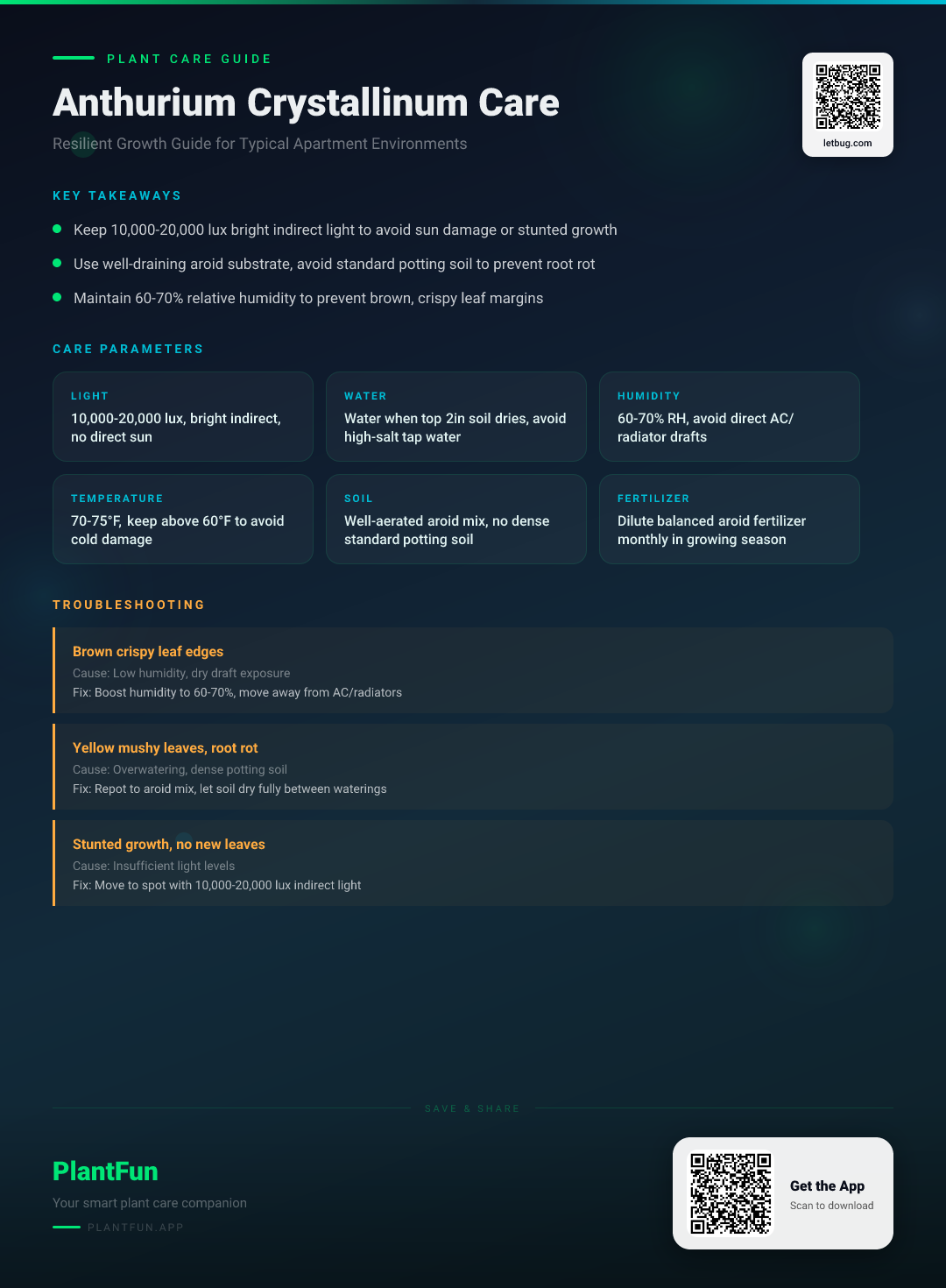
Key Takeaways
- Check soil moisture before watering — overwatering is the #1 killer of houseplants.
- Ensure your plant gets the right amount of light for its species.
- Be patient with recovery — most plants need 2–4 weeks to bounce back.
Quick Care Card
| Feature | Requirement |
|---|---|
| Light | 10,000–20,000 lux (Bright, indirect) |
| Watering | When top 1-2 inches of substrate are dry |
| Humidity | 60–70% relative humidity |
| Temperature | 70–75°F (21–24°C) |
| Soil | Chunky aroid mix (bark, perlite, coco coir) |
| Fertilizer | Balanced liquid feed at half strength monthly |
| Toxicity | Toxic to cats and dogs (ASPCA, 2026) |
TL;DR
Anthurium crystallinum struggles in apartments because typical indoor air is too dry and stagnant. To succeed, stop treating it like a standard houseplant. Mimic its jungle canopy origin by maintaining 60–70% humidity and providing high, diffused light (10,000–20,000 lux). Avoid standard potting soil, which suffocates roots, and prioritize a chunky, well-aerated substrate. If you keep your plant out of direct drafts and monitor moisture levels carefully, you will achieve the velvety, silver-veined leaves this species is prized for.
Understanding Your Environment
When I first brought home my Anthurium crystallinum, I made the mistake of placing it on a windowsill in my living room, assuming standard houseplant care would suffice. Within two weeks, the leaf margins began to turn brown and crispy. I soon realized that my apartment’s HVAC system was stripping the air of moisture, creating a desert-like environment for a plant that naturally thrives in the humid, still air of Central and South American understories (NC State Extension, 2026).
Step 1: Mastering Light (10,000–20,000 lux)
Anthurium crystallinum needs bright, indirect light. If you place it in a dark corner, growth will stall. Conversely, direct sun will scorch the delicate, velvety foliage. I aim for approximately 15,000 lux. If you lack a light meter, ensure the plant is in a spot where it can “see” the sky but never the sun directly. If your leaves are stretching (petioles becoming long and weak), it is crying out for more light.
Step 2: The Perfect Irrigation Schedule
I never use a rigid calendar for watering. Instead, I perform a tactile check: insert your finger two inches into the substrate. If it feels slightly moist, leave it alone. When the top two inches are dry to the touch, water thoroughly. I prefer top-down watering with filtered water to prevent salt buildup, ensuring excess water drains freely. Avoid letting the plant sit in standing water, as this invites root rot.
Step 3: Humidity Hacks
To achieve the “velvet glow” without a pricey greenhouse cabinet, I use a simple humidity tray filled with pebbles and water beneath the pot. More importantly, keeping the plant clustered with other foliage-heavy species helps create a localized micro-climate. Avoid placing your plant directly in the path of air vents, which dehydrate leaf tissue rapidly.
Step 4: Choosing the Right Substrate
Standard potting soil is a death sentence for Anthurium crystallinum. Its roots require immense airflow to prevent infection (Liu & Zhou, 2015). I create a mix consisting of 40% orchid bark, 40% perlite, and 20% high-quality peat or coco coir. This ensures the substrate is “chunky” and fast-draining, mimicking the epiphytic-adjacent conditions of their natural habitat (Lê Sơn & Nguyễn, 2025).
Seasonal Care Calendar
- Summer: High temperatures increase evaporation. Check soil moisture twice weekly and ensure the humidity doesn’t drop below 60%.
- Winter: If using radiators, move the plant away from the heat source. Growth naturally slows, so reduce fertilizer to once every six weeks.
Frequently Asked Questions
- Can I keep my Anthurium crystallinum in my bedroom? Yes, provided the room has a window with bright, indirect light and the temperature remains consistently above 65°F.
- How do I know if my Anthurium is getting enough light? If the plant is growing new leaves that are a similar size to the previous ones and the stems are upright rather than leaning toward the window, your light levels are likely ideal.
- Is it safe for my pets? No. According to the ASPCA (2026), this plant contains insoluble calcium oxalates and is toxic to cats and dogs.
Troubleshooting Guide
Brown, Crispy Leaf Edges
Symptom: Dry, brown, papery margins on older or newer leaves.
Likely cause: Low humidity or inconsistent watering.
Fix:
- Increase ambient humidity using a pebble tray or humidifier.
- Stick to a consistent watering schedule using the two-inch finger test.
Yellowing Leaves
Symptom: General yellowing, often starting from the bottom of the plant.
Likely cause: Over-watering or root suffocation in dense soil.
Fix:
- Repot into a chunkier, better-aerating aroid mix.
- Ensure the pot has large drainage holes.
Common Mistakes to Avoid
- Mistake: Using a pot that is too large.
- What happens: Excess soil holds too much water, leading to root rot.
- Instead: Choose a pot only 1–2 inches wider than the root ball.
- Mistake: Using tap water with high mineral content.
- What happens: Salt accumulation at the root zone can burn sensitive tips.
- Instead: Use rainwater or filtered water whenever possible.
References
- Lê Sơn, .; Nguyễn, T. (2025). NGHIÊN CỨU NHÂN GIỐNG IN VITRO CÂY HỒNG MÔN crystallinum (Anthurium crystallinum). TẠP CHÍ KHOA HỌC LÂM NGHIỆP. https://doi.org/10.70169/vjfs.1032. Accessed 2026-03-17.
- Liu, Q.; Zhou, X. (2015). First Report of Bacterial Blight Caused by Xanthomonas axonopodis pv. dieffenbachiae on Anthurium crystallinum in China. Plant Disease. https://doi.org/10.1094/pdis-02-15-0142-pdn. Accessed 2026-03-17.
- ASPCA. (2026). Toxic and Non-Toxic Plants List — ASPCA. https://www.aspca.org/pet-care/animal-poison-control/toxic-and-non-toxic-plants. Accessed 2026-03-17.
- NC State Extension. (2026). Anthurium crystallinum — NC State Extension Gardener Plant Toolbox. https://plants.ces.ncsu.edu/plants/anthurium-crystallinum/. Accessed 2026-03-17.
Optional Helper: Plantfun.App
Plantfun.App identifies your plants by photo, diagnoses pests and diseases with clear fixes, and creates personalised watering and light schedules that adapt to your home conditions — a handy companion for putting this guide into daily practice.
Found an error or have suggestions? We'd love your feedback.
Need help identifying this problem?
Get instant identification, personalized care schedules, and effective pest treatment plans directly on your phone.
Sponsored • We may earn a commission from app downloads
Related Guides
Anthurium Crystallinum Care in Small Apartments: The Complete Guide to Resilient Growth
Master Anthurium Crystallinum care in your apartment. Follow these 4 essential thresholds and seasonal steps for velvety, damage-free foliage in small spaces.
Care GuideWhy Your Anthurium andraeanum Isn’t Blooming: 7 Fixes That Actually Work For East-Facing Home Offices
Stop wondering why your anthurium won’t bloom. Get 7 evidence-based fixes, exact light/lux levels, and a seasonal care calendar tailored for your east-facing home office Anthurium andraeanum, even with forced winter heating and weekend neglect.
Care GuideWhy Your Anthurium Isn’t Blooming in a Low-Lit Home Office: 7 Fixes That Actually Work
Stop wondering why your office anthurium never blooms. Get exact lux levels, 50ml watering amounts, humidity targets, and 7 science-backed fixes to produce bright, long-lasting spathes all year.
Pest ControlAnts on Plants: What They Mean and What to Do
Ants usually aren't eating your plant. They are farming other pests.