
Key Takeaways
- Check soil moisture before watering — overwatering is the #1 killer of houseplants.
- Ensure your plant gets the right amount of light for its species.
- Be patient with recovery — most plants need 2–4 weeks to bounce back.
Anthurium Crystallinum in Low-Humidity Apartments: The Ultimate 4-Step Resilience Guide for Lush Leaves
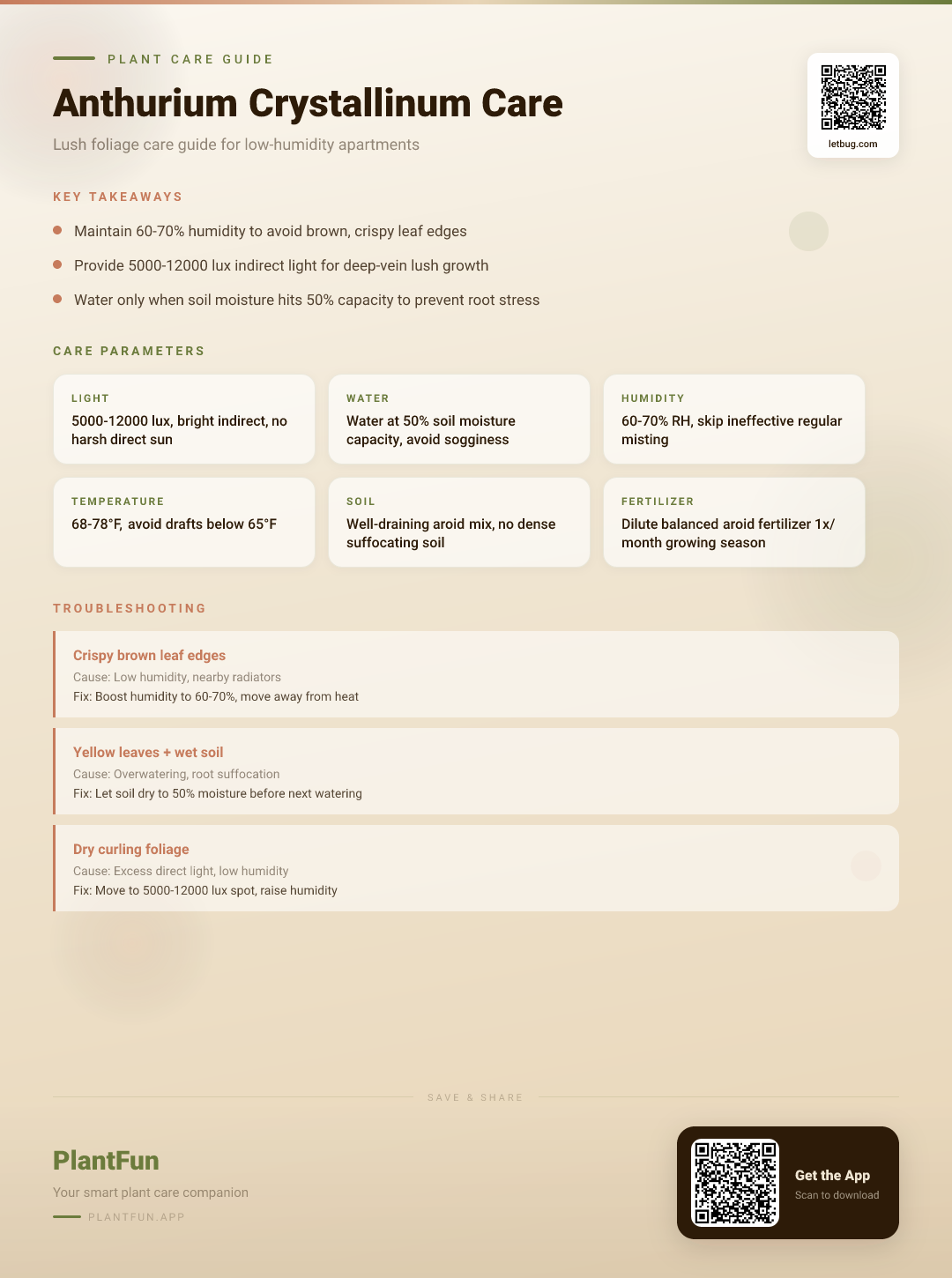
TL;DR: Your Anthurium crystallinum isn’t dying because it lacks a greenhouse; it’s likely suffering from erratic watering and low light. To thrive in an apartment, maintain 60-70% humidity, provide 5,000–12,000 lux of indirect light, and use an airy, chunky aroid soil mix. Stop misting—it doesn’t raise ambient humidity—and focus on localized moisture control instead.
Quick Care Card: Essential Thresholds for Anthurium Crystallinum
| Feature | Optimal Threshold |
|---|---|
| Light | 5,000 – 12,000 lux (Bright indirect) |
| Watering | When soil is 50% dry by volume |
| Humidity | 60% – 70% |
| Temperature | 68°F – 78°F |
| Soil | Chunky, high-drainage aroid mix |
| Fertilizer | Diluted balanced liquid (monthly) |
| Toxicity | Toxic to cats and dogs (ASPCA, 2026) |
Why Your Apartment Environment Challenges Your Anthurium
When I first brought home my Anthurium crystallinum, I made the mistake of placing it directly in front of a drafty window. Its beautiful, silver-veined leaves curled within days. Unlike native tropical environments where humidity is constant, apartments feature HVAC systems that strip moisture from the air. According to the NC State Extension (2026), these plants originate from the understory of tropical forests, meaning they prefer stable, high-humidity environments that standard living rooms rarely provide naturally.
Format B: The Rescue Plan - Assessing Leaf Stress
To save a struggling Anthurium, you must perform a ‘Leaf Audit’:
- Check for yellowing: If leaves are yellow but the soil is wet, you are likely looking at root rot (NC State Extension, 2026).
- Examine the edges: Brown, crispy edges signify low ambient humidity or underwatering.
- Assess pet safety: Ensure your plant is placed out of reach, as the ASPCA (2026) classifies all Anthurium species as toxic to household pets.
Root Cause Analysis: Why Humidity Matters More Than Water
Many growers overwater in a desperate attempt to compensate for dry air. This leads to the buildup of pathogens like Xanthomonas (Liu & Zhou, 2015). High humidity reduces the transpiration rate of the leaf, allowing the plant to maintain turgor pressure. If the air is too dry, the plant loses moisture faster than the roots can uptake it, resulting in unsightly leaf damage.
Measurable Care Thresholds
- Humidity (60-70%): Use a digital hygrometer. If your apartment dips below 50%, a localized humidifier is necessary.
- Light (5,000-12,000 lux): Use a light meter app to ensure the plant isn’t sitting in deep shade, which stunts growth, or harsh sun, which burns velvet foliage.
- Watering (50% capacity): Use the finger test—if the top 2 inches feel dry, it is time to hydrate.
- Temperature (68-78°F): Keep away from radiator vents and AC units, as extreme fluctuations cause cellular stress.
Immediate Rescue Steps for Dry, Curling Foliage
- Stabilize: Move the plant to a spot with consistent temperatures (68–78°F).
- Hydrate: Flush the pot with filtered water until it drains freely, ensuring no salt buildup from tap water.
- Isolate: Place the plant on a pebble tray (filled with water but not touching the pot base) to create a microclimate.
- Prune: Trim only the severely crispy sections using sterilized shears to prevent bacterial entry (Liu & Zhou, 2015).
FAQ
How do I fix crispy leaf edges on my Anthurium without a greenhouse?
You don’t need a greenhouse. Use a small humidifier within 3 feet of the plant to maintain local humidity at 60%+, which prevents further desiccation of the leaf margins.
Can I keep my Anthurium in a bedroom with standard radiator heating?
It is difficult. Radiators create hot, dry air that desiccates Anthurium foliage quickly. If you must, keep the plant as far from the radiator as possible and use a well-draining soil mix to prevent roots from cooking.
Why is my Anthurium yellowing even though the soil feels wet?
This is a classic sign of root suffocation. Even if the soil feels damp, it may lack the oxygenation required for healthy root function, potentially leading to bacterial blight (Liu & Zhou, 2015).
The 12-Month Resilience Calendar: Adjusting for Apartment Seasonality
- Spring/Summer: Increase light exposure and begin a bi-weekly dilute fertilization schedule.
- Fall/Winter: Reduce water frequency as growth slows. Avoid placing the plant near heat sources. Supplement light if natural day length drops significantly.
Common Mistakes: Avoid the ‘Misting Myth’ and Root-Suffocating Soils
- Mistake: Misting leaves to increase humidity.
- What happens: Water evaporates in minutes, leaving potential for fungal spots.
- Instead: Use a humidifier or group plants together to create a humid microclimate.
- Mistake: Using standard potting soil.
- What happens: Roots suffocate and rot due to lack of aeration.
- Instead: Use a chunky aroid mix containing bark, perlite, and coco coir.
Long-Term Prevention: The Benefits of Semi-Hydroponic Transition
For many, transitioning to semi-hydroponics (using leca or pon) simplifies Anthurium crystallinum care by providing consistent moisture and oxygen access to the root zone, effectively mitigating the common issue of soil-based root rot (Lê Sơn & Nguyễn, 2025).
Expert Troubleshooting: When to Prune vs. When to Leave Be
Brown Leaf Edges
Symptom: Dry, papery edges on foliage.
Likely cause: Low ambient humidity or root stress.
Fix:
- Increase humidity with a humidifier.
- Monitor soil moisture levels to ensure the substrate isn’t staying waterlogged.
Yellowing Leaves
Symptom: General yellowing of older leaves.
Likely cause: Overwatering or poor drainage.
Fix:
- Repot into a high-aeration aroid-specific soil mix.
- Check for signs of root rot; trim affected roots with sterilized equipment.
References
- Lê Sơn, .; Nguyễn, T. (2025). NGHIÊN CỨU NHÂN GIỐNG IN VITRO CÂY HỒNG MÔN crystallinum (Anthurium crystallinum). TẠP CHÍ KHOA HỌC LÂM NGHIỆP. https://doi.org/10.70169/vjfs.1032. Accessed 2026-03-14.
- Liu, Q.; Zhou, X. (2015). First Report of Bacterial Blight Caused by Xanthomonas axonopodis pv. dieffenbachiae on Anthurium crystallinum in China. Plant Disease. https://doi.org/10.1094/pdis-02-15-0142-pdn. Accessed 2026-03-14.
- ASPCA. (2026). Toxic and Non-Toxic Plants List — ASPCA. https://www.aspca.org/pet-care/animal-poison-control/toxic-and-non-toxic-plants. Accessed 2026-03-14.
- NC State Extension. (2026). Anthurium Crystallinum — NC State Extension Gardener Plant Toolbox. https://plants.ces.ncsu.edu/plants/crystallinum-care/. Accessed 2026-03-14.
Optional Helper: Plantfun.App
Plantfun.App identifies your plants by photo, diagnoses pests and diseases with clear fixes, and creates personalised watering and light schedules that adapt to your home conditions — a handy companion for putting this guide into daily practice.
Found an error or have suggestions? We'd love your feedback.
Need help identifying this problem?
Get instant identification, personalized care schedules, and effective pest treatment plans directly on your phone.
Sponsored • We may earn a commission from app downloads
Related Guides
Anthurium Crystallinum in Small Apartments: The Complete Care Guide for Resilient Growth
Transform your small apartment into a thriving jungle with this Anthurium crystallinum guide. Learn the exact light, humidity, and water metrics for success.
Care GuideThe Complete Anthurium Andraeanum Care Checklist for East-Facing Apartments: Grow Resilient Blooms Year-Round
Stop struggling to get your Anthurium to bloom in your apartment. Grab this 12-point care checklist with exact light, water, humidity parameters for year-round resilient growth and bright blooms.
Care GuideAnthurium Crystallinum in Low-Humidity Apartments: The Complete Budget-Friendly Growth and Care Guide
Stop killing your Anthurium. Master the exact light, humidity, and soil-mix thresholds to keep those signature velvet leaves lush in any standard home environment.
Pest ControlAnts on Plants: What They Mean and What to Do
Ants usually aren't eating your plant. They are farming other pests.