
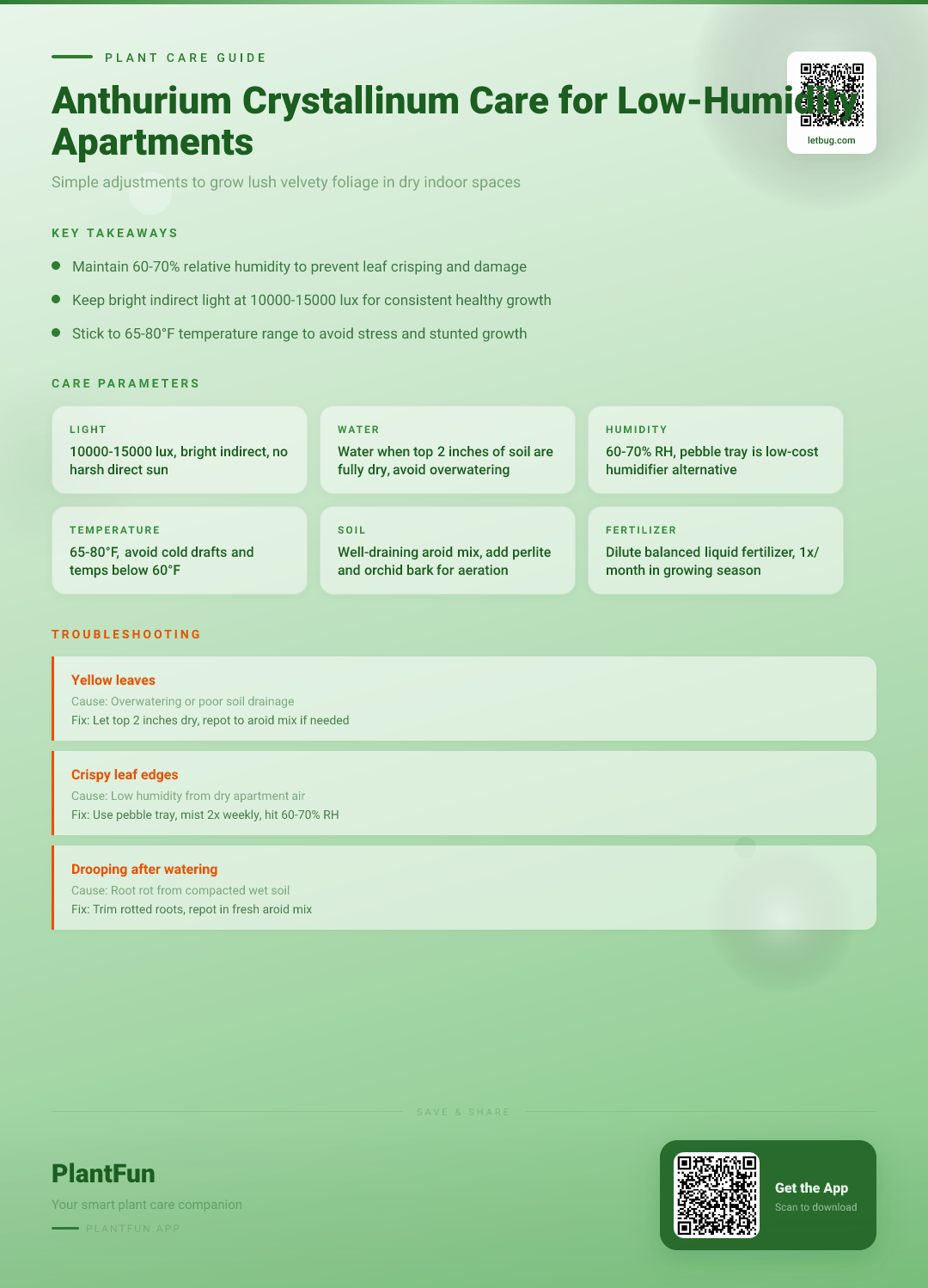
Key Takeaways
- Check soil moisture before watering — overwatering is the #1 killer of houseplants.
- Ensure your plant gets the right amount of light for its species.
- Be patient with recovery — most plants need 2–4 weeks to bounce back.
TL;DR: The Essentials
To keep Anthurium crystallinum thriving in an apartment, maintain 60–70% relative humidity, provide 10,000–15,000 lux of bright indirect light, and use an airy, well-draining aroid substrate. Avoid dense soil, which causes root rot, and keep temperatures between 65–80°F. If leaves crisp at the edges, your humidity is likely falling below 50%.
Quick Care Card: Essential Data Points for Success
| Category | Requirement |
|---|---|
| Light | 10,000–15,000 Lux (Bright Indirect) |
| Watering | When top 2 inches of substrate are dry |
| Humidity | 60–70% Relative Humidity |
| Temperature | 65–80°F (18–27°C) |
| Soil | Chunky Aroid Mix (Bark, Perlite, Coco Coir) |
| Fertilizer | Balanced liquid feed at half-strength monthly |
| Toxicity | Toxic to cats and dogs (ASPCA, 2026) |
My Experience: The “Crispy Leaf” Lesson
When I first brought home my Anthurium crystallinum, I placed it on a bookshelf near a drafty window. Within weeks, the beautiful, velvety foliage started developing unsightly brown, crispy margins. I realized my living room’s humidity was hovering around 35%. I had to pivot my entire care strategy, moving away from standard potting soil—which stayed too wet and suffocated the roots—and adopting a micro-climate approach. This shift stopped the decline and sparked new, healthy growth.
Why Anthurium Crystallinum Struggles in Typical Apartment Air
Native to tropical rainforests, Anthurium crystallinum thrives in high-moisture environments. Modern apartments typically feature HVAC systems that strip moisture from the air. This causes excessive transpiration—the process where plants lose water through their leaves—faster than the roots can replenish it, leading to the hallmark brown, crispy edges (NC State Extension, 2026).
Understanding Your Environment: Measuring Lux and Humidity
To succeed, you must move beyond guessing. Download a light meter app to measure the lux (a unit of illuminance) reaching your plant. Aim for 10,000–15,000 lux. Simultaneously, use a digital hygrometer to monitor humidity. If your levels remain below 50% for extended periods, you will likely see physical damage to the leaf tissue.
The Substrate Science: Why Standard Potting Soil Fails Your Anthurium
Standard peat-based potting soil is too dense, retaining moisture for too long and preventing the oxygen exchange necessary for healthy aroid roots. A proper mix should mimic the forest floor: coarse, chunky, and fast-draining. I recommend a mix of 40% orchid bark, 30% perlite, and 30% premium coco coir to ensure proper aeration.
Step 1: Achieving 60-70% Relative Humidity Without a Greenhouse
- Group plants: Placing plants together creates a localized micro-climate where transpiration moisture is trapped between leaves.
- Use pebble trays: Fill a tray with pebbles and water, ensuring the pot sits above the waterline, not in it.
- Humidity cabinet: For the best results, consider a glass cabinet or enclosed shelf to stabilize ambient humidity.
Step 2: Mastering the 10,000–15,000 Lux Threshold
Anthurium crystallinum needs bright, indirect light to produce its iconic iridescent veins. If light is too low, the plant will become leggy; if too high, leaves will bleach. Use sheer curtains to diffuse direct sunlight, ensuring the light level stays within the 10,000–15,000 lux range throughout the day.
Step 3: Precision Watering: How Many Milliliters to Apply and When
Never follow a calendar. Use the “two-inch test”: stick your finger into the substrate. If it feels dry, apply enough water until it drains freely from the bottom. For a 6-inch pot, this is typically 200–300ml. Ensure your indoor plant drainage is unobstructed to prevent root rot.
Step 4: Temperature Control: The 65-80°F Rule for Continuous Growth
This species is sensitive to rapid fluctuations. Keep your plant away from AC vents and radiators. Maintaining a steady 65–80°F is critical for steady, consistent growth (NC State Extension, 2026). In colder months, monitor nearby windows, as glass temperatures can drop significantly below room ambient temperature.
Troubleshooting Guide: Why are my Anthurium leaves yellowing or crisping?
Crispy Leaf Edges
Symptom: Dry, brown, brittle edges on the foliage.
Likely cause: Low humidity environment causing excessive transpiration.
Fix:
- Increase local humidity using a humidifier or pebble tray.
- Move the plant away from direct drafts or HVAC vents.
Yellowing Leaves
Symptom: General yellowing or yellow spotting on older leaves.
Likely cause: Overwatering or poor drainage leading to root stress.
Fix:
- Check roots for brown/mushy signs of decay.
- Repot into a chunkier, better-draining aroid potting mix.
FAQ: Why is my Anthurium crystallinum drooping even after I water it?
Drooping often indicates root damage. If the roots are compromised by root rot (Lê Sơn & Nguyễn, 2025), they cannot intake water, regardless of how much is in the soil. Inspect the roots and refresh the substrate if they appear dark or smell sour.
FAQ: How do I increase humidity for my Anthurium without buying an expensive humidifier?
Can I put my plant in the bathroom? Yes. Bathrooms offer naturally higher humidity from showers. If you lack natural light there, you can supplement with a full-spectrum LED grow light.
Seasonal Maintenance: Adapting Care from Summer to Winter
In winter, growth slows due to lower light and cooler temps. Reduce watering frequency and stop fertilizing entirely between November and February to prevent salt buildup, which can also contribute to leaf tip burn.
References: Botanical Sources and Indoor Cultivation Standards
- ASPCA. (2026). Toxic and Non-Toxic Plants List — ASPCA. https://www.aspca.org/pet-care/animal-poison-control/toxic-and-non-toxic-plants. Accessed 2026-03-13.
- Lê Sơn, .; Nguyễn, T. (2025). NGHIÊN CỨU NHÂN GIỐNG IN VITRO CÂY HỒNG MÔN crystallinum (Anthurium crystallinum). TẠP CHÍ KHOA HỌC LÂM NGHIỆP. https://doi.org/10.70169/vjfs.1032. Accessed 2026-03-13.
- Liu, Q.; Zhou, X. (2015). First Report of Bacterial Blight Caused by Xanthomonas axonopodis pv. dieffenbachiae on Anthurium crystallinum in China. Plant Disease. https://doi.org/10.1094/pdis-02-15-0142-pdn. Accessed 2026-03-13.
- NC State Extension. (2026). Anthurium Crystallinum — NC State Extension Gardener Plant Toolbox. https://plants.ces.ncsu.edu/plants/anthurium-crystallinum/. Accessed 2026-03-13.
Optional Helper: Plantfun.App
Plantfun.App identifies your plants by photo, diagnoses pests and diseases with clear fixes, and creates personalised watering and light schedules that adapt to your home conditions — a handy companion for putting this guide into daily practice.
Found an error or have suggestions? We'd love your feedback.
Need help identifying this problem?
Get instant identification, personalized care schedules, and effective pest treatment plans directly on your phone.
Sponsored • We may earn a commission from app downloads
Related Guides
Anthurium crystallinum in a Typical Apartment: The Essential Guide to Resilient Indoor Growth
Transform your living space into a thriving tropical haven. Master Anthurium crystallinum care with 4 exact environmental thresholds and our foolproof, 7-day routine.
Care GuideAnthurium Crystallinum in Low-Humidity Apartments: The Complete Rescue and Growth Guide
Transform your crispy Anthurium crystallinum into a velvet-leaf beauty. Learn 4 proven humidity hacks, precise watering volumes, and light benchmarks for growth.
Care GuideAnthurium Crystallinum in Low-Humidity Apartments: The Complete Care Guide for Resilient Foliage Growth
Stop watching your Anthurium leaves turn brown. Master the exact humidity levels, light intensity, and watering schedules needed for lush, velvet growth at home.
Pest ControlAnts on Plants: What They Mean and What to Do
Ants usually aren't eating your plant. They are farming other pests.