
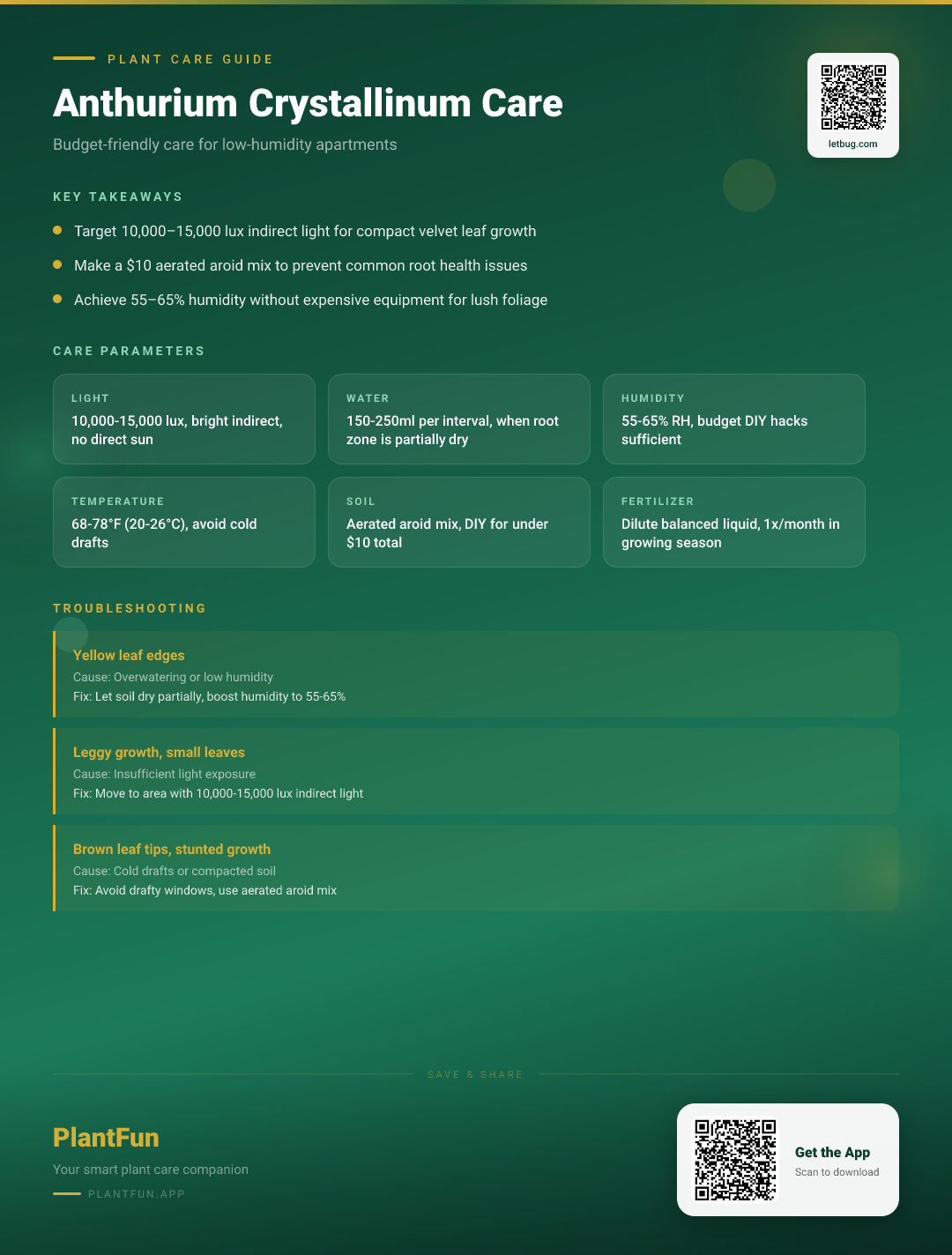
Key Takeaways
- Check soil moisture before watering — overwatering is the #1 killer of houseplants.
- Ensure your plant gets the right amount of light for its species.
- Be patient with recovery — most plants need 2–4 weeks to bounce back.
Quick Care Card: Essential Data Points
| Feature | Requirement |
|---|---|
| Light | 10,000–15,000 Lux (Bright, indirect) |
| Water | 150ml–250ml when top 2 inches dry |
| Humidity | 55–65% Relative Humidity |
| Temperature | 68–78°F (20–26°C) |
| Soil | Chunky Aroid Mix (high aeration) |
| Fertilizer | Balanced liquid feed (diluted) monthly |
| Toxicity | Toxic to pets/humans (ASPCA, 2026) |
TL;DR: Why Your Anthurium Needs a Budget-Conscious Approach
Many growers assume Anthurium crystallinum requires a high-tech greenhouse to survive. In reality, this aroid thrives on consistency rather than expensive equipment. By maintaining a stable, chunky soil medium and providing moderate, filtered light, you can prevent root rot and leaf dehydration even in dry apartments. Successful growth relies on mimicking its natural epiphyte environment—where roots need air as much as water—without needing to break the bank on climate control.
Understanding the Anthurium Crystallinum: Natural Habitat vs. Apartment Reality
When I first got my Anthurium crystallinum, I made the mistake of placing it directly on a sunny windowsill, which scorched the beautiful, silver-veined leaves. In its native tropical habitat, this plant grows as an epiphyte or terrestrial plant on the forest floor, shielded by the canopy (NC State Extension, 2026). Our apartments are significantly drier than the rainforest, which is why we must focus on creating a microclimate that prevents leaf-edge browning.
Lighting Strategies: Targeting 10,000–15,000 Lux for Compact Growth
Anthurium photosynthesis is maximized in bright, indirect light. I use a simple light meter app to ensure my plants receive between 10,000 and 15,000 lux. Direct sun will cause permanent damage, while too little light will lead to thin, floppy stems. Place your plant near a north or east-facing window where the morning sun is soft and diffused.
The Watering Science: 150ml–250ml intervals based on root-zone saturation
To master how often to water Anthurium, stop using a schedule. Instead, perform the finger test: if the top 2 inches of your soil feel dry, it is time to irrigate. I typically use 150ml to 250ml of water, poured slowly to ensure even saturation. Never let the plant sit in standing water, as this invites pathogens (Liu & Zhou, 2015).
Budget Humidity Hacks: Achieving 55–65% Relative Humidity Without Expensive Equipment
Expensive humidifiers aren’t always necessary for Anthurium crystallinum care. You can boost local humidity by:
- Grouping plants: Creating a cluster allows plants to share moisture released through transpiration.
- Pebble trays: A shallow tray filled with stones and water creates a small humid zone as it evaporates.
- Terrarium domes: For smaller specimens, a clear glass cloche acts as a perfect, low-cost moisture trap.
Soil Science: Creating an Aerated Aroid Mix for Less Than $10
Stop using standard potting soil. To mimic the forest floor, I mix:
- 1 part orchid bark (for aeration)
- 1 part perlite (for drainage)
- 1 part coco coir (for moisture retention) This mix prevents root suffocation and promotes the healthy root-zone environment described in recent propagation research (Lê Sơn & Nguyễn, 2025).
Temperature Control: Keeping Your Anthurium Within 68–78°F (20–26°C)
This plant is sensitive to thermal fluctuations. Keep it away from AC vents or radiators. If your room sits within the 68–78°F range, your plant will maintain a steady metabolic rate.
Can I keep my Anthurium in a room with a drafty window?
No. Drafts cause rapid transpiration, leading to crisp, brown leaf margins. If you must use that space, install a heavy sheer curtain to diffuse both light and air movement.
Why is my Anthurium leaf turning yellow at the edges?
This is usually a symptom of inconsistent watering or dry air. First, check your soil moisture; if it’s bone-dry, increase your frequency. If the soil is soggy, you may be experiencing early signs of root stress (Liu & Zhou, 2015).
How do I know when my Anthurium needs more light?
If the plant is “stretching” (long, weak petioles) or the leaves are losing their dark, velvet intensity, move it closer to a light source. Ideally, the leaves should remain compact and upright.
Seasonal Care Calendar: Navigating Apartment Climate Changes
- Spring/Summer: Increase watering slightly as metabolic rates rise; check for pests weekly.
- Autumn/Winter: Reduce water by 20% to account for slower growth; monitor humidity closely as central heating dries out your home.
Common Mistakes: When ‘Love’ Becomes Overwatering
- Mistake: Watering on a rigid calendar.
- What happens: Roots suffocate, leading to yellowing or mushy leaves.
- Instead: Water only when the top 2 inches of soil are dry.
- Mistake: Misting the leaves directly.
- What happens: Water sits on the leaf, potentially encouraging bacterial growth.
- Instead: Use a humidifier or pebble tray to raise ambient humidity.
References
- ASPCA. (2026). Toxic and Non-Toxic Plants List — ASPCA. https://www.aspca.org/pet-care/animal-poison-control/toxic-and-non-toxic-plants. Accessed 2026-03-12.
- Lê Sơn, .; Nguyễn, T. (2025). NGHIÊN CỨU NHÂN GIỐNG IN VITRO CÂY HỒNG MÔN crystallinum (Anthurium crystallinum). TẠP CHÍ KHOA HỌC LÂM NGHIỆP. https://doi.org/10.70169/vjfs.1032. Accessed 2026-03-12.
- Liu, Q.; Zhou, X. (2015). First Report of Bacterial Blight Caused by Xanthomonas axonopodis pv. dieffenbachiae on Anthurium crystallinum in China. Plant Disease. https://doi.org/10.1094/pdis-02-15-0142-pdn. Accessed 2026-03-12.
- NC State Extension. (2026). Anthurium Crystallinum — NC State Extension Gardener Plant Toolbox. https://plants.ces.ncsu.edu/plants/crystallinum-care/. Accessed 2026-03-12.
Optional Helper: Plantfun.App
Plantfun.App identifies your plants by photo, diagnoses pests and diseases with clear fixes, and creates personalised watering and light schedules that adapt to your home conditions — a handy companion for putting this guide into daily practice.
Found an error or have suggestions? We'd love your feedback.
Need help identifying this problem?
Get instant identification, personalized care schedules, and effective pest treatment plans directly on your phone.
Sponsored • We may earn a commission from app downloads
Related Guides
Anthurium Crystallinum in Low-Humidity Apartments: The Complete Rescue and Growth Guide
Transform your crispy Anthurium crystallinum into a velvet-leaf beauty. Learn 4 proven humidity hacks, precise watering volumes, and light benchmarks for growth.
Care GuideAnthurium crystallinum in a Typical Apartment: The Essential Guide to Resilient Indoor Growth
Transform your living space into a thriving tropical haven. Master Anthurium crystallinum care with 4 exact environmental thresholds and our foolproof, 7-day routine.
Care GuideWhy Your Anthurium andraeanum Isn’t Blooming: 7 Fixes That Actually Work For East-Facing Home Offices
Stop wondering why your anthurium won’t bloom. Get 7 evidence-based fixes, exact light/lux levels, and a seasonal care calendar tailored for your east-facing home office Anthurium andraeanum, even with forced winter heating and weekend neglect.
Pest ControlAnts on Plants: What They Mean and What to Do
Ants usually aren't eating your plant. They are farming other pests.