
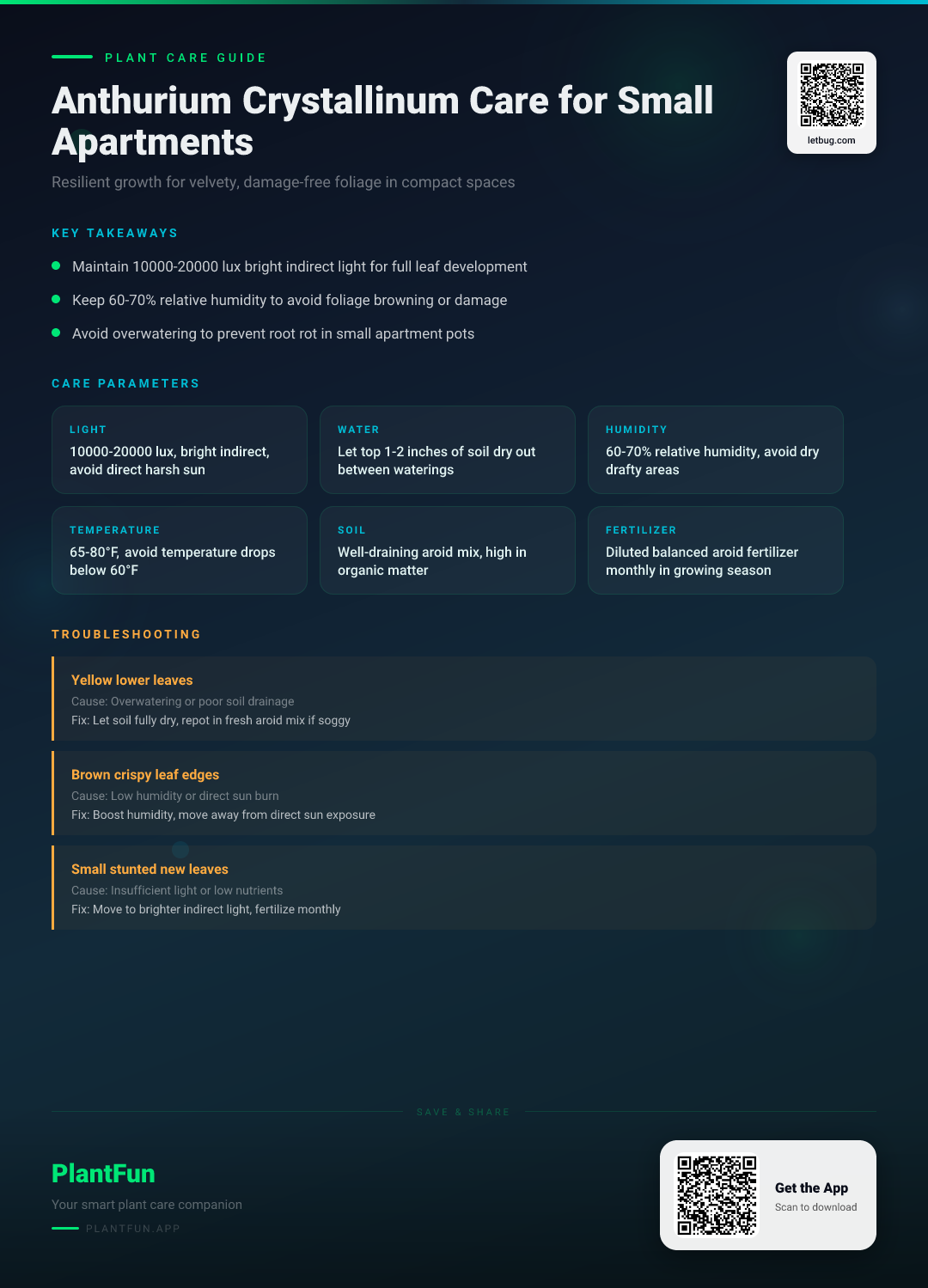
Key Takeaways
- Check soil moisture before watering — overwatering is the #1 killer of houseplants.
- Ensure your plant gets the right amount of light for its species.
- Be patient with recovery — most plants need 2–4 weeks to bounce back.
Quick Care Card: Essential Thresholds for Anthurium Success
| Feature | Requirement |
|---|---|
| Light | Bright, indirect (10,000–20,000 lux) |
| Water | Keep substrate moist; allow top 1” to dry |
| Humidity | 60–70% constant (use a tray or cloche) |
| Temperature | 65–80°F (18–27°C) |
| Soil | Aroid mix: bark, perlite, sphagnum moss |
| Fertilizer | Balanced liquid feed at 1/4 strength monthly |
| Toxicity | Toxic to cats and dogs (ASPCA, 2026) |
TL;DR: The Apartment-Dweller’s Cheat Sheet
To keep an Anthurium crystallinum happy in a compact space, prioritize a high-porosity aroid soil mix and consistent ambient humidity. Maintain 60–70% relative humidity and 10,000–20,000 lux of indirect light. Avoid overwatering; only water when the top inch of soil feels dry. Keep your plant away from AC vents and heaters to ensure stable leaf development.
My Experience: The “Too Dry” Lesson
When I first brought home my Anthurium crystallinum, I placed it on a bookshelf six feet away from a window. Within weeks, the beautiful, velvety leaves began to crisp at the edges. I realized my apartment’s HVAC system was sucking the moisture right out of the air. Moving the plant to a pebble tray near the window and grouping it with other aroids changed everything—the new leaves returned to their signature dark, shimmery state.
Why Your Anthurium Needs a Micro-Climate: Understanding Natural Habitat vs. Studio Living
In their native tropical habitats, Anthurium crystallinum grow as epiphytes or lithophytes, thriving in high-humidity, dappled-light environments (NC State Extension, 2026). In an apartment, you must simulate this. Without a controlled micro-climate, the thin, heart-shaped foliage loses water faster than the roots can supply it, leading to stunted growth.
Lighting Strategies: Maximizing 10,000-20,000 Lux in Compact Floor Plans
Direct sun is the enemy of the crystallinum. Aim for 10,000–20,000 lux, which can be measured via light meter apps or by ensuring the plant is in a bright spot where it receives no harsh, direct sun. In small apartments, if you lack window space, a simple LED grow bulb on a flexible clamp arm is an excellent space-saving solution.
The Hydration Balance: Watering Technique and Avoiding Root Rot in Small Pots
Overwatering is the fastest way to kill an anthurium. Using a coarse, airy soil mix is essential—I recommend a blend of orchid bark, perlite, and charcoal. To check if it needs water, stick your index finger two inches into the soil. If it feels dry, irrigate. If it feels damp, wait two more days (NC State Extension, 2026).
Humidity Hacking: How to Maintain 60-70% Relative Humidity Without a Greenhouse
High humidity is non-negotiable for lush foliage. If you don’t have room for a cabinet, try placing your pot on a wide tray filled with LECA and water. As the water evaporates, it creates a localized pocket of humidity. Keeping your plant away from central heating is a critical apartment plant care tip for maintaining leaf integrity.
Thermal Comfort: Why Keeping Temperatures Between 65-80°F Matters for Leaf Size
Anthuriums are tropical; they dislike cold drafts. During winter, avoid placing them near drafty windows. Research into in vitro propagation shows that stable thermal conditions are essential for maintaining healthy, robust cell division in developing leaves (Lê Sơn & Nguyễn, 2025).
Common Mistakes: Why Is My Anthurium Turning Yellow in a Small Room?
Yellowing Leaves
Symptom: Lower leaves turning yellow or mushy.
Likely cause: Overwatering leading to root hypoxia.
Fix:
- Remove the plant from its pot and check roots.
- Trim away any soft, brown, or mushy roots.
- Repot in a fresh, well-draining aroid mix.
Browning Edges
Symptom: Crispy, brown edges on otherwise green leaves.
Likely cause: Low ambient humidity or chemical burn from tap water.
Fix:
- Increase local humidity using a humidifier or pebble tray.
- Use distilled or filtered water to avoid salt buildup.
Stunted Growth
Symptom: Small, pale, or non-velvety leaves.
Likely cause: Insufficient light or lack of nutrients.
Fix:
- Move to a brighter location or add a supplement grow light.
- Apply a balanced, diluted liquid fertilizer during the active growing season.
Voice Search FAQ: How do I know when my Anthurium needs water?
Check the soil by pushing your finger two inches deep into the substrate. If you feel no moisture, it is time to water. Consistency is key, as extreme wet-dry cycles stress the root system.
Voice Search FAQ: Can I keep my Anthurium on a shelf away from the window?
Only if that shelf is supplemented by a dedicated grow light. Without supplemental light, the plant will struggle to photosynthesize, leading to elongated, weak stems and eventual decline.
Seasonal Care Calendar: Adapting to Apartment Temperature Fluctuations
- Spring/Summer: Increase watering frequency and introduce monthly fertilization (1/4 strength). This is your primary indoor plant care guide window for active growth.
- Autumn/Winter: Reduce watering as growth slows. Monitor for bacterial blight, which can appear as water-soaked spots during cooler, stagnant air months (Liu & Zhou, 2015).
References: Horticultural Research and Botanical Best Practices
- ASPCA. (2026). Toxic and Non-Toxic Plants List — ASPCA. https://www.aspca.org/pet-care/animal-poison-control/toxic-and-non-toxic-plants. Accessed 2026-03-16.
- Lê Sơn, .; Nguyễn, T. (2025). NGHIÊN CỨU NHÂN GIỐNG IN VITRO CÂY HỒNG MÔN crystallinum (Anthurium crystallinum). TẠP CHÍ KHOA HỌC LÂM NGHIỆP. https://doi.org/10.70169/vjfs.1032. Accessed 2026-03-16.
- Liu, Q.; Zhou, X. (2015). First Report of Bacterial Blight Caused by Xanthomonas axonopodis pv. dieffenbachiae on Anthurium crystallinum in China. Plant Disease. https://doi.org/10.1094/pdis-02-15-0142-pdn. Accessed 2026-03-16.
- NC State Extension. (2026). Anthurium Crystallinum Care — NC State Extension Gardener Plant Toolbox. https://plants.ces.ncsu.edu/plants/crystallinum-care/. Accessed 2026-03-16.
Optional Helper: Plantfun.App
Plantfun.App identifies your plants by photo, diagnoses pests and diseases with clear fixes, and creates personalised watering and light schedules that adapt to your home conditions — a handy companion for putting this guide into daily practice.
Found an error or have suggestions? We'd love your feedback.
Need help identifying this problem?
Get instant identification, personalized care schedules, and effective pest treatment plans directly on your phone.
Sponsored • We may earn a commission from app downloads
Related Guides
The Complete Anthurium Care Guide for 500 Sq Ft Studio Apartments: Grow Blooms Year-Round
Grow vibrant, year-round anthurium blooms even in a tiny 500 sq ft studio apartment. Get exact light levels, measured watering amounts, and space-saving hacks that fit your small living space.
Care GuideAnthurium crystallinum in a Typical Apartment: The Essential Guide to Resilient Indoor Growth
Transform your living space into a thriving tropical haven. Master Anthurium crystallinum care with 4 exact environmental thresholds and our foolproof, 7-day routine.
Care GuideAnthurium Crystallinum in Low-Humidity Apartments: The Complete Budget-Friendly Growth and Care Guide
Stop killing your Anthurium. Master the exact light, humidity, and soil-mix thresholds to keep those signature velvet leaves lush in any standard home environment.
Pest ControlAnts on Plants: What They Mean and What to Do
Ants usually aren't eating your plant. They are farming other pests.