
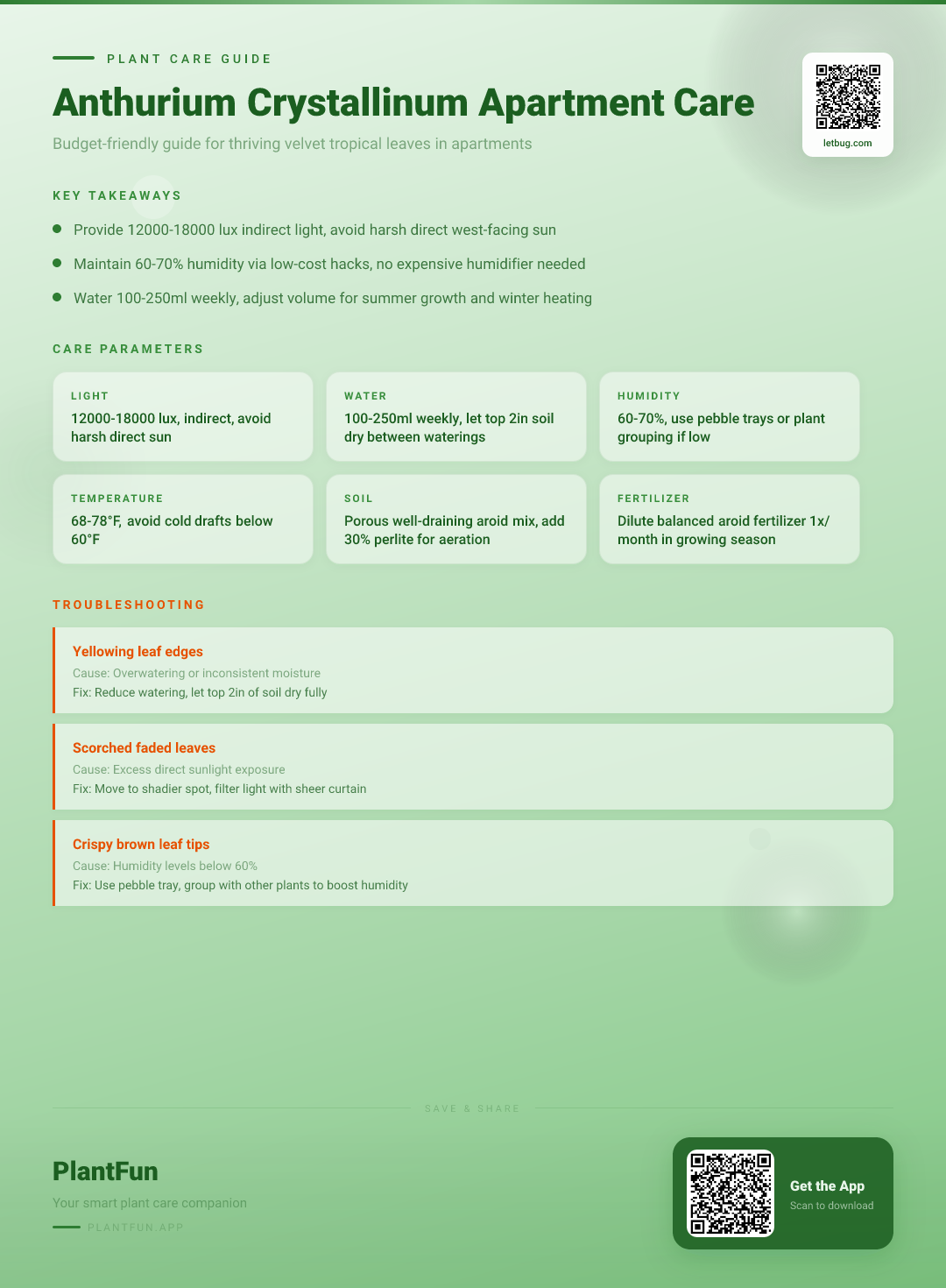
Key Takeaways
- Check soil moisture before watering — overwatering is the #1 killer of houseplants.
- Ensure your plant gets the right amount of light for its species.
- Be patient with recovery — most plants need 2–4 weeks to bounce back.
Quick Care Card: Essential Data
| Feature | Requirement |
|---|---|
| Light | 12,000–18,000 lux (bright, indirect) |
| Humidity | 60–70% |
| Water | 100–250ml per week (when top 2 inches dry) |
| Temperature | 68–78°F (20–25°C) |
| Soil | Chunky, well-draining aroid mix |
| Fertilizer | Balanced liquid feed at half-strength monthly |
| Toxicity | Toxic to cats and dogs (ASPCA, 2026) |
TL;DR: The Reality of Apartment Anthuriums
You don’t need a professional greenhouse to keep an Anthurium crystallinum happy. By mimicking their native understory environment using budget-friendly hacks like pebble trays and strategic grouping, you can maintain their signature silver-veined, velvety foliage. The key is stable ambient conditions rather than extreme effort.
Why Anthurium Crystallinum Thrives in Modern Apartments
When I first brought home my Anthurium crystallinum, I treated it like a delicate piece of glass. I quickly learned that this plant is more resilient than its reputation suggests, provided you respect its tropical origins. Unlike many high-maintenance exotics, A. crystallinum is quite adaptable to typical indoor temperatures (NC State Extension, 2026). In an apartment, the primary challenge is not the plant’s sensitivity, but the lack of consistent moisture. By mastering your microclimate, you can grow these plants successfully on a windowsill.
Step-by-Step Care Guide: Lighting and Orientation
Finding the right light is critical for deep velvet color.
- Placement: Position your plant 2–3 feet away from a bright, east-facing window.
- Measurement: Aim for 12,000 to 18,000 lux. You can use a basic light meter app on your phone to check these levels.
- Avoid Direct Sun: If you notice bleached spots, your light is too intense. Conversely, slow growth suggests you need to move the plant closer to the light source.
Mastering the Moisture Balance: Soil Media and Watering Habits
I always recommend a chunky soil mix to prevent root rot. A standard recipe consists of 40% orchid bark, 40% coco coir, and 20% perlite.
- The Finger Test: Stick your finger 2 inches into the soil. If it feels damp, wait. If it’s dry, water until excess drains from the bottom.
- Consistency: Aim for 100–250ml of water weekly, depending on your apartment’s ambient temperature.
Budget-Friendly Humidity Hacks for Dry Apartment Air
- Grouping: Place your Anthurium next to other tropicals; they share moisture through transpiration.
- Pebble Trays: Fill a tray with pebbles and water, placing the pot on top (ensure the roots don’t touch the water).
- Shower Steam: Bringing your plant into the bathroom during a hot shower provides a weekly humidity boost.
Seasonal Care Calendar: Navigating Winter Heating and Summer Growth
- Winter: Heating systems drastically drop humidity. Move your plant away from vents and monitor soil drying rates closely.
- Summer: Higher light levels and temperatures encourage growth (Lê Sơn & Nguyễn, 2025). Increase fertilizer slightly, but never over-saturate.
Common Mistakes to Avoid: The ‘Velvet Leaf’ Trap
- Mistake: Using dense, garden-variety potting soil.
- What happens: Root suffocation leading to sudden decline.
- Instead: Use an airy, porous aroid potting mix designed for epiphytes.
- Mistake: Misting the leaves directly to increase humidity.
- What happens: Fungal spots from standing water.
- Instead: Use a humidifier or pebble tray for ambient humidity.
FAQ: Why are my Anthurium leaves yellowing at the edges?
Yellowing, specifically chlorosis or necrosis at the margins, often signals moisture stress. Either you are underwatering, or the roots are sitting in soggy soil. Check the drainage holes immediately (Liu & Zhou, 2015).
FAQ: How do I increase humidity without an expensive humidifier?
Can I put my plant in the bathroom? Yes, the bathroom is an excellent spot if you have a window. Otherwise, a group of plants on a tray of water and expanded clay pebbles creates a natural micro-climate (NC State Extension, 2026).
FAQ: Is my west-facing window too bright for a Crystallinum?
It can be. West-facing windows get intense afternoon heat. Use a sheer curtain to diffuse the light, or move the plant further back into the room.
Troubleshooting Guide: Identifying Pest Infestations Early
Mealybug Infestation
Symptom: Small, white, cotton-like masses in leaf axils.
Likely cause: Low plant vigor or new plant introduction.
Fix:
- Wipe the area with a cotton swab dipped in 70% isopropyl alcohol.
- Treat the entire plant with insecticidal soap every 7 days until clear.
Spider Mites
Symptom: Fine webbing between leaves or yellow stippling.
Likely cause: Excessively dry, stagnant apartment air.
Fix:
- Thoroughly wash the foliage under lukewarm water.
- Increase your local humidity levels to discourage re-infestation.
Conclusion: Keeping Your Tropical Collection Resilient
By focusing on these fundamental environmental controls, your Anthurium crystallinum will not just survive, but thrive. Remember, consistent care beats occasional pampering every time.
References
- ASPCA. (2026). Toxic and Non-Toxic Plants List — ASPCA. https://www.aspca.org/pet-care/animal-poison-control/toxic-and-non-toxic-plants. Accessed 2026-03-18.
- Lê Sơn, .; Nguyễn, T. (2025). NGHIÊN CỨU NHÂN GIỐNG IN VITRO CÂY HỒNG MÔN crystallinum (Anthurium crystallinum). TẠP CHÍ KHOA HỌC LÂM NGHIỆP. https://doi.org/10.70169/vjfs.1032. Accessed 2026-03-18.
- Liu, Q.; Zhou, X. (2015). First Report of Bacterial Blight Caused by Xanthomonas axonopodis pv. dieffenbachiae on Anthurium crystallinum in China. Plant Disease. https://doi.org/10.1094/pdis-02-15-0142-pdn. Accessed 2026-03-18.
- NC State Extension. (2026). Anthurium Crystallinum Care — NC State Extension Gardener Plant Toolbox. https://plants.ces.ncsu.edu/plants/crystallinum-care/. Accessed 2026-03-18.
Optional Helper: Plantfun.App
Plantfun.App identifies your plants by photo, diagnoses pests and diseases with clear fixes, and creates personalised watering and light schedules that adapt to your home conditions — a handy companion for putting this guide into daily practice.
Found an error or have suggestions? We'd love your feedback.
Need help identifying this problem?
Get instant identification, personalized care schedules, and effective pest treatment plans directly on your phone.
Sponsored • We may earn a commission from app downloads
Related Guides
Anthurium Crystallinum Care in Small Apartments: The Complete Guide to Resilient Growth
Master Anthurium Crystallinum care in your apartment. Follow these 4 essential thresholds and seasonal steps for velvety, damage-free foliage in small spaces.
Care GuideAnthurium Crystallinum in Low-Humidity Apartments: The Complete Budget-Friendly Growth and Care Guide
Stop killing your Anthurium. Master the exact light, humidity, and soil-mix thresholds to keep those signature velvet leaves lush in any standard home environment.
Care GuideThe Complete Anthurium Care Checklist for Resilient Growth in Small Urban Apartments
Stop guessing at your Anthurium care. Get a free printable checklist, exact light, water, and humidity thresholds, and 5 quick fixes for common apartment-specific issues to keep blooms vibrant year-round.
Pest ControlAnts on Plants: What They Mean and What to Do
Ants usually aren't eating your plant. They are farming other pests.