
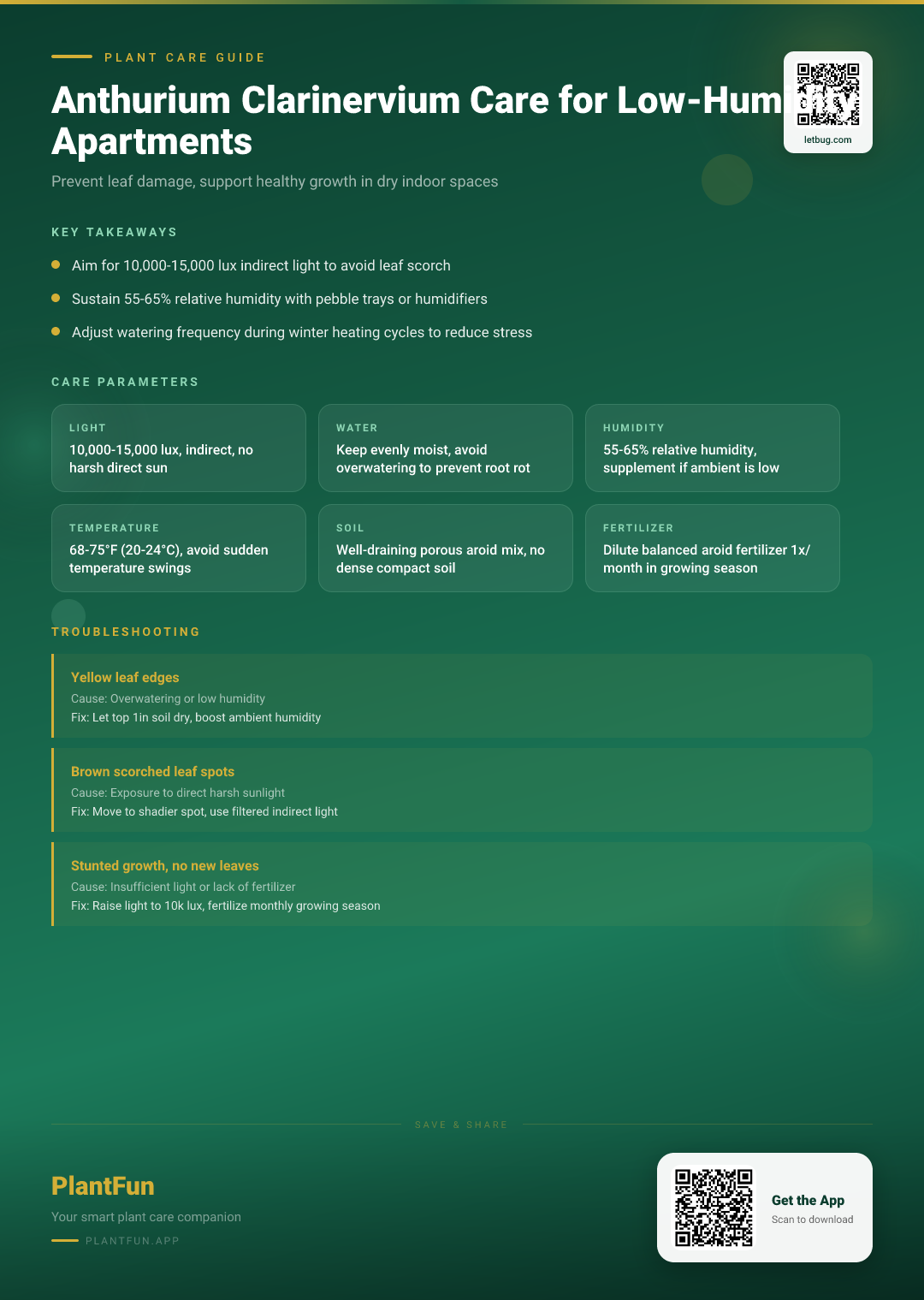
Key Takeaways
- Check soil moisture before watering — overwatering is the #1 killer of houseplants.
- Ensure your plant gets the right amount of light for its species.
- Be patient with recovery — most plants need 2–4 weeks to bounce back.
Quick Care Card: Essential Data Points
| Feature | Requirement |
|---|---|
| Light | 10,000–15,000 lux (bright, indirect) |
| Water | When top 2 inches of soil are dry |
| Humidity | 55–65% constant |
| Temperature | 68–75°F (20–24°C) |
| Soil | Chunky aroid mix (bark, perlite, coco coir) |
| Fertilizer | Balanced liquid, diluted by half, monthly |
| Toxicity | Toxic to pets/humans (ASPCA, 2026) |
TL;DR: The Reality of Keeping Anthuriums in Apartments
An Anthurium clarinervium is not a low-maintenance plant, but it is a rewarding one. In most apartments, the challenge is bridging the gap between its native tropical rainforest environment and your climate-controlled home. To succeed, you must prioritize stable humidity (55–65%) and a highly aerated, fast-draining substrate (NC State Extension, 2026). If your leaves are browning, the culprit is almost always low humidity or inconsistent watering, not a lack of fertilizer. Keep it stable, keep it chunky, and it will thrive.
Understanding the Anatomy of Your Anthurium’s Leaf Stress
When I first brought home my Anthurium clarinervium, I placed it right next to a radiator, thinking the warmth would mimic the tropics. Within a week, the beautiful, velvety leaves developed crisp, brown edges. I learned quickly that the plant’s heart-shaped, veined leaves are specialized for capturing low-level light in high-humidity understories. When exposed to arid indoor air, the plant’s stomata (tiny pores on the leaf surface) close to conserve water, effectively stalling growth and leading to tissue necrosis—the “brown spots” we all fear.
Light Requirements: Achieving 10,000-15,000 lux without Scorching
These plants are understory dwellers; they crave light, but they despise the direct “laser” rays of the sun. In my experience, a north-facing window with a sheer curtain or a few feet back from a bright south-facing window is ideal. You want to aim for 10,000–15,000 lux. If you don’t have a light meter, you can use a free mobile app to get a rough estimate. If the leaves are turning dark green and drooping, they are starving for light; if they are bleaching or showing yellow spots, move them back.
Watering Protocols: Maintaining Moisture without Root Suffocation
Watering is where most enthusiasts fail. Because this species grows naturally as an epiphyte (a plant growing on other plants), its roots need constant airflow. If the soil stays sodden, the roots rot rapidly.
- Use the “finger test”: Stick your finger two inches into the soil. If it feels moist, wait.
- When dry, water thoroughly until the excess drains completely from the bottom of the pot.
- Never let the pot sit in standing water, as this prevents the gas exchange required for healthy root function (Kleiber & Komosa, 2010).
Humidity Engineering: How to Sustain 55-65% Relative Humidity Indoors
Apartments are notorious for dropping below 40% humidity, especially in winter. To reach the 55–65% sweet spot, I recommend a small, dedicated humidifier near the plant rather than frequent misting. Misting provides only a temporary spike in moisture and can actually promote fungal issues on the leaf surface.
Temperature Ranges: Why 68-75°F (20-24°C) is the Sweet Spot
Anthuriums are sensitive to rapid temperature fluctuations. While they can survive slightly cooler temperatures, they perform best within the 68–75°F (20–24°C) range (NC State Extension, 2026). Avoid placing your plant near drafty doors or AC vents, as cold air shocks the metabolic processes of the plant, often leading to slow, stunted growth.
FAQ: Why is my Anthurium Clarinervium turning yellow at the edges?
This usually indicates root stress, often caused by overwatering or soil that is too dense. When the roots cannot “breathe,” the plant struggles to transport water, leading to yellowing edges. Ensure your soil mix is airy—I personally use a mix of orchid bark, perlite, and a small amount of peat or coco coir.
FAQ: Can I use a pebble tray to increase humidity for my Anthurium?
You can, but it is rarely enough for a Clarinervium. While it provides a marginal increase in the micro-environment, a humidifier or a small greenhouse cabinet is far more effective for maintaining the humidity levels these plants require to prevent edge browning.
FAQ: How often should I fertilize for resilient leaf growth?
I fertilize once a month during the growing season (spring and summer) with a balanced, liquid houseplant fertilizer diluted to half-strength. Anthuriums are not heavy feeders; it is better to provide a little nutrition consistently than to risk salt buildup in the substrate.
Identifying Common Mistakes: The Over-Mist and Over-Potting Traps
- Mistake: Misting the leaves constantly. What happens: Water sits on the velvety surface, leading to fungal spot development. Instead: Use a humidifier or a cloche/cabinet to raise ambient humidity.
- Mistake: Planting in a pot that is too large. What happens: Excess soil holds too much moisture, leading to root rot. Instead: Choose a pot only 1–2 inches larger than the root ball.
Seasonal Care Calendar: Adjusting for Winter Heating Cycles
- Spring: Repot if necessary and begin increasing light as the sun strengthens.
- Summer: Monitor closely for soil dehydration; keep away from direct afternoon sun.
- Autumn: Gradually reduce watering frequency as growth slows.
- Winter: Increase humidity via a humidifier. Ensure the plant is not in the path of direct heat from vents.
References and Botanical Notes
- Journal of Plant Biotechnology. (2003). In Vitro Propagation of Anthurium andreanum ′Atlanta′ Developed for Pot Culture. https://doi.org/10.5010/jpb.2003.30.2.179. Accessed 2026-03-19.
- Kleiber, T.; Komosa, A. (2010). GUIDE VALUES FOR ANTHURIUM (ANTHURIUM CULTORUM BIRDSEY) GROWN IN EXPANDED CLAY. Journal of Plant Nutrition. https://doi.org/10.1080/01904167.2010.489987. Accessed 2026-03-19.
- ASPCA. (2026). Toxic and Non-Toxic Plants List — ASPCA. https://www.aspca.org/pet-care/animal-poison-control/toxic-and-non-toxic-plants. Accessed 2026-03-19.
- NC State Extension. (2026). Anthurium Clarinervium Care — NC State Extension Gardener Plant Toolbox. https://plants.ces.ncsu.edu/plants/clarinervium-care/. Accessed 2026-03-19.
Optional Helper: Plantfun.App
Plantfun.App identifies your plants by photo, diagnoses pests and diseases with clear fixes, and creates personalised watering and light schedules that adapt to your home conditions — a handy companion for putting this guide into daily practice.
Found an error or have suggestions? We'd love your feedback.
Need help identifying this problem?
Get instant identification, personalized care schedules, and effective pest treatment plans directly on your phone.
Sponsored • We may earn a commission from app downloads
Related Guides
Anthurium Crystallinum in Low-Humidity Apartments: The Complete Rescue and Growth Guide
Transform your crispy Anthurium crystallinum into a velvet-leaf beauty. Learn 4 proven humidity hacks, precise watering volumes, and light benchmarks for growth.
Care GuideAnthurium Crystallinum in Low-Humidity Apartments: The Complete Budget-Friendly Growth and Care Guide
Stop killing your Anthurium. Master the exact light, humidity, and soil-mix thresholds to keep those signature velvet leaves lush in any standard home environment.
Care GuideAnthurium Crystallinum Care in Small Apartments: The Complete Guide to Resilient Growth
Master Anthurium Crystallinum care in your apartment. Follow these 4 essential thresholds and seasonal steps for velvety, damage-free foliage in small spaces.
Pest ControlAnts on Plants: What They Mean and What to Do
Ants usually aren't eating your plant. They are farming other pests.