
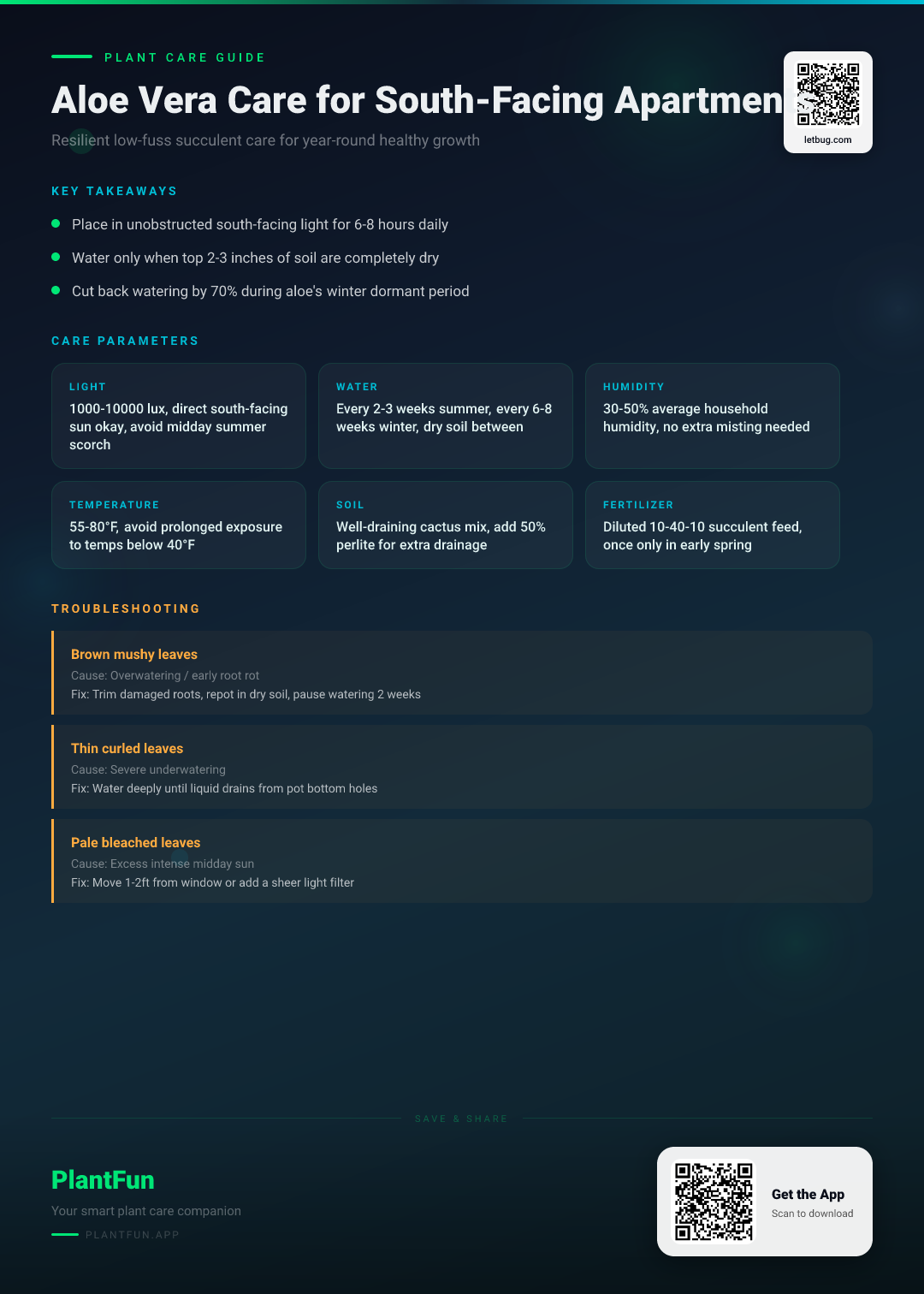
Key Takeaways
- Check soil moisture before watering — overwatering is the #1 killer of houseplants.
- Ensure your plant gets the right amount of light for its species.
- Be patient with recovery — most plants need 2–4 weeks to bounce back.
Quick Care Card: Essential Thresholds for Your Aloe
| Category | Requirement |
|---|---|
| Light | High light (Direct sun or bright, filtered window) |
| Water | Allow soil to dry 100% between waterings |
| Humidity | Low to moderate (30-50%) |
| Temperature | 60°F – 80°F (15°C – 27°C) |
| Soil | Well-draining cactus/succulent mix |
| Fertilizer | Balanced liquid fertilizer (diluted) during summer |
| Toxicity | Toxic to cats and dogs (ASPCA, 2026) |
TL;DR: The 60-Second Aloe Survival Protocol
To keep your Aloe barbadensis miller thriving in a south-facing apartment, follow this: Place it in the brightest spot available. Water deeply until liquid runs from the drainage holes, but wait until the soil is bone-dry throughout the entire pot before doing it again. During winter, pull back to watering once every 4–6 weeks. Avoid repotting into oversized containers to prevent excess moisture retention, which is the leading cause of root rot (NC State Extension, 2026).
Why South-Facing Apartments Are an Aloe’s Best Friend
When I first started keeping succulents in my tiny studio, I struggled to find the right balance. I quickly learned that an Aloe Vera in a south-facing apartment is actually in its element. Because this plant originates from arid climates, it thrives on the intense solar energy that south-facing windows provide (NC State Extension, 2026). Unlike tropical foliage plants that scorch easily, your Aloe uses this light to build thick, rigid leaves packed with energy-rich gel.
Understanding Your Aloe: Anatomy of a Resilient Succulent
An Aloe is essentially a storage vessel. Its leaves are specialized tissues designed to retain moisture for months (Plant Science Archives, 2019). When you look at the leaf, you are looking at a hydrated reserve that the plant taps into when soil moisture is low. If you find the leaves feel soft or squishy, the plant is signaling that its structural integrity is compromised by either too much water or not enough light to photosynthesize effectively.
Step-by-Step Care: Light, Soil, and Watering Precision
- Light: Your Aloe needs at least 6 hours of bright, direct light. If you notice the leaves flattening out, move the plant closer to the glass.
- Soil: Never use standard peat-heavy potting soil. Use a specialized cactus mix. I recommend adding extra perlite to improve aeration (Derbe, 2015).
- Watering: Use a moisture meter or the “finger test.” Push your finger 2 inches into the soil; if you feel any dampness, wait another 3 days. When you do water, provide roughly 100-200ml depending on the pot size, ensuring it flows through the drainage hole.
The Seasonal Routine: Adjusting Care from Summer Growth to Winter Dormancy
In summer, your Aloe is in active growth. I fertilize lightly every 6 weeks with a 10-10-10 formula diluted to half-strength. As autumn light wanes, transition to winter care. During the colder months, the plant enters a period of dormancy. Reduce your watering frequency significantly; in my apartment, I drop to watering once per month. This winter care prevents the root system from sitting in cold, damp soil, which is often fatal.
Troubleshooting: Why Are My Aloe Leaves Turning Brown or Mushy?
Leaf Tip Browning
Symptom: The very tips of the leaves turn dry, crispy, and brown.
Likely cause: Underwatering or low humidity.
Fix:
- Increase your watering frequency slightly.
- Check if the root ball has become too compacted.
Mushy, Discolored Leaves
Symptom: Leaves become soft, translucent, or turn yellow/brown at the base.
Likely cause: Root rot due to overwatering.
Fix:
- Remove the plant from the pot and trim away any black, slimy roots.
- Repot in fresh, dry, fast-draining soil.
Voice Search FAQ: Can I leave my Aloe Vera in direct sun all day?
Yes, Aloe barbadensis miller is one of the few houseplants that truly enjoys direct sun. However, if your plant has been in a low-light environment, introduce it to the south-facing window gradually over 7–10 days to prevent leaf scorch (NC State Extension, 2026).
Voice Search FAQ: How often should I water my Aloe in the winter?
In winter, water your Aloe sparingly. Once every 4 to 6 weeks is usually sufficient. Always verify the soil is completely dry to the touch before adding water, as growth slows significantly in lower light levels (NC State Extension, 2026).
Common Mistakes That Lead to Root Rot
- Mistake: Using a decorative pot without drainage holes.
- What happens: Water pools at the bottom, suffocating the roots.
- Instead: Use a nursery pot inside a decorative pot so you can remove it for watering.
- Mistake: Repotting into a container that is too large.
- What happens: Large amounts of extra soil stay wet too long.
- Instead: Repot into a container no more than 1-2 inches wider than the current root ball.
Essential Tools for Professional-Grade Aloe Maintenance
- Moisture Meter: Essential for determining when the deeper layers of soil are dry.
- Unglazed Terracotta Pots: These are porous and help wick moisture away from the roots, acting as a safeguard against overwatering.
- Balanced Fertilizer: Use during the peak of summer to supplement nutrients depleted from the soil (Derbe, 2015).
Conclusion: Building a Long-Term Connection with Your Plant
Successfully keeping an Aloe Vera isn’t about constant maintenance; it’s about observation. By matching your care routine to the high-light, low-moisture rhythm of your apartment, you allow this resilient succulent to flourish. Remember, the ASPCA (2026) lists this plant as toxic to pets, so keep it in an elevated spot if you share your home with curious animals.
References
- ASPCA. (2026). Toxic and Non-Toxic Plants List — ASPCA. https://www.aspca.org/pet-care/animal-poison-control/toxic-and-non-toxic-plants. Accessed 2026-03-13.
- Derbe, T. (2015). Spectroscopic Investigation of Metal Level in Aloe Vera Plant, and the Soil Where the Aloe Vera Grows: Arba Minch, Southern Ethiopia. Modern Chemistry. https://doi.org/10.11648/j.mc.20150301.11. Accessed 2026-03-13.
- NC State Extension. (2026). Aloe Vera — NC State Extension Gardener Plant Toolbox. https://plants.ces.ncsu.edu/plants/vera-care/. Accessed 2026-03-13.
- Plant Science Archives. (2019). Aloe vera plant products as antimicrobial agents. Plant Science Archives. https://doi.org/10.33680/plsa.2019.016. Accessed 2026-03-13.
Optional Helper: Plantfun.App
Plantfun.App identifies your plants by photo, diagnoses pests and diseases with clear fixes, and creates personalised watering and light schedules that adapt to your home conditions — a handy companion for putting this guide into daily practice.
Found an error or have suggestions? We'd love your feedback.
Need help identifying this problem?
Get instant identification, personalized care schedules, and effective pest treatment plans directly on your phone.
Sponsored • We may earn a commission from app downloads
Related Guides
Aloe Vera in Low-Light Apartments: A Budget-Friendly Guide to Resilient, Succulent Growth
Transform your dim apartment into a succulent sanctuary. Learn exactly how to manage light, water, and soil for a resilient Aloe Vera without breaking the bank.
Care GuideThe Complete Aloe Vera Care Guide for Typical Apartments: Seasonal Tips for Resilient Growth
Grow plump, hardy aloe vera in your apartment without guesswork. Get exact light, water, and soil thresholds plus a 4-season care routine to prevent browning and boost gel yield.
Care GuideAloe Vera In Typical Small Apartments: The Only Resilient Growth Checklist You’ll Ever Need
Skip generic aloe care advice. Get exact light, water, and soil thresholds, plus a printable weekly checklist to keep your aloe vera thriving in any standard apartment.
Pest ControlAnts on Plants: What They Mean and What to Do
Ants usually aren't eating your plant. They are farming other pests.