
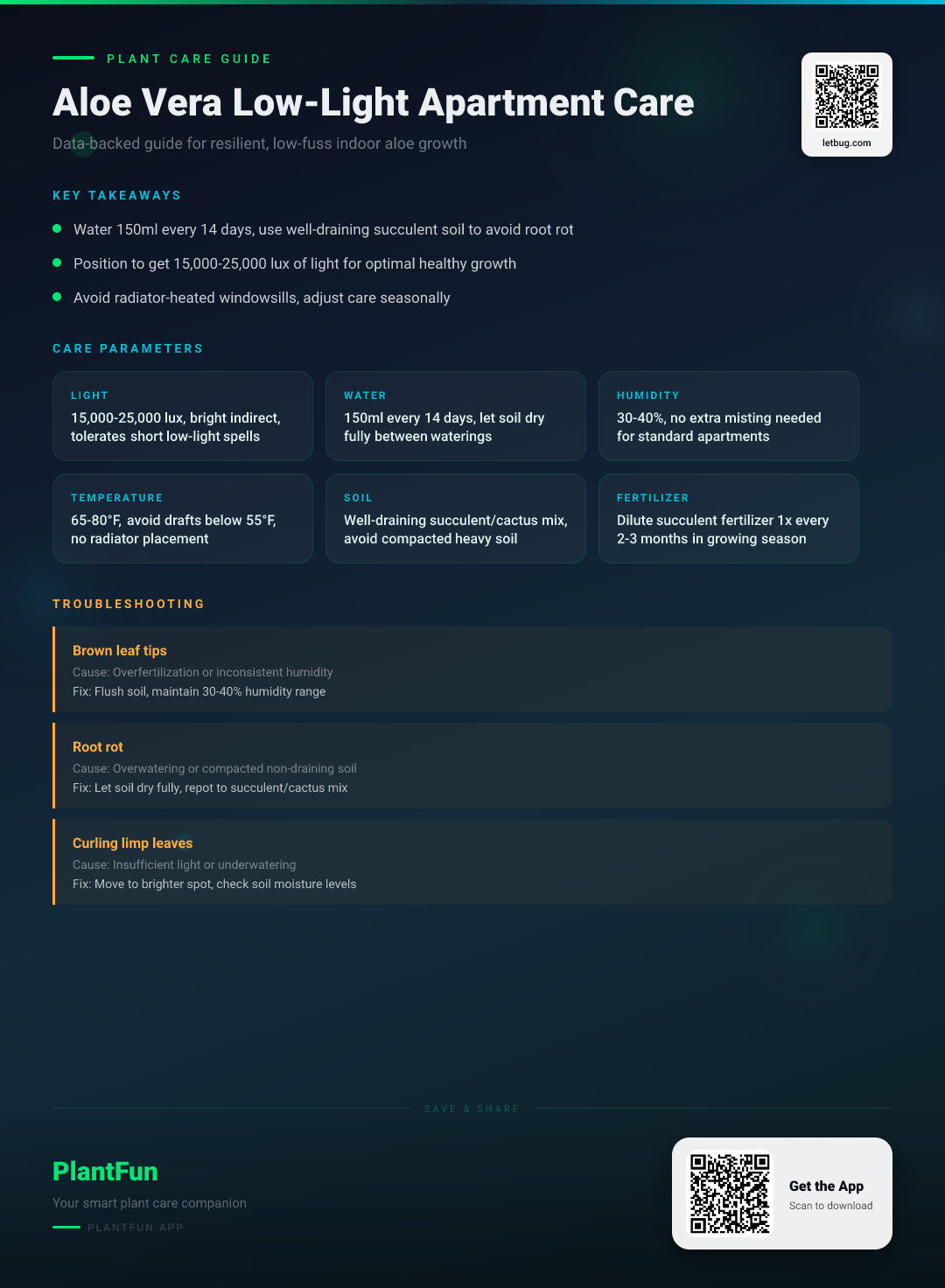
Key Takeaways
- Check soil moisture before watering — overwatering is the #1 killer of houseplants.
- Ensure your plant gets the right amount of light for its species.
- Be patient with recovery — most plants need 2–4 weeks to bounce back.
Quick Care Card: Essential Data
| Feature | Requirement |
|---|---|
| Light | 15,000–25,000 Lux (Bright, indirect) |
| Water | 150ml per 14 days (Wait for complete dry-out) |
| Temperature | 65–80°F (18–27°C) |
| Humidity | 30–40% |
| Soil | Fast-draining gritty cactus mix |
| Fertilizer | Low-nitrogen balanced (10-10-10) monthly in summer |
| Toxicity | Toxic to cats and dogs (ASPCA, 2026) |
TL;DR: The Reality of Aloe Vera in Apartment Life
Aloe Vera is frequently marketed as a “set-it-and-forget-it” plant, but in the low-light, stagnant air of an apartment, it is a high-maintenance guest. The secret to success lies in matching your watering frequency strictly to the plant’s light intake. If your apartment doesn’t offer at least 15,000 lux, you must adjust your watering schedule significantly downward to prevent systemic rot.
Decoding Your Aloe’s Environment: Why Apartment Light Is Often Miscalculated
When I first started collecting succulents, I thought my windowsill was “bright enough.” I learned the hard way that our human eyes are terrible at measuring light. We perceive light as sufficient while the plant is starving. Aloe vera sunlight requirements are specific: they crave intense, unfiltered light (NC State Extension, 2026). In many apartments, the “shadow” cast by nearby buildings or window tinting reduces the effective light far below the 15,000-lux threshold needed for robust growth.
Section 1: The Golden Ratio of Watering and Drainage (Preventing Root Rot)
Preventing root rot in Aloe is all about soil structure and evaporation rates. You should be using a fast-draining, grit-heavy mix—ideally 50% inorganic components like perlite or pumice (Derbe, 2015).
- The Finger Test: Never water on a schedule. Stick your finger two inches into the soil. If you feel any moisture, walk away.
- The 150ml Rule: When the soil is bone dry, apply approximately 150ml of water directly to the soil, avoiding the center rosette where water pools and causes rot.
- Drainage: If your decorative pot lacks a drainage hole, you are setting the stage for death. Always use a nursery pot inside a decorative cover pot.
Section 2: Maximizing Photon Intake in Dim Apartments
If you find your Aloe leaves stretching (etiolation), your plant is searching for light.
- Reflective Surfaces: Place your Aloe near a light-colored wall or use a mirror to bounce extra light toward the plant.
- Clean Your Windows: Dust and grime on apartment windows can block up to 10-20% of incoming light.
- Supplemental Lighting: In true low-light apartments, a small full-spectrum LED clip-on lamp, set 6 inches from the plant, can provide the missing photons needed for metabolic processes (Plant Science Archives, 2019).
Section 3: Seasonal Calibration: How to Adjust Care Between Winter and Summer
Succulent care in apartments changes drastically with the seasons. During winter, ambient light levels drop and temperatures often decrease, slowing the plant’s metabolism. I stop fertilizing entirely between November and March. Water intake should be reduced by 50% during these colder months, as the potting medium stays damp for much longer periods (NC State Extension, 2026).
Symptom-to-Action: What Your Aloe’s Leaves Are Trying to Tell You
Mushy, Dark Base Leaves
Symptom: The leaves near the soil line are soft, translucent, or black.
Likely cause: Overwatering leading to fungal root decay.
Fix:
- Remove the plant from the pot and inspect the roots.
- Trim away blackened or slimy roots using sterile shears.
- Repot in fresh, dry, gritty succulent soil.
Thin, Downward Curling Leaves
Symptom: Leaves are not plump and seem to fold inward.
Likely cause: Chronic dehydration or inadequate light.
Fix:
- Check the soil moisture; if bone dry, give a deep watering.
- If soil is moist but leaves are curling, move the plant to a brighter location.
Horizontal Stretching (Etiolation)
Symptom: The plant is growing long, pale, and weak rather than compact.
Likely cause: Severe light deficiency.
Fix:
- Gradually introduce more light, but avoid direct hot sun immediately.
- Consider a supplemental LED grow light for 8-10 hours daily.
Voice Search FAQ: Why is my Aloe Vera turning brown at the tips?
This is usually a signal of salt build-up from tap water or fertilizer. If your water is heavily “hard” (containing minerals), those minerals accumulate in the tips of the leaves (Derbe, 2015). Try switching to distilled or filtered water and flush the soil thoroughly with clean water to clear out excess salts.
Voice Search FAQ: How do I know if my apartment is too dark for an Aloe?
If you cannot read a book comfortably at midday without turning on a lamp exactly where the plant sits, it is likely too dark for an Aloe. These plants evolved in high-light, arid environments. If you observe the plant leaning aggressively toward the window, it is signaling a desperate need for more energy (NC State Extension, 2026).
Voice Search FAQ: Can I leave my Aloe on a radiator-heated windowsill?
I highly recommend against this. While Aloe loves warmth, direct heat from a radiator dries out the soil unevenly and can scorch the foliage. It also creates extreme humidity fluctuations, which the plant does not enjoy. Move it at least two feet away from any direct heat source.
Common Apartment Mistakes: The Over-Potting and Soil Compaction Traps
- Mistake: Using a pot that is too large for the root ball.
- What happens: The extra soil holds too much water, staying damp for weeks.
- Instead: Choose a pot that is only 1-2 inches wider than the root mass.
- Mistake: Using standard indoor potting soil.
- What happens: Standard soil is too dense, causing root suffocation and compaction.
- Instead: Always use a blend specifically labeled for cacti or succulents.
The Science of Succulent Resiliency: Building Long-Term Growth
Understanding the chemistry behind your Aloe’s health helps in making better decisions. Research shows that the soil composition directly influences the chemical profile of the plant, including the secondary metabolites that give Aloe its antimicrobial properties (Plant Science Archives, 2019). By maintaining a consistent, well-draining environment, you aren’t just keeping a plant alive; you are helping it develop the chemical resilience it needs to thrive. Remember, the ASPCA lists Aloe as toxic to cats and dogs, so keep your plant in a high, secure location if you share your home with pets (ASPCA, 2026).
References and Botanical Best Practices
- Plant Science Archives. (2019). Aloe vera plant products as antimicrobial agents. https://doi.org/10.33680/plsa.2019.016. Accessed 2026-03-17.
- Derbe, T. (2015). Spectroscopic Investigation of Metal Level in Aloe Vera Plant, and the Soil Where the Aloe Vera Grows: Arba Minch, Southern Ethiopia. Modern Chemistry. https://doi.org/10.11648/j.mc.20150301.11. Accessed 2026-03-17.
- ASPCA. (2026). Toxic and Non-Toxic Plants List — ASPCA. https://www.aspca.org/pet-care/animal-poison-control/toxic-and-non-toxic-plants. Accessed 2026-03-17.
- NC State Extension. (2026). Aloe Vera — NC State Extension Gardener Plant Toolbox. https://plants.ces.ncsu.edu/plants/vera-care/. Accessed 2026-03-17.
Optional Helper: Plantfun.App
Plantfun.App identifies your plants by photo, diagnoses pests and diseases with clear fixes, and creates personalised watering and light schedules that adapt to your home conditions — a handy companion for putting this guide into daily practice.
Found an error or have suggestions? We'd love your feedback.
Need help identifying this problem?
Get instant identification, personalized care schedules, and effective pest treatment plans directly on your phone.
Sponsored • We may earn a commission from app downloads
Related Guides
Aloe Vera in Low-Light Apartments: A Budget-Friendly Guide to Resilient, Succulent Growth
Transform your dim apartment into a succulent sanctuary. Learn exactly how to manage light, water, and soil for a resilient Aloe Vera without breaking the bank.
Care GuideAloe Vera in a South-Facing Apartment: The Resilient Care Guide for Year-Round Health
Master Aloe Vera care in high-light apartments with our seasonal routine. Discover precise water volumes, light thresholds, and growth tips for 100% success.
Care GuideThe Complete Aloe Vera Care Guide for Typical Apartments: Seasonal Tips for Resilient Growth
Grow plump, hardy aloe vera in your apartment without guesswork. Get exact light, water, and soil thresholds plus a 4-season care routine to prevent browning and boost gel yield.
Pest ControlAnts on Plants: What They Mean and What to Do
Ants usually aren't eating your plant. They are farming other pests.