
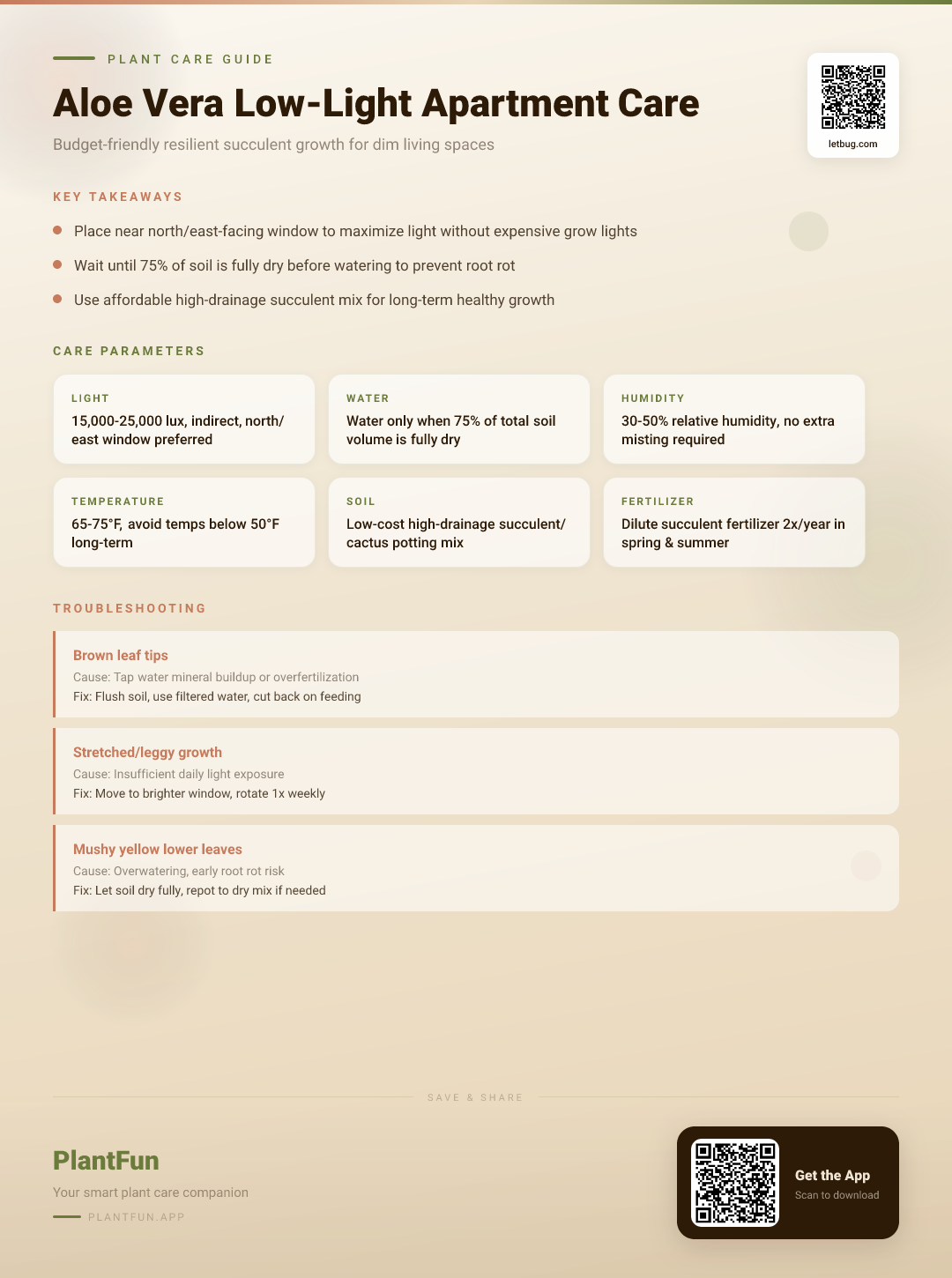
Key Takeaways
- Check soil moisture before watering — overwatering is the #1 killer of houseplants.
- Ensure your plant gets the right amount of light for its species.
- Be patient with recovery — most plants need 2–4 weeks to bounce back.
TL;DR: To keep your Aloe Vera thriving in an apartment, place it in your brightest window (aim for 15,000–25,000 lux), use a porous cactus mix, and only water when the top 75% of the soil is bone dry. Avoid overwatering at all costs, as this is the primary cause of decline in indoor succulents. Stick to these basics to ensure long-term health.
Quick Care Card
| Feature | Requirement |
|---|---|
| Light | 15,000–25,000 lux |
| Water | When 75% of soil is dry |
| Humidity | 30–50% |
| Temperature | 65–75°F (18–24°C) |
| Soil | Fast-draining succulent/cactus mix |
| Fertilizer | Minimal (diluted balanced liquid) |
| Toxicity | Toxic to cats and dogs (ASPCA, 2026) |
My Experience
When I first started keeping plants in my tiny, north-facing studio apartment, I bought a beautiful Aloe Vera. I made the mistake of treating it like a thirsty tropical fern, watering it every week because the surface looked dry. Within a month, the base turned mushy—a classic case of rot. I learned the hard way that these resilient plants aren’t just “low light” tolerant; they are highly specialized machines that store moisture. Once I adjusted to a “less is more” philosophy, my Aloe began to sprout healthy, firm pups, all while costing me next to nothing in maintenance.
Why Your Apartment Isn’t a Desert
While Aloe vera originates from arid environments, your living room lacks the high UV intensity of its native habitat. According to NC State Extension (2026), these plants are adapted to well-drained soils and high light. In an apartment, light becomes your limiting factor. Understanding that the plant is essentially in a “stasis” mode during low-light months helps you avoid the temptation to over-feed or over-water it.
The Budget-Care Philosophy
You don’t need fancy grow lights or expensive fertilizers to succeed. Achieving professional growth results is possible by leveraging natural solar gain and proper soil physics. I suggest using a basic terra cotta pot (which is breathable and affordable) and mixing your own soil using standard potting soil cut with 50% perlite or pumice to ensure drainage.
Light Strategy
Maximize your window real estate. If you have a north or east-facing window, keep the plant as close to the glass as possible. Use a free light meter app on your phone to check for at least 15,000 lux during midday. If your apartment is too dim, rotate the plant once a week to ensure even growth and prevent the leaves from leaning drastically toward the light source.
The Watering Science
Preventing root rot is the goal. Use the “chopstick test”: insert a wooden skewer deep into the pot. If it comes out damp or with soil clinging to it, wait. Only water when the soil is 75% dry throughout the container. This cycle is essential because improper metal levels in the soil can impede plant health (Derbe, 2015).
Soil & Potting Basics
Avoid standard garden soil, which holds too much moisture. Opt for a commercial cactus mix. If you are on a budget, take standard indoor potting soil and add a handful of coarse sand or perlite. Ensure your pot has drainage holes—no exceptions (NC State Extension, 2026).
Seasonal Maintenance Calendar
- Spring/Summer: Increase light exposure; water once the top 50-75% is dry.
- Fall/Winter: Growth slows down. Reduce watering to once every 4–6 weeks as evaporation rates drop. Keep away from cold drafts near window frames.
Common Mistakes
Etiolation (Leggy Growth)
Symptom: The leaves are thin, pale, and stretching downward.
Likely cause: Insufficient light intensity.
Fix:
- Move the plant to the brightest available window.
- Increase the frequency of rotating the pot.
Root Rot
Symptom: The base of the leaves turns translucent or brown/mushy.
Likely cause: Overwatering in low light.
Fix:
- Remove the plant from the pot and inspect the roots.
- Trim away blackened, slimy roots and repot in fresh, dry soil.
FAQ
Why is my Aloe Vera leaves turning brown at the tips?
This is often a sign of either underwatering (if the leaves are thin) or a buildup of salts from tap water. Try flushing the soil with distilled water or check if the plant needs a slightly larger pot.
How often should I water my indoor Aloe Vera in winter?
In winter, the plant enters a period of reduced activity. I typically water mine once every 5 to 6 weeks, only after checking that the soil is completely dry.
Can I use tap water for my Aloe Vera?
Yes, but if your water is heavily chlorinated, let it sit in an open container for 24 hours before using it. This allows the chlorine to dissipate and the water to reach room temperature.
Expert Tips for Propagating Pups
- Wait until the “pup” (the smaller plant offset) is at least 3 inches tall.
- Gently remove the parent plant from its pot.
- Use a clean knife to separate the pup from the mother, ensuring it has its own roots.
- Let the pup callus (dry out) for 2 days before potting it in its own small container.
References
- Plant Science Archives. (2019). Aloe vera plant products as antimicrobial agents. https://doi.org/10.33680/plsa.2019.016. Accessed 2026-03-10.
- Derbe, T. (2015). Spectroscopic Investigation of Metal Level in Aloe Vera Plant, and the Soil Where the Aloe Vera Grows: Arba Minch, Southern Ethiopia. Modern Chemistry. https://doi.org/10.11648/j.mc.20150301.11. Accessed 2026-03-10.
- ASPCA. (2026). Toxic and Non-Toxic Plants List — ASPCA. https://www.aspca.org/pet-care/animal-poison-control/toxic-and-non-toxic-plants. Accessed 2026-03-10.
- NC State Extension. (2026). Aloe Vera — NC State Extension Gardener Plant Toolbox. https://plants.ces.ncsu.edu/plants/vera-care/. Accessed 2026-03-10.
Optional Helper: Plantfun.App
Plantfun.App identifies your plants by photo, diagnoses pests and diseases with clear fixes, and creates personalised watering and light schedules that adapt to your home conditions — a handy companion for putting this guide into daily practice.
Found an error or have suggestions? We'd love your feedback.
Need help identifying this problem?
Get instant identification, personalized care schedules, and effective pest treatment plans directly on your phone.
Sponsored • We may earn a commission from app downloads
Related Guides
Aloe Vera in a South-Facing Apartment: The Resilient Care Guide for Year-Round Health
Master Aloe Vera care in high-light apartments with our seasonal routine. Discover precise water volumes, light thresholds, and growth tips for 100% success.
Care GuideThe Complete Aloe Vera Care Guide for Typical Apartments: Seasonal Tips for Resilient Growth
Grow plump, hardy aloe vera in your apartment without guesswork. Get exact light, water, and soil thresholds plus a 4-season care routine to prevent browning and boost gel yield.
Care GuideThe Complete Aloe Vera Care Checklist for Resilient Growth in Small Urban Apartments
Grab this free, budget-friendly aloe vera care checklist to grow plump, gel-rich, resilient plants even in dark, dry small urban apartments with zero fancy supplies required.
Pest ControlAnts on Plants: What They Mean and What to Do
Ants usually aren't eating your plant. They are farming other pests.