
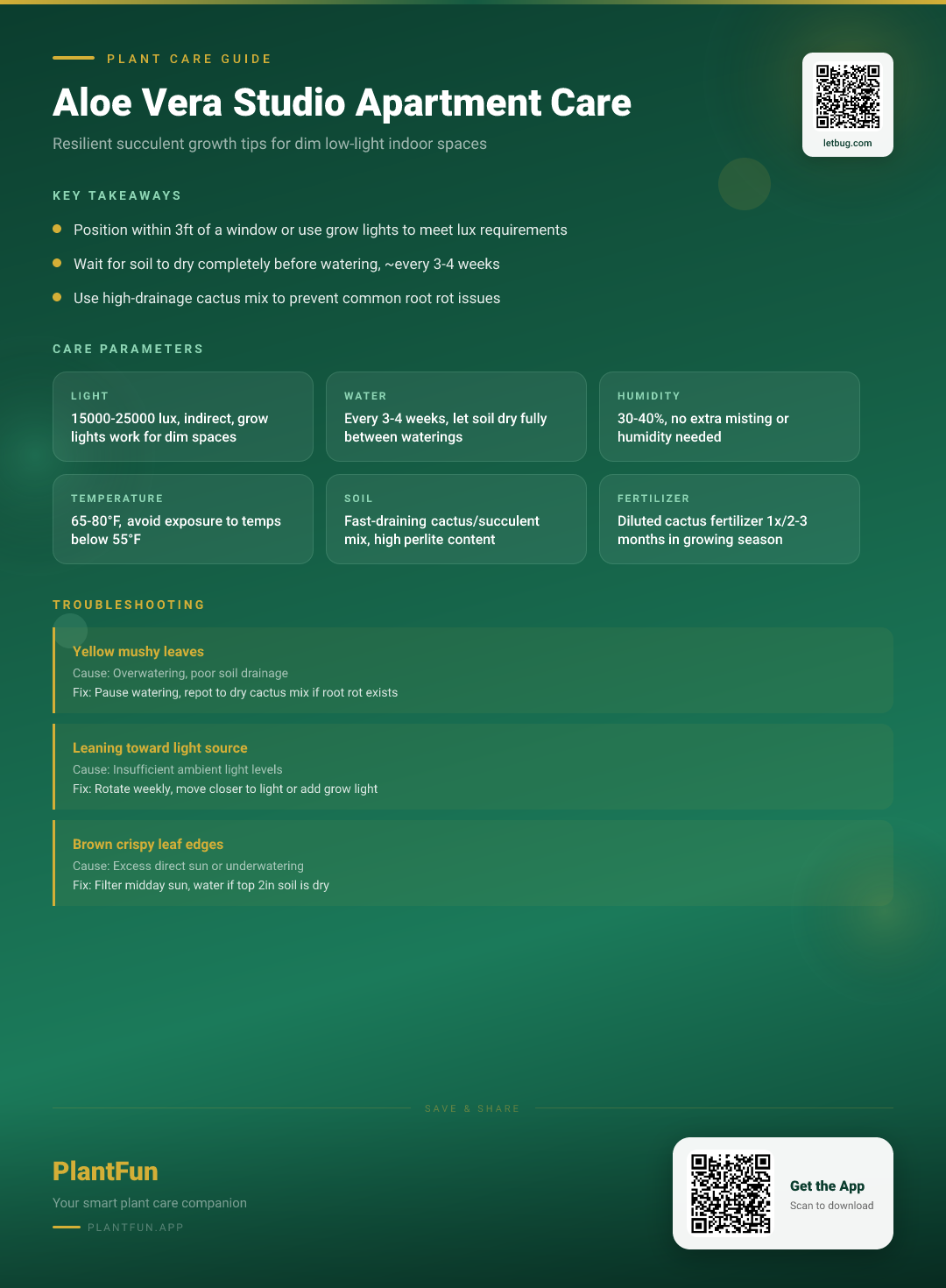
Key Takeaways
- Check soil moisture before watering — overwatering is the #1 killer of houseplants.
- Ensure your plant gets the right amount of light for its species.
- Be patient with recovery — most plants need 2–4 weeks to bounce back.
Quick Care Card: Essential Data
| Feature | Requirement |
|---|---|
| Light | 15,000–25,000 lux |
| Water | Every 3–4 weeks (check for 100% dry soil) |
| Temp | 65–80°F (18–27°C) |
| Humidity | 30–40% |
| Soil | Inorganic, well-draining succulent mix |
| Fertilizer | Minimal, balanced liquid (diluted) in summer |
| Toxicity | Toxic to cats and dogs (ASPCA, 2026) |
TL;DR: Why Your Studio Apartment Aloe Vera is Struggling
Your Aloe vera is struggling because studio apartments usually offer ambient light below 5,000 lux, while the plant requires 15,000–25,000 lux for healthy metabolism (NC State Extension, 2026). In low light, the plant’s photosynthetic rate drops, meaning it cannot process water efficiently. When you water on a regular calendar schedule, the soil remains wet too long, leading to the cellular breakdown of roots. To save your plant, increase light exposure significantly and lengthen the interval between waterings.
Understanding the Succulent Metabolism: Why Apartments are Tricky
When I first brought my Aloe vera into a studio apartment, I made the mistake of treating it like a standard tropical foliage plant. I kept it in a decorative pot without drainage and watered it whenever the surface looked dry. Within a month, the leaves turned mushy and translucent.
Succulents like Aloe have specialized succulent tissues adapted for arid environments (NC State Extension, 2026). They utilize a metabolic process called Crassulacean Acid Metabolism (CAM) to conserve water. In a low-light apartment, this biological clock is disrupted. If the plant doesn’t get enough energy from the sun, it cannot draw moisture up from the soil, creating a stagnant, waterlogged environment that invites pathogens (Plant Science Archives, 2019).
The Lighting Equation: Maximizing Photon Intake in Dim Interiors
If your plant isn’t within 2 feet of a south-facing window, it is likely light-starved. I recommend using a light meter app or a dedicated sensor to check your indoor lux.
- Maximize window time: Place the Aloe on the brightest windowsill available.
- Clean the glass: Dust and grime on windows can reduce light intensity by up to 20%.
- Artificial assistance: If you cannot reach 15,000 lux, add a full-spectrum LED grow light for 8–10 hours a day.
Watering by Soil Moisture, Not Calendar: A Step-by-Step Irrigation Guide
Forget the ‘once a week’ rule. In a low-light studio, your soil may take 4 weeks to dry out.
- The Finger Test: Insert your finger 2 inches deep into the soil. If you feel any dampness, wait another week.
- The Weight Test: Lift the pot. If it feels unexpectedly heavy, the soil is still holding significant water (Derbe, 2015).
- The Flush: When you do water, soak it until water runs freely from the drainage holes. Remove the excess immediately from the saucer to ensure the roots aren’t sitting in a pool of water.
Soil Science: Creating a Drainage-Heavy Medium That Prevents Root Rot
Most off-the-shelf potting mixes are too organic and hold too much water. For Aloe, I always modify store-bought succulent mix. My go-to recipe is 50% commercial succulent mix, 25% perlite, and 25% horticultural grit or pumice. This mineral-heavy blend ensures air circulation around the root zone, which is critical for preventing the microbial growth associated with root rot (Plant Science Archives, 2019).
Seasonal Shifts: Adjusting Care from High-Sun Summers to Low-Light Winters
During winter, the sun’s angle changes, and your apartment likely becomes dimmer. During this dormant period (NC State Extension, 2026), your Aloe needs almost no supplemental water. I drop my watering frequency to every 6–8 weeks in the deep winter months to match the plant’s decreased light absorption.
Voice Search FAQ
Why is my Aloe Vera leaning towards the window?
This is called phototropism. The plant is physically elongating its cells to reach for a stronger light source. Rotate the pot 90 degrees every time you water to encourage balanced growth.
How do I know if I have overwatered my Aloe plant?
Look for soft, mushy leaves, often starting at the base. The leaves may turn brown or translucent, and there may be a faint, sour odor coming from the soil, indicating root decay (Plant Science Archives, 2019).
Can I use grow lights for my indoor Aloe Vera?
Yes, and in a studio apartment, it is highly recommended. Position a white-spectrum LED 6–10 inches above the foliage for at least 8 hours a day to provide the intensity required for structural integrity.
Common Mistakes: Stop Doing These 3 Things Immediately
- Mistake: Using a pot without drainage holes. What happens: Water accumulates at the bottom, creating a swamp. Instead: Only use pots with drainage holes and saucers.
- Mistake: Misting your Aloe. What happens: Aloe is adapted to dry air; moisture trapped in the leaf rosettes causes crown rot. Instead: Keep the foliage dry and improve airflow.
- Mistake: Fertilizer in winter. What happens: The plant cannot process nutrients in low light, leading to salt buildup in the soil. Instead: Only fertilize sparingly during the peak summer growing season.
The LetBug Troubleshooting Table: Symptoms to Action
Soft, Mushy Leaves
Symptom: Leaves feel squishy or watery to the touch.
Likely cause: Chronic overwatering or poor drainage.
Fix:
- Gently remove the plant and inspect the roots; trim away any black, slimy root sections.
- Repot into a fresh, inorganic, fast-draining substrate.
Brown, Crispy Tips
Symptom: Tips are dry and brittle.
Likely cause: Dehydration or mineral buildup from tap water.
Fix:
- Increase water frequency slightly if soil is bone-dry.
- Use filtered or distilled water to avoid heavy metal accumulation (Derbe, 2015).
Pale, Stretched Growth
Symptom: Leaves are long, thin, and drooping.
Likely cause: Severe light deficiency (etiolation).
Fix:
- Move the plant to the brightest location possible.
- Consider adding a supplemental grow light.
References and Botanical Notes
- ASPCA. (2026). Toxic and Non-Toxic Plants List — ASPCA. https://www.aspca.org/pet-care/animal-poison-control/toxic-and-non-toxic-plants. Accessed 2026-03-11.
- NC State Extension. (2026). Aloe Vera — NC State Extension Gardener Plant Toolbox. https://plants.ces.ncsu.edu/plants/vera-care/. Accessed 2026-03-11.
- Plant Science Archives. (2019). Aloe vera plant products as antimicrobial agents. Plant Science Archives. https://doi.org/10.33680/plsa.2019.016. Accessed 2026-03-11.
- Derbe, T. (2015). Spectroscopic Investigation of Metal Level in Aloe Vera Plant, and the Soil Where the Aloe Vera Grows: Arba Minch, Southern Ethiopia. Modern Chemistry. https://doi.org/10.11648/j.mc.20150301.11. Accessed 2026-03-11.
Optional Helper: Plantfun.App
Plantfun.App identifies your plants by photo, diagnoses pests and diseases with clear fixes, and creates personalised watering and light schedules that adapt to your home conditions — a handy companion for putting this guide into daily practice.
Found an error or have suggestions? We'd love your feedback.
Need help identifying this problem?
Get instant identification, personalized care schedules, and effective pest treatment plans directly on your phone.
Sponsored • We may earn a commission from app downloads
Related Guides
Aloe Vera In Typical Small Apartments: The Only Resilient Growth Checklist You’ll Ever Need
Skip generic aloe care advice. Get exact light, water, and soil thresholds, plus a printable weekly checklist to keep your aloe vera thriving in any standard apartment.
Care GuideThe Complete Aloe Vera Care Guide for Small Low-Light Apartments: Resilient Growth On A Budget
Grow lush, gel-producing aloe vera in your apartment without expensive supplies. Get exact light, water, and soil parameters plus a free care checklist for year-round resilient growth.
Care GuideThe Complete Aloe Vera Care Guide for Typical Apartments: Seasonal Tips for Resilient Growth
Grow plump, hardy aloe vera in your apartment without guesswork. Get exact light, water, and soil thresholds plus a 4-season care routine to prevent browning and boost gel yield.
Pest ControlAnts on Plants: What They Mean and What to Do
Ants usually aren't eating your plant. They are farming other pests.