
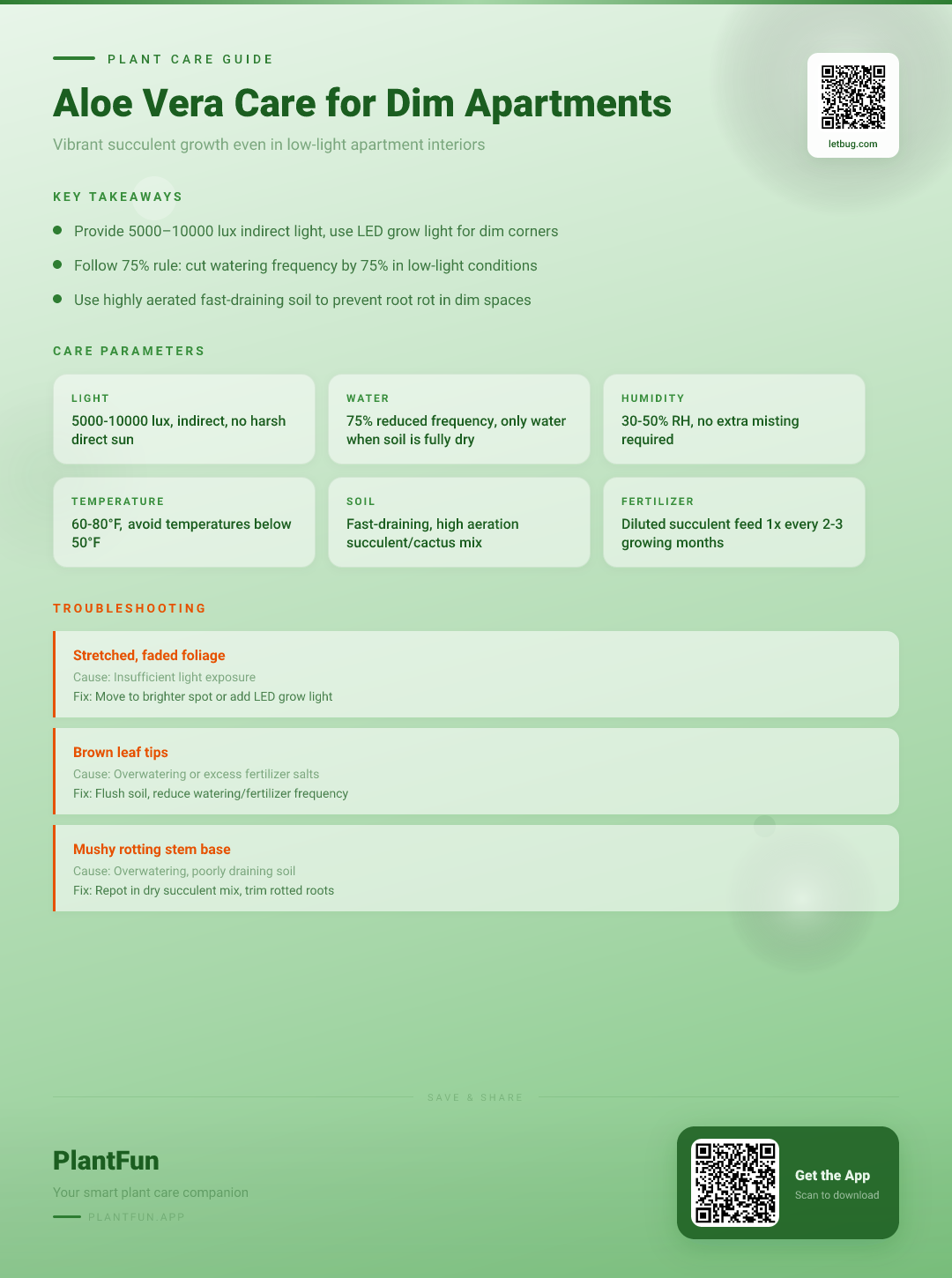
Key Takeaways
- Check soil moisture before watering — overwatering is the #1 killer of houseplants.
- Ensure your plant gets the right amount of light for its species.
- Be patient with recovery — most plants need 2–4 weeks to bounce back.
Quick Care Card: The Gold Standard for Apartment Aloe
| Feature | Requirement |
|---|---|
| Light | Bright, indirect; 5,000–10,000 lux |
| Water | Only when soil is 75% dry |
| Humidity | Low to moderate (30-50%) |
| Temperature | 60°F–75°F (15°C–24°C) |
| Soil | Well-draining cactus/succulent mix |
| Fertilizer | Diluted balanced liquid, sparse |
| Toxicity | Toxic to cats and dogs (ASPCA, 2026) |
TL;DR: The Reality of Keeping Aloe in Suboptimal Light
Can you keep an Aloe vera in an apartment with limited sun? Yes, but you must shift your mindset. Forget the “desert cactus” myth; your plant needs consistent, diffused light and precise water management to avoid rot. In dim spaces, you must aim for 5,000 to 10,000 lux—the threshold for photosynthesis without sunburn. By using an aerated potting mix and waiting until the soil is 75% dry before watering, you prevent the most common killer: root decay (NC State Extension, 2026).
Why Your Apartment Aloe Needs a Strategic Approach
When I first started collecting succulents, I made the mistake of treating my Aloe barbadensis Miller like a plastic decoration. I shoved it in a dark corner, watered it whenever I remembered, and watched in horror as the leaves turned mushy and “stretched.” This condition, known as etiolation, happens because the plant is desperately reaching for a light source that isn’t there. Because Aloe is a CAM (Crassulacean Acid Metabolism) photosynthetic plant, it closes its pores during the day to save water and opens them at night; this unique biology means it demands specific care to thrive indoors (Plant Science Archives, 2019).
Light Requirements: Achieving 5,000–10,000 Lux Without Direct Sun
Many apartment dwellers wonder if a north-facing window is enough. In my experience, north-facing windows often fall below the 5,000-lux threshold. To keep your Aloe healthy, place it as close to the glass as possible without allowing direct, scorching rays to hit the leaves for more than an hour. If you cannot reach these levels, the plant will stop producing chlorophyll, leading to a pale, weak appearance.
The 75% Rule: Why Watering Frequency Must Drop in Dim Interiors
In a bright desert, an Aloe might dry out in days. In your apartment, that same plant might hold moisture for weeks. I use the “75% rule”: before I touch my watering can, I check that the top three-quarters of the pot are bone dry. Watering based on a schedule is the primary cause of root rot in indoor succulents. If the soil stays damp, minerals and heavy metals can accumulate, stressing the plant further (Derbe, 2015).
Soil Science: Creating an Aerated Medium That Prevents Root Decay
Never use standard potting soil; it retains too much moisture. I mix one part standard succulent mix with one part perlite or pumice to ensure maximum aeration. Good drainage is your best defense against the pathogens that thrive in suffocating, wet conditions.
Seasonal Adjustments: Managing Dormancy in Temperature-Controlled Units
Your apartment’s central heating can trick your Aloe into thinking it’s summer. However, with reduced winter light, it needs a “cool-down” period. From November to February, I decrease my watering frequency by an additional 25%. This prevents the plant from attempting new, leggy growth in low-light conditions.
Step-by-Step: How to Assess if Your Aloe is Receiving Enough Energy
- Visual Check: Look for deep, green, firm leaves. If the leaves are flat or concave, they are losing stored energy.
- Lux Test: Use a light meter app to measure the surface of the leaves. Aim for 5,000 lux as your baseline.
- Growth Rate: Aloe should produce a leaf from the center every 4-6 weeks during active growth. No growth? You need more light.
Voice Search FAQ: Can I use an LED grow light to help my Aloe in a dark corner?
Yes. A full-spectrum LED grow light is a game-changer for urban gardeners. Position the light 6-12 inches above the plant for 10-12 hours a day to mimic natural conditions.
Voice Search FAQ: Why is my Aloe Vera turning brown at the tips in my living room?
This is usually a sign of either dehydration or salt buildup from tap water. If the tips are crispy, try using distilled water to flush the soil and increase your humidity slightly.
Voice Search FAQ: How do I know if the soil is dry enough to water again?
Don’t rely on the surface. Insert a wooden skewer or your finger 2-3 inches deep into the soil. If it comes out damp or with soil clinging to it, wait another three days.
Troubleshooting: Common Symptoms and Their Immediate Corrective Actions
[Soft, Mushy Leaf Bases]
Symptom: The base of the leaves turns translucent and collapses.
Likely cause: Chronic overwatering leading to root rot.
Fix:
- Remove the plant from the pot and inspect the roots for dark, slimy growth.
- Trim away rotten sections and repot in fresh, dry, porous succulent soil.
[Stretching or “Legginess”]
Symptom: Leaves are thin, pale, and reaching upward at extreme angles.
Likely cause: Insufficient light intensity.
Fix:
- Move the plant to a brighter location immediately.
- Rotate the pot weekly to ensure even growth.
[Reddish-Brown Discoloration]
Symptom: Leaves turning a reddish or bronze color.
Likely cause: Sun stress from moving into direct, intense light too quickly.
Fix:
- Move the plant back into indirect light.
- Allow the plant to acclimate over two weeks by slowly moving it closer to the sun.
[Shriveled, Wrinkled Leaves]
Symptom: The plant looks “deflated” and the leaves are curling inward.
Likely cause: Severe underwatering.
Fix:
- Deeply water the plant until moisture runs out the drainage hole.
- Avoid “sips” of water; soak the root ball thoroughly.
References
- American Society for the Prevention of Cruelty to Animals. (2026). Toxic and Non-Toxic Plants List — ASPCA. https://www.aspca.org/pet-care/animal-poison-control/toxic-and-non-toxic-plants. Accessed 2026-03-11.
- Plant Science Archives. (2019). Aloe vera plant products as antimicrobial agents. https://doi.org/10.33680/plsa.2019.016. Accessed 2026-03-11.
- Derbe, T. (2015). Spectroscopic Investigation of Metal Level in Aloe Vera Plant, and the Soil Where the Aloe Vera Grows: Arba Minch, Southern Ethiopia. Modern Chemistry. https://doi.org/10.11648/j.mc.20150301.11. Accessed 2026-03-11.
- North Carolina State University Extension. (2026). Aloe Vera — NC State Extension Gardener Plant Toolbox. https://plants.ces.ncsu.edu/plants/vera-care/. Accessed 2026-03-11.
Optional Helper: Plantfun.App
Plantfun.App identifies your plants by photo, diagnoses pests and diseases with clear fixes, and creates personalised watering and light schedules that adapt to your home conditions — a handy companion for putting this guide into daily practice.
Found an error or have suggestions? We'd love your feedback.
Need help identifying this problem?
Get instant identification, personalized care schedules, and effective pest treatment plans directly on your phone.
Sponsored • We may earn a commission from app downloads
Related Guides
Aloe Vera in a Dim Studio Apartment: A Resilient Growth Plan for Low-Light Survival
Revive your struggling Aloe Vera in a dim apartment. Get precise light levels, a 4-step watering schedule, and the recovery secrets to ensure thick, sturdy leaves.
Care GuideAloe Vera in a Dim Studio Apartment: The Ultimate Care Guide for Resilient Growth
Revive your struggling Aloe Vera with our data-driven guide. Learn the exact light thresholds, watering schedules, and soil mixes to guarantee resilient growth.
Care GuideAloe Vera In Typical Small Apartments: The Only Resilient Growth Checklist You’ll Ever Need
Skip generic aloe care advice. Get exact light, water, and soil thresholds, plus a printable weekly checklist to keep your aloe vera thriving in any standard apartment.
Pest ControlAnts on Plants: What They Mean and What to Do
Ants usually aren't eating your plant. They are farming other pests.