
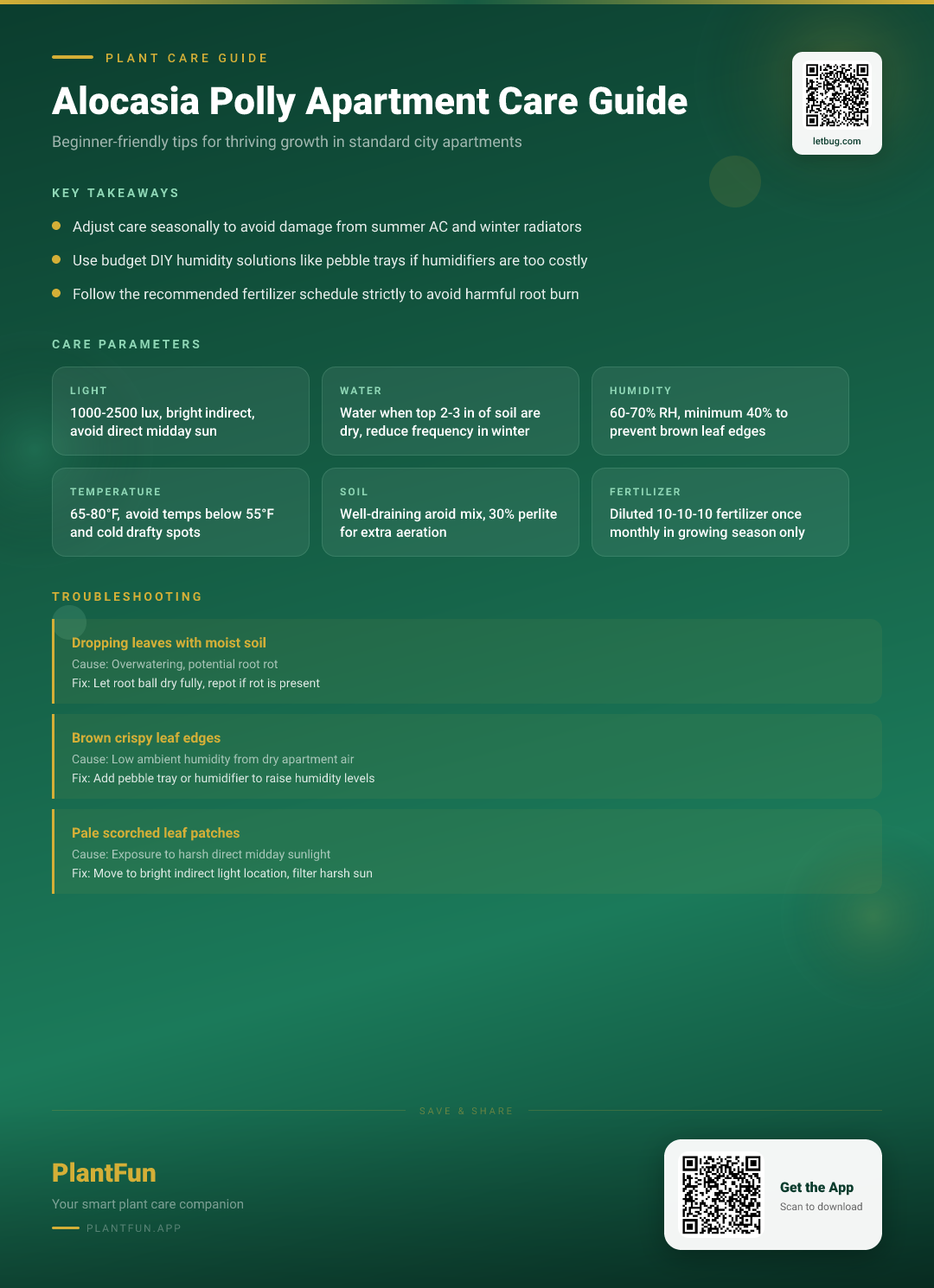
Key Takeaways
- Check soil moisture before watering — overwatering is the #1 killer of houseplants.
- Ensure your plant gets the right amount of light for its species.
- Be patient with recovery — most plants need 2–4 weeks to bounce back.
Quick Care Card: Essential Thresholds for Apartment Success
| Feature | Threshold |
|---|---|
| Light | Bright, indirect (2,000–5,000 lux) |
| Water | Allow top 2 inches to dry (NC State Extension, 2026) |
| Humidity | 50–60% constant |
| Temperature | 65°F–80°F (18°C–27°C) |
| Soil | Chunky, well-draining aroid mix |
| Fertilizer | Balanced liquid feed at half-strength, monthly |
| Toxicity | Toxic to cats and dogs (ASPCA, 2026) |
TL;DR: Why Alocasia Polly Struggle in Apartments (And How to Fix It)
Alocasia Polly often fail in apartments due to three primary stressors: low light, erratic watering, and dry heating systems. To fix this, move your plant within 3 feet of a window, water only when the top two inches of soil are dry, and group it with other plants to naturally boost local humidity. My experience has shown that consistency, not perfection, is the key to preventing the dreaded leaf drop.
Understanding the Habitat: Why Your Living Room Isn’t a Greenhouse
When I first brought home my Alocasia amazonica ‘Polly’, I treated it like a delicate fern. I made the mistake of keeping it in a dark corner, which triggered immediate dormancy. Unlike tropical jungles, apartments are characterized by static, dry air. As noted by the (Journal of Plant Biotechnology, 2004), Alocasia species require specific environmental conditions to maintain cell turgor and foliage health. Your living room lacks the circulating moisture of a rainforest floor, which means you must manually bridge that gap.
The 4 Pillars of Resilient Alocasia Growth: Light, Water, Soil, and Humidity
1. Light
These plants crave bright, indirect light. If you can see your shadow clearly, the light is likely sufficient.
2. Water
Use the “finger test”: stick your finger two inches into the soil. If it feels moist, wait. Overwatering is the fastest path to root rot (NC State Extension, 2026).
3. Soil
An ideal mix includes equal parts orchid bark, perlite, and high-quality potting soil to ensure the roots have access to oxygen.
4. Humidity
These plants are sensitive to ambient air moisture. Anything below 40% will cause leaf edges to crisp.
Seasonal Care Calendar: Adjusting for AC in Summer and Radiators in Winter
- Summer (AC Season): Keep your plant away from direct drafts. Air conditioning strips humidity rapidly. Increase misting or move away from vents.
- Winter (Radiator Season): Move the plant away from radiators. The dry, hot air is the primary cause of spider mite infestations. This is the time to prioritize winter plant care tips to maintain plant vigor.
Can I keep my Alocasia Polly in a low-light corner of my studio apartment?
While it may survive, it will not thrive. In low light, the plant stops producing energy, leading to smaller leaves and eventual yellowing. If you have no other space, consider a modest LED grow light to hit the threshold requirements mentioned in my care card.
Why is my Alocasia dropping leaves even though the soil is moist?
[Persistent Leaf Drop]
Symptom: Leaves yellow and drop while soil remains damp.
Likely cause: Root suffocation from overwatering.
Fix:
- Remove the plant from the pot to inspect roots.
- Trim away mushy, black roots.
- Repot in fresh, dry, porous soil.
How do I know if my apartment air is too dry for my plant?
Watch the leaf margins. If they turn brown and brittle while the rest of the leaf remains green, your humidity is too low. Using a hygrometer is the most accurate way to monitor this, as (Surahmaida, S.; Aisa, I., 2025) note the specific physiological needs of these leaves.
Budget-Friendly DIY Humidity Solutions: Pebbles vs. Humidifiers
A pebble tray filled with water and river stones can raise local humidity by 5–10%. While an ultrasonic humidifier is more effective, grouping your plants together creates a microclimate that mimics their natural environment more affordably.
The Step-by-Step Fertilizer Schedule: Avoiding Root Burn
- Use a balanced 10-10-10 liquid fertilizer.
- Dilute to 50% strength (1/2 teaspoon per gallon of water).
- Apply only during the growing season (spring and summer).
- Flush the soil with plain water every third feeding to prevent salt buildup.
Common Mistakes to Avoid: From Overpotting to Tap Water Sensitivity
- Mistake: Using a pot that is too large.
- What happens: Excess soil holds too much water, leading to root rot.
- Instead: Choose a pot only 1–2 inches wider than the root ball.
- Mistake: Using cold tap water.
- What happens: Cold water can shock the root system.
- Instead: Use room-temperature, filtered water.
References
- Journal of Plant Biotechnology. (2004). In Vitro Propagation of Alocasia cadieri Chantrier. https://doi.org/10.5010/jpb.2004.31.1.061. Accessed 2026-03-10.
- Surahmaida, S.; Aisa, I. (2025). Pharmacognostic Study of Donkey Ear Taro Leaves (Alocasia polly). Jurnal Biologi Tropis. https://doi.org/10.29303/jbt.v25i3.9239. Accessed 2026-03-10.
- ASPCA. (2026). Toxic and Non-Toxic Plants List — ASPCA. https://www.aspca.org/pet-care/animal-poison-control/toxic-and-non-toxic-plants. Accessed 2026-03-10.
- NC State Extension. (2026). Alocasia Polly — NC State Extension Gardener Plant Toolbox. https://plants.ces.ncsu.edu/plants/polly-care/. Accessed 2026-03-10.
Optional Helper: Plantfun.App
Plantfun.App identifies your plants by photo, diagnoses pests and diseases with clear fixes, and creates personalised watering and light schedules that adapt to your home conditions — a handy companion for putting this guide into daily practice.
Found an error or have suggestions? We'd love your feedback.
Need help identifying this problem?
Get instant identification, personalized care schedules, and effective pest treatment plans directly on your phone.
Sponsored • We may earn a commission from app downloads
Related Guides
Alocasia Polly in a Typical Apartment: The Complete Guide to Resilient Growth
Stop losing leaves on your Alocasia. Master 4 critical care metrics, seasonal watering cycles, and humidity tricks to grow a lush, resilient Polly at home.
Care GuideThe Complete Alocasia Polly Care Checklist for Thriving Growth in Small Urban Apartments
Skip pricy plant gadgets to keep your Alocasia Polly thriving in your apartment. Get exact light, water, and humidity thresholds plus a budget 8-step care checklist for resilient, lush growth.
Care GuideThe Complete Alocasia Polly Care Guide for Small Urban Apartments: Grow Lush Resilient Foliage
Stop watching your Alocasia drop leaves every winter. Get exact light, water, and humidity thresholds, plus a free printable checklist for lush, resilient growth in small urban apartments.
Pest ControlAnts on Plants: What They Mean and What to Do
Ants usually aren't eating your plant. They are farming other pests.