
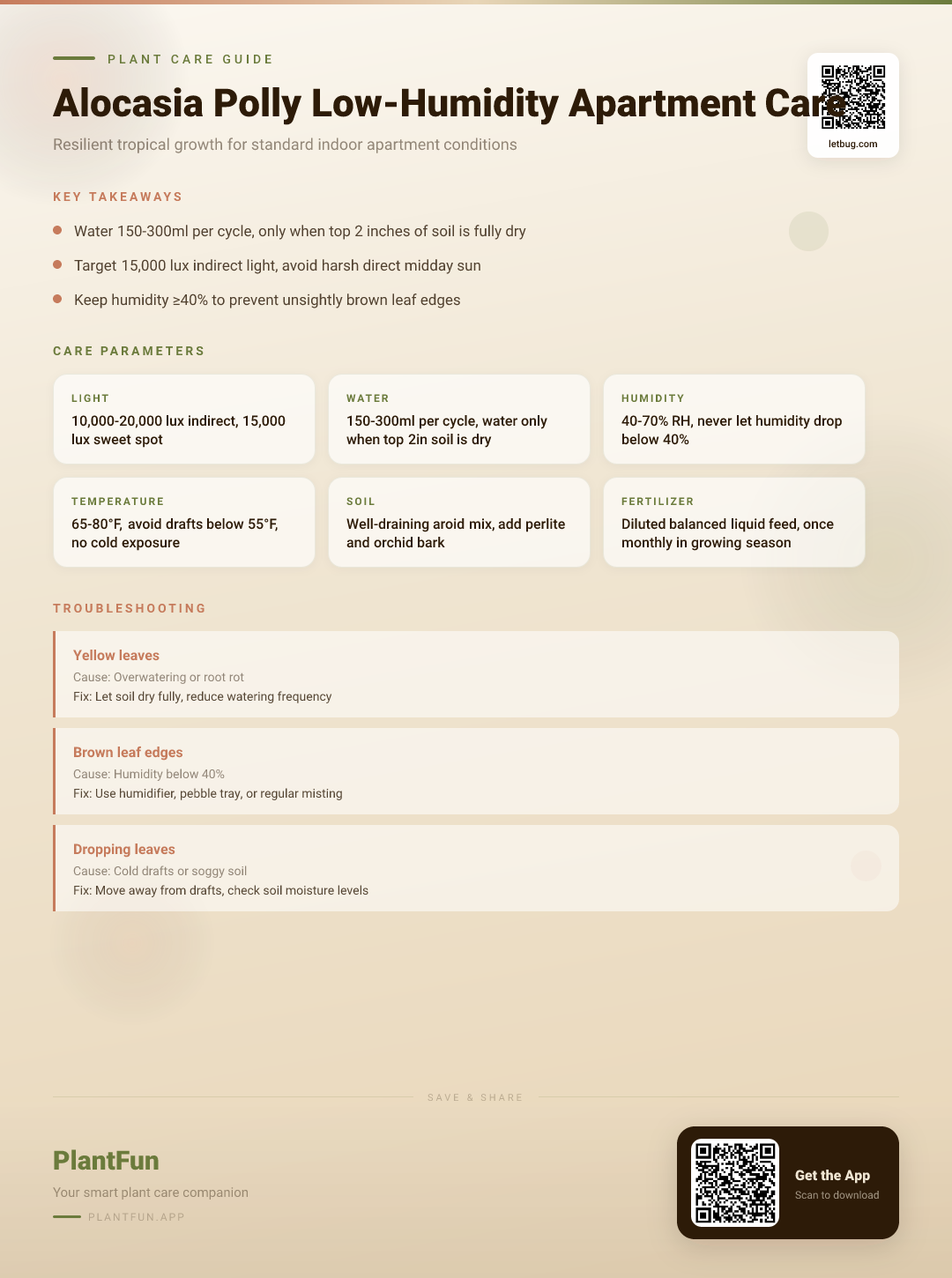
Key Takeaways
- Check soil moisture before watering — overwatering is the #1 killer of houseplants.
- Ensure your plant gets the right amount of light for its species.
- Be patient with recovery — most plants need 2–4 weeks to bounce back.
Quick Care Card: Essential Data for Alocasia Polly
| Feature | Requirement |
|---|---|
| Light | 15,000 lux (bright, indirect) |
| Watering | When top 2 inches of soil are dry |
| Humidity | 50% to 65% ideal; minimum 40% |
| Temperature | 65°F–80°F (18°C–27°C) |
| Soil | Chunky, well-draining aroid mix |
| Fertilizer | Balanced liquid feed at half-strength (monthly in growth) |
| Toxicity | Toxic to cats and dogs (ASPCA, 2026) |
TL;DR: Can an Alocasia Survive in Typical Apartment Conditions?
Yes, but it requires a shift from “set and forget” to “monitored care.” While these plants originate from high-humidity rainforest floors, they can acclimate to apartment life if you maintain a stable micro-climate above 40% humidity and avoid waterlogged roots. The key is consistent light and avoiding cold drafts, which often trigger the dormancy cycles many owners mistake for plant death.
Why Your Alocasia Needs More Than Just Watering
When I first brought my Alocasia amazonica ‘Polly’ home, I treated it like my Pothos—watering whenever the top layer looked dry. My plant responded with significant leaf drop within two weeks. I learned the hard way that Alocasia are sensitive to soil aeration and humidity fluctuations. Unlike sturdier houseplants, Alocasia Polly demands a specific balance of gas exchange in the roots and moisture in the air. If the ambient air is too dry, the plant loses moisture faster through its leaves than the roots can supply, leading to the dreaded crispy brown tips (NC State Extension, 2026).
Measurement Thresholds: Defining the Perfect Apartment Micro-Climate
To succeed, treat your Alocasia like a delicate scientific subject. In a typical apartment, moisture escapes quickly.
- Humidity Floor: 40%. Anything lower leads to rapid transpiration and yellowing.
- Temperature Stability: Avoid spots near heaters or AC vents. The plant thrives best between 65°F and 80°F (NC State Extension, 2026).
- Light Intensity: Aim for 15,000 lux. You can measure this using a free light-meter app on your phone, placing it at leaf level.
Step-by-Step: Adjusting Your Watering Schedule (150ml to 300ml per cycle)
Watering is not about a schedule; it is about moisture capacity.
- The Finger Test: Insert your finger 2 inches into the soil. If it feels cool and damp, do not water.
- The Pour: Use 150ml to 300ml of water, depending on pot size (typically 6-8 inches).
- The Drainage: Never let your plant sit in the cache pot with water. If water accumulates in the saucer, discard it immediately. Root rot is the fastest killer of indoor Alocasias.
- Frequency: In my home, this averages to every 8–10 days in the growing season, but never follow a clock—follow the soil moisture.
Mastering Humidity: How to Bridge the 40% Gap
If your apartment stays below 40% humidity, your plant will struggle.
- Grouping: Place your Alocasia near other plants to create a micro-climate of transpiration.
- Pebble Trays: Fill a shallow tray with pebbles and water. Place the pot on the pebbles—not directly in the water—to create a localized humidity boost.
- Humidifiers: If you are serious about growth, a small room humidifier set to 50% is the most effective solution for maintaining healthy foliage.
Light Requirements: Hitting the 15,000 Lux Sweet Spot
Alocasia Polly needs “bright indirect light.” This means the plant should “see” the sky but not the direct sun, which will burn its waxy leaves. If your plant is stretching or losing variegation/deep color, it needs more light. Conversely, if leaves bleach, move it further from the window.
Troubleshooting: Interpreting Leaf Yellowing and Droop Patterns
Yellowing Leaves (Lower)
Symptom: The oldest, lowest leaf turns yellow and eventually wilts.
Likely cause: Natural aging or overwatering.
Fix:
- Check soil moisture; if soggy, stop watering immediately.
- If soil is dry, ensure you are fertilizing during the growing season.
Drooping Stems
Symptom: Stems lose turgor pressure and flop over.
Likely cause: Dehydration or root system damage.
Fix:
- Check if the root ball has pulled away from the pot sides.
- If dry, give a thorough soak; if soil is wet, check for root rot.
Brown, Crispy Edges
Symptom: Edges of the leaves turn brown and brittle.
Likely cause: Low humidity or salt buildup from tap water.
Fix:
- Increase humidity to above 40%.
- Flush the soil with distilled water to remove mineral salts.
FAQ 1: Why is my Alocasia dropping leaves even when the soil feels moist?
This is a classic sign of “suffocation.” Even when soil is moist, if it is too dense (lacking perlite or orchid bark), the roots cannot get oxygen. This is why using the best soil mix is vital for recovering an Alocasia plant.
FAQ 2: Can I keep my Alocasia Polly in a drafty apartment living room?
No. Alocasia are highly sensitive to temperature fluctuations. A draft from a window or AC unit will cause the plant to drop leaves as a defensive mechanism. Keep it in a stable, temperate environment.
FAQ 3: How do I know if my Alocasia is suffering from root rot?
If you gently tip the plant out of its nursery pot, healthy roots should be firm and white. Rotting roots will be brown, mushy, and often smell foul. If you see this, you must trim the affected roots with sterile shears and repot into fresh, dry, porous substrate.
Seasonal Care: Adjusting Growth Habits for Winter and Summer
During the summer, your Alocasia will actively push new leaves. This is the time to fertilize monthly. In winter, growth slows down significantly (Surahmaida & Aisa, 2025). Reduce watering by 30% and stop fertilizing entirely until the days lengthen in spring.
Common Mistakes That Kill Apartment Alocasias
- Mistake: Using dense, garden-center potting soil.
- What happens: Roots lack oxygen and rot.
- Instead: Use an aroid mix containing coco coir, perlite, and bark.
- Mistake: Moving the plant constantly.
- What happens: The plant wastes energy acclimating to new light levels.
- Instead: Find one stable spot and leave it there.
References
- Journal of Plant Biotechnology. (2004). In Vitro Propagation of Alocasia cadieri Chantrier. Journal of Plant Biotechnology. https://doi.org/10.5010/jpb.2004.31.1.061. Accessed 2026-03-11.
- Surahmaida, S.; Aisa, I. (2025). Pharmacognostic Study of Donkey Ear Taro Leaves (Alocasia polly). Jurnal Biologi Tropis. https://doi.org/10.29303/jbt.v25i3.9239. Accessed 2026-03-11.
- ASPCA. (2026). Toxic and Non-Toxic Plants List — ASPCA. https://www.aspca.org/pet-care/animal-poison-control/toxic-and-non-toxic-plants. Accessed 2026-03-11.
- North Carolina State University Extension. (2026). Alocasia Polly — NC State Extension Gardener Plant Toolbox. https://plants.ces.ncsu.edu/plants/polly-care/. Accessed 2026-03-11.
Optional Helper: Plantfun.App
Plantfun.App identifies your plants by photo, diagnoses pests and diseases with clear fixes, and creates personalised watering and light schedules that adapt to your home conditions — a handy companion for putting this guide into daily practice.
Found an error or have suggestions? We'd love your feedback.
Need help identifying this problem?
Get instant identification, personalized care schedules, and effective pest treatment plans directly on your phone.
Sponsored • We may earn a commission from app downloads
Related Guides
Alocasia Polly in a Typical Apartment: The Complete Care Guide for Resilient Growth
Transform your Alocasia Polly into a resilient showpiece. Follow these exact lux thresholds and seasonal schedules to prevent leaf drop and ensure healthy growth.
Care GuideThe Complete Alocasia Polly Care Checklist for Resilient Growth in Urban Apartments
Grow a lush, happy Alocasia Polly even in a small, drafty apartment. Get exact light levels, watering amounts, and a seasonal care calendar to prevent yellow leaves and encourage new growth.
Care GuideBudget-Friendly Alocasia Polly Care Checklist for Resilient Growth in Small Urban Apartments
Grow a thriving Alocasia Polly in your small apartment on a tight budget. Get exact light levels, watering amounts, and zero-cost hacks to avoid yellow leaves and drooping year-round.
Pest ControlAnts on Plants: What They Mean and What to Do
Ants usually aren't eating your plant. They are farming other pests.