
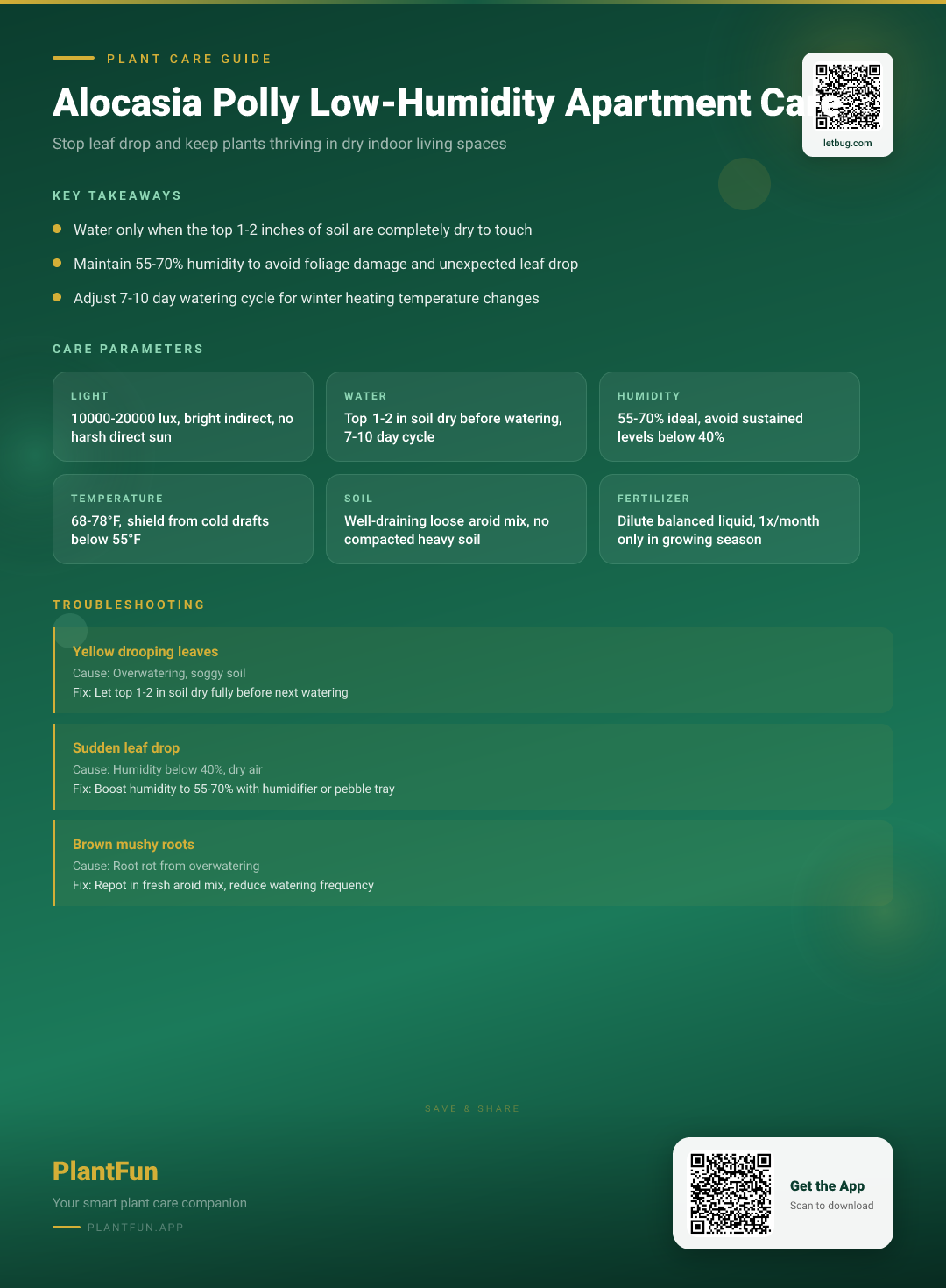
Key Takeaways
- Check soil moisture before watering — overwatering is the #1 killer of houseplants.
- Ensure your plant gets the right amount of light for its species.
- Be patient with recovery — most plants need 2–4 weeks to bounce back.
Quick Care Card: Essential Thresholds for Apartment Success
| Feature | Requirement |
|---|---|
| Light | 10,000–20,000 lux (bright, indirect) |
| Water | Top 1–2 inches of soil dry |
| Humidity | 55–70% |
| Temperature | 68–78°F (20–25°C) |
| Soil | Well-draining, airy aroid mix |
| Fertilizer | Balanced liquid feed, half-strength (monthly) |
| Toxicity | Toxic to pets and humans (ASPCA, 2026) |
TL;DR: The Reality of Keeping Alocasia in Dry Living Spaces
Alocasia ‘Polly’ (African Mask Plant) thrives in tropical environments, making the average apartment—often dropping below 40% humidity—an uphill battle. To keep it alive, you must prioritize localized humidity and strict soil moisture regulation. If you see crisping edges or premature leaf drop, it is a direct signal of environmental stress. Stabilizing these variables is not just possible; it is a repeatable science.
Identifying the Problem: Distinguishing Between Dormancy and Environmental Stress
When I first brought home my own Alocasia Polly, I panicked when it dropped its oldest leaf within a week. I assumed it was dying, but in reality, it was simply acclimating to my living room.
Distinguishing stress from dormancy is vital:
- Dormancy: Typically happens in winter when light levels drop. The plant stops growing and may lose all its foliage, but the corm (the root-like bulb) remains firm in the soil.
- Environmental Stress: This occurs year-round. Symptoms include yellowing leaves that remain attached, brown and crispy leaf margins, or stalks that droop (wilt) despite damp soil. If your plant is losing leaves while the environment is warm and bright, it is suffering from an improper humidity-to-water ratio.
Root Cause Analysis: Why Apartment Humidity Levels Under 40% Destroy Foliage
Modern apartments often feature forced-air heating that strips moisture from the air. Because the leaf surface of the Alocasia is designed to transpire in high-moisture environments, the plant struggles to regulate internal water pressure when the air is too dry (Surahmaida & Aisa, 2025). When transpiration outpaces water uptake, the plant pulls moisture away from the leaf tips, leading to that tell-tale browning.
Immediate Rescue Steps: Stabilizing the Micro-Climate Without a Greenhouse
If your plant is currently struggling, follow these steps to stabilize it immediately:
- Create a Humidity Zone: Group your Alocasia with other tropical plants to create a shared micro-climate.
- Utilize a Pebble Tray: Place your pot on a tray filled with pebbles and water, ensuring the pot sits above the water line. This increases ambient humidity directly around the foliage.
- Lux Calibration: Move your plant to within 2–3 feet of a bright, east-facing window. If you don’t have a light meter, ensure it is in a spot where it can clearly “see” the sky without direct sun touching its leaves (NC State Extension, 2026).
- Soil Check: Insert your finger 2 inches into the soil. If it feels wet, stop watering. Your plant likely needs time to recover its root health.
- Airflow: Ensure there is gentle air movement. Stagnant, dry air is worse for leaf tissue than moving air, but avoid placing the plant directly in the path of a heater vent.
Long-Term Maintenance: Mastering the 7-10 Day Watering Cycle
I recommend a ‘check and react’ system rather than a strict calendar. Stick your finger 2 inches into the soil; if it is dry, it is time to water (NC State Extension, 2026). Overwatering is the most common cause of failure in domestic Alocasia care. When you water, ensure the excess drains completely from the bottom of the pot. Never let the plant sit in standing water, as this encourages root rot (Journal of Plant Biotechnology, 2004).
Common Mistakes: Stop These 3 Habits That Lead to Root Rot
- Mistake: Watering on a rigid schedule (e.g., every Monday). What happens: The soil remains waterlogged, suffocating the roots. Instead: Use the finger-test method to check soil moisture regardless of the date.
- Mistake: Placing the plant in low light. What happens: Lower light levels decrease the plant’s metabolic rate, meaning it uses less water, often leading to rot. Instead: Prioritize bright, indirect light to keep the plant’s metabolic processes efficient.
- Mistake: Heavy, dense potting soil. What happens: Dense soil lacks the aeration required for healthy Alocasia roots. Instead: Use an airy, chunky mix containing perlite, orchid bark, and high-quality peat or coco coir.
FAQ: Why is my Alocasia Polly dropping leaves even though the soil is wet?
This is a classic sign of root suffocation. The roots are likely struggling due to a lack of oxygen in the soil or cold temperatures preventing proper water uptake. Check for mushy roots—if present, you must repot into a fresh, well-draining medium.
FAQ: Can I keep my Alocasia in a dry apartment if I mist it daily?
I often caution against misting. It provides only a fleeting spike in humidity and, if water sits on the leaves too long, it can encourage fungal issues. A small humidifier or a pebble tray is far more effective for long-term health.
FAQ: How do I know if my Alocasia is just going dormant?
If the days are shortening and the temperature drops, the plant may slow down. If it remains firm at the base, it is likely just resting. Reduce watering frequency significantly during this phase, but do not let the corm dry out completely.
Seasonal Care Calendar: Adjusting for Winter Heating Cycles
During winter, your indoor humidity will likely hit its lowest point. Monitor your radiator usage closely. You may need to increase the frequency of your pebble tray refills or move the plant away from heat sources. Always keep the plant away from drafty windows, as Alocasia is sensitive to cold shock (NC State Extension, 2026).
References
- Journal of Plant Biotechnology. (2004). In Vitro Propagation of Alocasia cadieri Chantrier. https://doi.org/10.5010/jpb.2004.31.1.061. Accessed 2026-03-18.
- Surahmaida, S.; Aisa, I. (2025). Pharmacognostic Study of Donkey Ear Taro Leaves (Alocasia polly). Jurnal Biologi Tropis. https://doi.org/10.29303/jbt.v25i3.9239. Accessed 2026-03-18.
- ASPCA. (2026). Toxic and Non-Toxic Plants List — ASPCA. https://www.aspca.org/pet-care/animal-poison-control/toxic-and-non-toxic-plants. Accessed 2026-03-18.
- NC State Extension. (2026). Alocasia Polly — NC State Extension Gardener Plant Toolbox. https://plants.ces.ncsu.edu/plants/polly-care/. Accessed 2026-03-18.
Optional Helper: Plantfun.App
Plantfun.App identifies your plants by photo, diagnoses pests and diseases with clear fixes, and creates personalised watering and light schedules that adapt to your home conditions — a handy companion for putting this guide into daily practice.
Found an error or have suggestions? We'd love your feedback.
Need help identifying this problem?
Get instant identification, personalized care schedules, and effective pest treatment plans directly on your phone.
Sponsored • We may earn a commission from app downloads
Related Guides
Alocasia in Low-Humidity Apartments: The Essential Guide to Keeping Leaves Healthy and Vibrant
Stop your Alocasia leaves from browning. Discover the exact 60% humidity target, precise light ranges, and a step-by-step recovery plan for lush apartment growth.
Care GuideAlocasia Polly in a Typical Apartment: The Complete Care Guide for Resilient Growth
Transform your struggling Alocasia into a lush centerpiece. Follow our 4-point resilient growth plan for exact light, water, and humidity levels every apartment needs.
Care GuideAlocasia Amazonica in a Dim Apartment: The Resilient Growth Guide for Low-Light Survival
Stop killing your Alocasia. Master the 4 key environmental thresholds for low-light survival and keep your leaves thriving in any apartment setting today.
Pest ControlAnts on Plants: What They Mean and What to Do
Ants usually aren't eating your plant. They are farming other pests.