
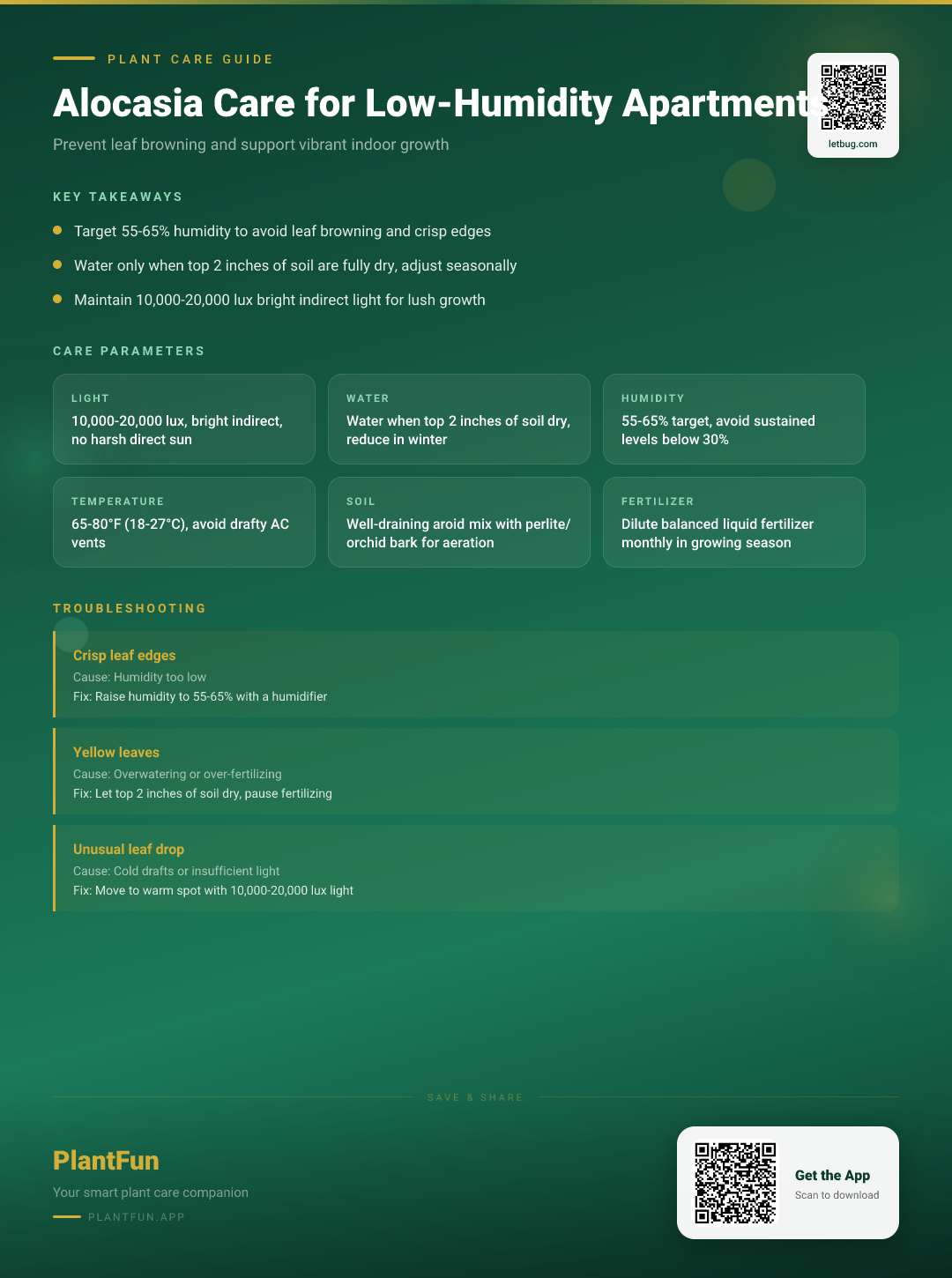
Key Takeaways
- Check soil moisture before watering — overwatering is the #1 killer of houseplants.
- Ensure your plant gets the right amount of light for its species.
- Be patient with recovery — most plants need 2–4 weeks to bounce back.
Quick Care Card: Essential Data for Thriving Alocasias
| Feature | Requirement |
|---|---|
| Light | 10,000–20,000 lux (Bright, indirect) |
| Water | Allow top 2 inches to dry between waterings |
| Humidity | 55–65% (Optimal for lush foliage) |
| Temperature | 65–80°F (18–27°C) |
| Soil Mix | Highly porous, chunky aroid mix |
| Fertilizer | Balanced liquid feed, monthly in season |
| Toxicity | Toxic to cats and dogs (ASPCA, 2026) |
TL;DR: The 3 Pillars of Resilient Alocasia Growth
To stop the cycle of browning leaves in an apartment, focus on these three non-negotiables: stabilize your humidity between 55-65%, provide bright, filtered light (avoiding direct midday sun), and maintain a strict watering schedule that prevents soil compaction (NC State Extension, 2026). When I first started growing these in my drafty apartment, I made the mistake of placing my Alocasia near a vent; keeping them away from sudden temperature shifts is just as critical as the humidity itself.
Why Your Apartment Environment Stresses Your Alocasia
Your apartment is a challenging environment for tropicals. While they are beautiful, Alocasias are specialized plants that thrive in high-moisture ecosystems (Miyake & Yafuso, 2005). Most homes sit around 30-40% humidity, which is essentially a desert for these plants. This lack of moisture causes the plant to lose water through its leaves faster than its roots can pull it from the soil, leading to the dreaded crispy, brown edges common in urban indoor gardening.
Decoding Symptoms: Leaf Drop vs. Crisp Edges vs. Yellowing
[Brown, Crispy Edges]
Symptom: Leaf margins become thin, brittle, and brown.
Likely cause: Chronic low humidity or erratic watering.
Fix:
- Increase ambient humidity with a dedicated ultrasonic humidifier.
- Group plants together to create a localized microclimate.
[Yellowing Lower Leaves]
Symptom: The oldest (lowest) leaf turns entirely yellow.
Likely cause: Natural senescence or inefficient root function.
Fix:
- Check if the plant is root-bound.
- Monitor if the yellowing stops after one leaf drops; if it spreads, check for overwatering.
[Sudden Droop or Collapse]
Symptom: Healthy-looking leaves lose turgor pressure and flop over.
Likely cause: Root rot due to dense soil.
Fix:
- Remove the plant from the pot and inspect roots for mushy, foul-smelling sections.
- Repot into a specialized aroid soil mix that prioritizes drainage.
Thresholds: Managing 10,000-20,000 lux and 55-65% Humidity
In an apartment, light quality varies wildly. I use a simple light meter app to ensure my plants receive at least 10,000 lux. If you find your plant reaching for light, it needs to move closer to the window. Humidity must be maintained above 55%; I rely on a hygrometer to track this daily. When the air drops, my humidifier automatically kicks in to maintain the equilibrium needed for cell expansion and growth (Journal of Plant Biotechnology, 2004).
Watering Mastery: Using the 2-Inch Rule and Seasonal Adjustments
When learning how to water your houseplants effectively, the “two-inch test” is my gold standard. Stick your finger two inches into the substrate; if it feels dry, it is time to water. In the summer, your Alocasia is a heavy drinker, but in winter, growth slows significantly, requiring a 30-40% reduction in water volume to prevent root rot.
Temperature Precision: Keeping Your Plant Between 65-80°F (18-27°C)
Alocasias are sensitive to cold drafts. If your apartment temperature dips below 60°F, the plant may initiate an early dormancy phase. Keep them away from front doors and air conditioning vents to maintain a steady ambient temperature.
Addressing the Myth: Are Pebbles Trays Actually Effective?
Many resources suggest pebble trays. In my experience, they are ineffective in low-humidity apartments. They simply do not provide the massive evaporation rate required to shift the humidity around a broad-leafed plant like an Alocasia. A humidifier is the only true solution for a plant suffering from dry air.
Voice Search FAQ
Why is my Alocasia dropping its lowest leaf?
This is often natural shedding of older foliage as the plant directs energy to new growth. However, if multiple leaves drop simultaneously, check for watering issues or temperature stress (NC State Extension, 2026).
Can I keep my Alocasia in an apartment with 30% humidity?
Technically, yes, but it will struggle. It will likely lose leaves and suffer from brown tips unless you use a cloche or a local humidifier to create a 60% zone around the plant.
Seasonal Care Calendar: Transitioning from Summer Growth to Winter Dormancy
- Spring/Summer: Increase light exposure, water when the top 1 inch is dry, and feed monthly.
- Autumn: Gradually reduce water as temperatures drop; bring the plant inside if it was moved to a balcony.
- Winter: Maintain at least 65°F. Keep in brighter light if available to prevent dormancy.
Common Mistakes: Avoiding Over-Fertilizing and Drafty AC Vents
- Mistake: Over-fertilizing during winter.
- What happens: Salt buildup burns the roots.
- Instead: Cease fertilization entirely when the plant is dormant.
- Mistake: Placing the plant in the direct path of an AC vent.
- What happens: Accelerated moisture loss and leaf curling.
- Instead: Relocate the plant to a spot with gentle, ambient air circulation.
References
- Journal of Plant Biotechnology. (2004). In Vitro Propagation of Alocasia cadieri Chantrier. https://doi.org/10.5010/jpb.2004.31.1.061. Accessed 2026-03-11.
- MIYAKE, T.; YAFUSO, M. (2005). Pollination of Alocasia cucullata (Araceae) by two Colocasiomyia flies known to be specific pollinators for Alocasia odora. Plant Species Biology. https://doi.org/10.1111/j.1442-1984.2005.00139.x. Accessed 2026-03-11.
- ASPCA. (2026). Toxic and Non-Toxic Plants List — ASPCA. https://www.aspca.org/pet-care/animal-poison-control/toxic-and-non-toxic-plants. Accessed 2026-03-11.
- NC State Extension. (2026). Alocasia — NC State Extension Gardener Plant Toolbox. https://plants.ces.ncsu.edu/plants/alocasia-care/. Accessed 2026-03-11.
Optional Helper: Plantfun.App
Plantfun.App identifies your plants by photo, diagnoses pests and diseases with clear fixes, and creates personalised watering and light schedules that adapt to your home conditions — a handy companion for putting this guide into daily practice.
Found an error or have suggestions? We'd love your feedback.
Need help identifying this problem?
Get instant identification, personalized care schedules, and effective pest treatment plans directly on your phone.
Sponsored • We may earn a commission from app downloads
Related Guides
Alocasia Polly in a Low-Humidity Apartment: The Ultimate Care Guide for Resilient Growth
Prevent yellowing leaves and brown edges on your Alocasia Polly. Learn exact humidity ranges and water cycles to keep your tropical houseplant thriving today.
Care GuideAlocasia Polly in a Typical Apartment: The Complete Guide to Resilient Growth
Stop losing leaves on your Alocasia. Master 4 critical care metrics, seasonal watering cycles, and humidity tricks to grow a lush, resilient Polly at home.
Care GuideThe Complete Alocasia Polly Care Checklist for Resilient Growth in Urban Apartments
Grow a lush, happy Alocasia Polly even in a small, drafty apartment. Get exact light levels, watering amounts, and a seasonal care calendar to prevent yellow leaves and encourage new growth.
Pest ControlAnts on Plants: What They Mean and What to Do
Ants usually aren't eating your plant. They are farming other pests.