
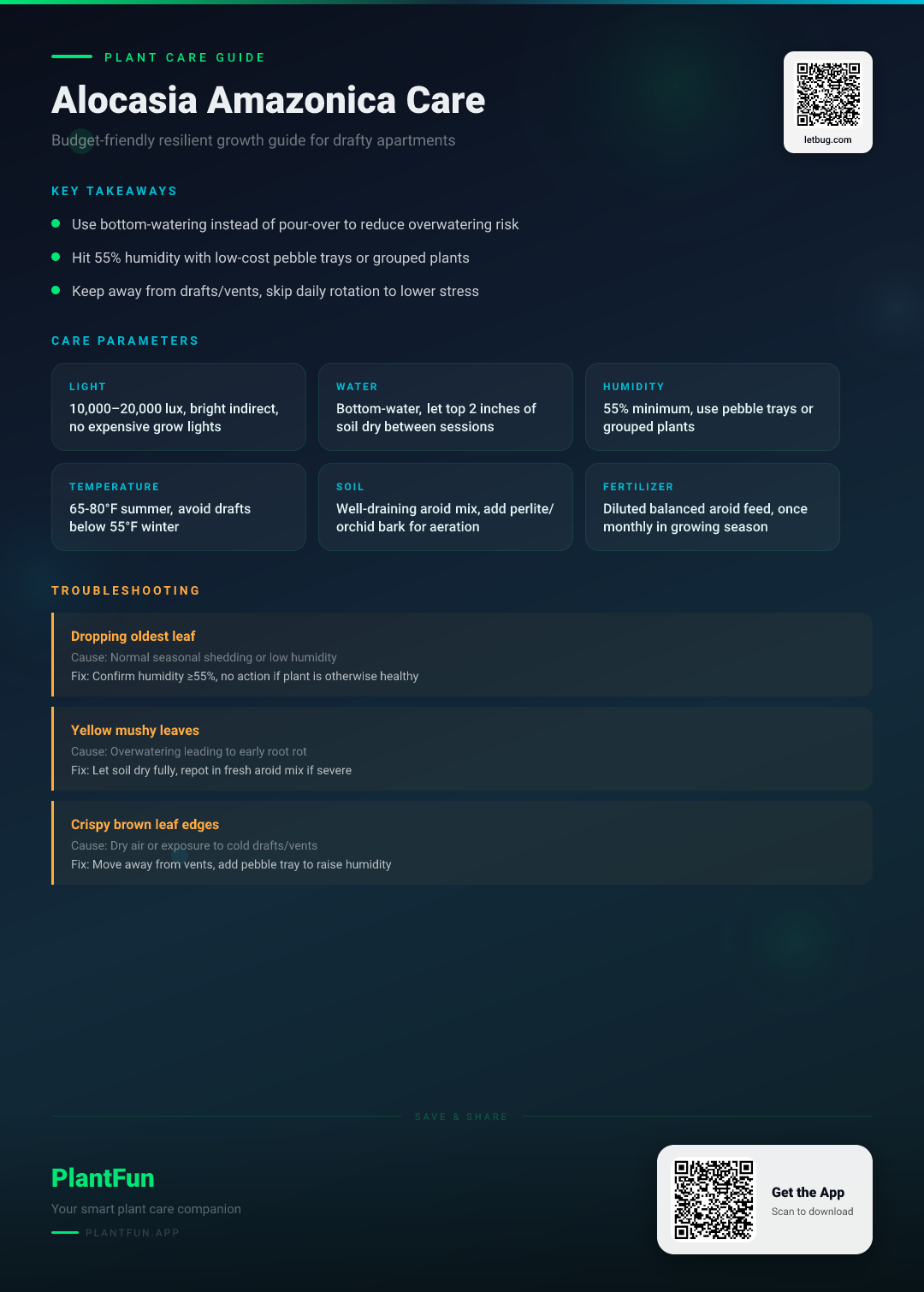
Key Takeaways
- Check soil moisture before watering — overwatering is the #1 killer of houseplants.
- Ensure your plant gets the right amount of light for its species.
- Be patient with recovery — most plants need 2–4 weeks to bounce back.
Quick Care Card: The Essential Metrics for Success
| Feature | Requirement |
|---|---|
| Light | Bright, indirect (10,000–20,000 lux) |
| Water | Allow top 2 inches to dry; use bottom-watering |
| Humidity | 55%–65% (Maintain via grouping or pebble trays) |
| Temperature | 65°F–80°F (Avoid drafts) |
| Soil | Chunky, well-draining aroid mix |
| Fertilizer | Balanced liquid feed, monthly during growth |
| Toxicity | Toxic to cats and dogs (ASPCA, 2026) |
TL;DR: Why Your Alocasia Needs a Microclimate Strategy
When I first started keeping Alocasia amazonica in my small apartment, I assumed that buying expensive automated humidifiers was the only way to prevent leaf crisping. I was wrong. Success with this species in a drafty apartment isn’t about expensive gear; it’s about creating a consistent microclimate. By grouping plants to trap transpiration and using bottom-watering techniques, you can stabilize moisture levels without spending a dime on electricity. This plant thrives when its environment remains steady, not when it is constantly forced to adapt to HVAC cycles.
Understanding Your Apartment’s Micro-Climates: Avoiding Drafts and Vents
My first Alocasia suffered immensely because I placed it near a window that leaked cold air in the winter and directly in the path of my AC unit in the summer. Alocasia amazonica is sensitive to temperature fluctuations (NC State Extension, 2026). In an apartment, you must identify “dead zones”—spots that are shielded from direct air currents.
- The Draft Test: Hold a thin piece of tissue paper near the plant’s spot. If it moves frequently, you have a draft.
- The Vent Rule: Never place your plant within 4 feet of a heating or cooling vent.
Light Requirements: Achieving 10,000–20,000 Lux Without Expensive Grow Lights
To keep your plant bushy, aim for 10,000 to 20,000 lux. In my apartment, this meant placing the plant roughly 18 inches from an east-facing window. You don’t need industrial lights; natural light filtered through a sheer curtain is often enough to mimic the dappled light of the forest floor. If your leaves are stretching (etiolation), move the plant a few inches closer to the light source, but monitor for leaf scorching.
Hydration Science: Why ‘Bottom-Watering’ Beats the Pour-Over Method
Watering frequency for Alocasia depends on your specific apartment’s ambient temperature and light. I recommend the “finger test”: stick your finger 2 inches into the soil. If it feels dry, it is time to water. I prefer bottom-watering—placing the pot in a bowl of water for 20 minutes—because it ensures the root zone is saturated without water-logging the crown, which helps prevent pathogens like Pectobacterium aroidearum that cause soft rot (Mikiciński et al., 2023).
Humidity Hacking: Using Pebble Trays and Grouping for 55% Moisture Levels
Increasing humidity for plants doesn’t require a humidifier. When I group my Alocasia with other tropicals, the plants create a collective micro-climate, trapping moisture as they transpire. Alternatively, place your pot on a tray filled with pebbles and water. Ensure the base of the pot sits above the water line to prevent root rot. This simple setup can raise local humidity significantly.
Seasonal Care Calendar: Adjusting for 65-80°F Summer and Cool Winters
- Spring/Summer (65–80°F): Active growth phase. Increase water slightly and apply a balanced liquid fertilizer diluted to half-strength.
- Autumn/Winter (Below 65°F): The plant enters semi-dormancy. Reduce watering frequency significantly. Because growth slows down, the plant requires less moisture, making this the most common time for rot to occur.
Common Mistakes: Stop Rotating Your Alocasia Daily
- Mistake: Rotating the plant every day.
- What happens: The plant wastes energy constantly re-orienting its leaves toward the light source.
- Instead: Only rotate once every two weeks by 90 degrees if you notice it leaning heavily.
Voice FAQ: Why is my Alocasia dropping its oldest leaf?
It is perfectly normal for your Alocasia to shed its oldest leaf to provide energy for a new one. However, if multiple leaves are yellowing simultaneously, you are likely overwatering or facing a drainage issue (NC State Extension, 2026).
Voice FAQ: How can I tell if my apartment is too dry for my Alocasia?
If the edges of your leaves are turning crispy brown or curling inward, your humidity is likely falling below 40%. You can verify this with an inexpensive analog hygrometer.
Troubleshooting: Recognizing Early Signs of Root Rot vs. Drought Stress
Root Rot Symptoms
Symptom: Leaves turn yellow with mushy brown spots at the base.
Likely cause: Over-saturated soil preventing oxygen from reaching the roots.
Fix:
- Check the root ball for black, slimy, or foul-smelling roots.
- Trim diseased tissue and repot in fresh, well-draining aroid mix.
Drought Stress
Symptom: Leaves drooping and soil pulling away from the pot edge.
Likely cause: Inconsistent watering schedule or excessive heat.
Fix:
- Submerge the pot in water for 30 minutes to rehydrate the soil medium.
- Introduce a mulch layer of sphagnum moss to retain moisture.
References
- Mikiciński, A., Warabieda, M., & Nowak, J. (2023). First report on Pectobacterium aroidearum, a new pathogen causing soft rot on alocasia (Alocasia amazonica) in Poland. Journal of Plant Pathology. https://doi.org/10.1007/s42161-023-01369-2. Accessed 2026-03-16.
- Raju, R., Hashi, A., & Jazib, A. (2022). Micropropagation of Alocasia amazonica through Indirect Shoot Organogenesis. Plant Tissue Culture and Biotechnology. https://doi.org/10.3329/ptcb.v32i1.60468. Accessed 2026-03-16.
- ASPCA. (2026). Toxic and Non-Toxic Plants List — ASPCA. https://www.aspca.org/pet-care/animal-poison-control/toxic-and-non-toxic-plants. Accessed 2026-03-16.
- NC State Extension. (2026). Alocasia Amazonica — NC State Extension Gardener Plant Toolbox. https://plants.ces.ncsu.edu/plants/amazonica-care/. Accessed 2026-03-16.
Optional Helper: Plantfun.App
Plantfun.App identifies your plants by photo, diagnoses pests and diseases with clear fixes, and creates personalised watering and light schedules that adapt to your home conditions — a handy companion for putting this guide into daily practice.
Found an error or have suggestions? We'd love your feedback.
Need help identifying this problem?
Get instant identification, personalized care schedules, and effective pest treatment plans directly on your phone.
Sponsored • We may earn a commission from app downloads
Related Guides
Alocasia in Low-Humidity Apartments: The Essential Guide to Keeping Leaves Healthy and Vibrant
Stop your Alocasia leaves from browning. Discover the exact 60% humidity target, precise light ranges, and a step-by-step recovery plan for lush apartment growth.
Care GuideAlocasia Polly in a Low-Humidity Apartment: The Ultimate Care Guide for Resilient Growth
Prevent yellowing leaves and brown edges on your Alocasia Polly. Learn exact humidity ranges and water cycles to keep your tropical houseplant thriving today.
Care GuideThe Complete Alocasia Amazonica Care Checklist for Resilient Growth in Small Urban Apartments
Grow lush, crisp Alocasia Amazonica leaves even in dry small apartments. Get exact light, water, humidity thresholds plus a 7-point weekly checklist to prevent yellowing and dormancy.
Pest ControlAnts on Plants: What They Mean and What to Do
Ants usually aren't eating your plant. They are farming other pests.