
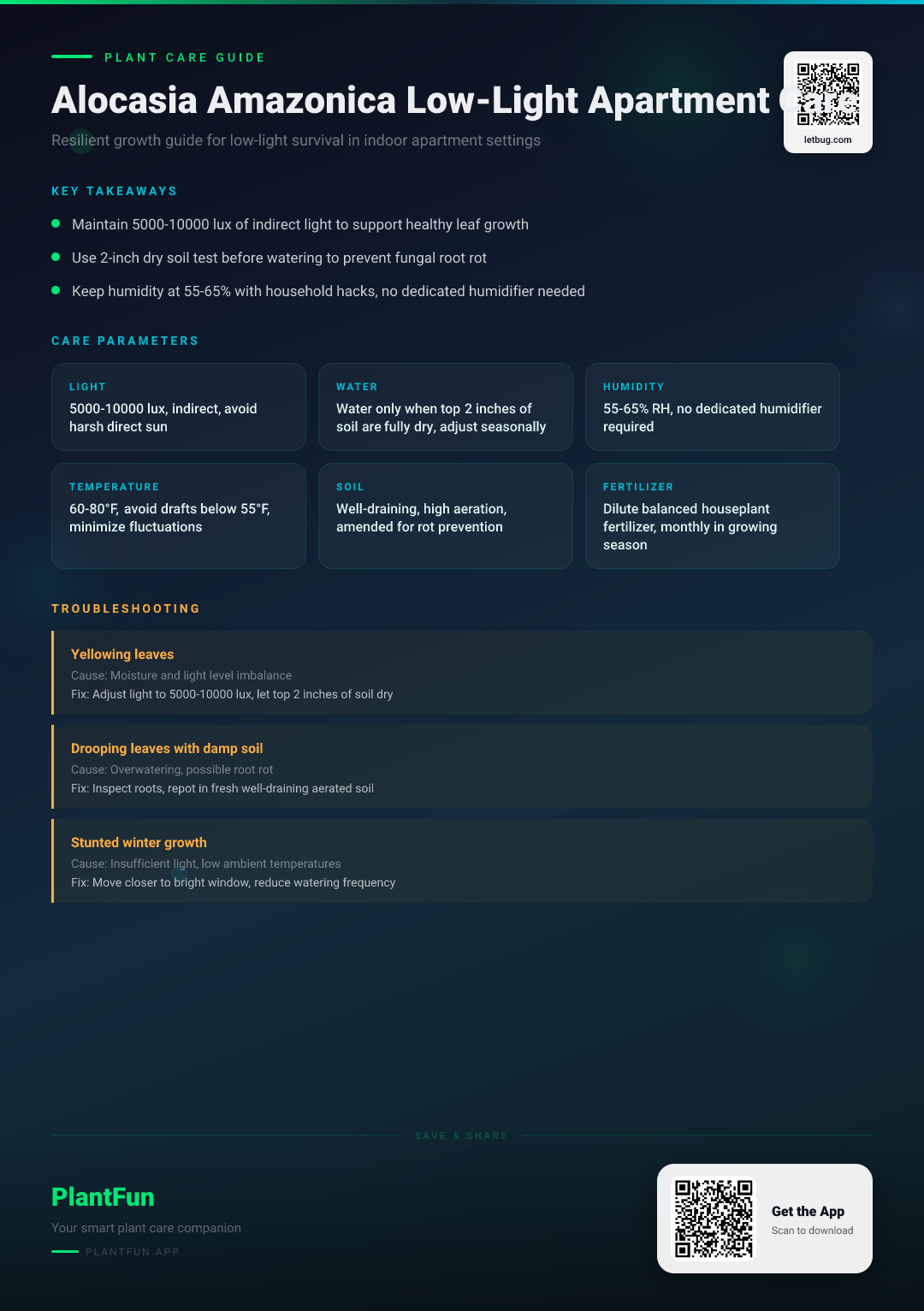
Key Takeaways
- Check soil moisture before watering — overwatering is the #1 killer of houseplants.
- Ensure your plant gets the right amount of light for its species.
- Be patient with recovery — most plants need 2–4 weeks to bounce back.
TL;DR: The Survival Cheat Sheet
If your Alocasia amazonica (African Mask Plant) is struggling, stop overwatering immediately. In dim apartments, this plant requires 5,000–10,000 lux of light and a “soak and dry” watering schedule where you wait until the top 2 inches of soil are completely dry. Most failures occur due to a mismatch between low light levels and high moisture retention. Keep humidity above 55% and ensure your soil mix is chunky and well-draining to prevent root rot.
Quick Care Card: Essential Data
| Feature | Requirement |
|---|---|
| Light | 5,000–10,000 lux (bright, indirect) |
| Water | Allow top 2 inches to dry between waterings |
| Humidity | 55–65% RH |
| Temperature | 65°F–80°F (18°C–27°C) |
| Soil | Aroid mix (bark, perlite, coco coir) |
| Fertilizer | Balanced liquid feed, half-strength (monthly) |
| Toxicity | Toxic to cats and dogs (ASPCA, 2026) |
My Experience: The “Learning Curve”
When I first brought home my Alocasia amazonica, I placed it in a dark corner of my studio apartment, assuming it was a “shade lover.” Within two weeks, I was dealing with persistent yellowing leaves and a drooping stalk. I learned the hard way that “low-light tolerant” does not mean “dark-dwelling.” My breakthrough came when I started using a dedicated light meter to track the actual lux reaching the plant. By optimizing the light and adjusting my watering to match the plant’s slower metabolic rate in lower light, I moved from constant rescues to consistent, healthy foliage.
Why Alocasia Amazonica Struggles in Apartment Life: A Botanical Reality Check
Alocasia amazonica is a complex hybrid that thrives in tropical understories (NC State Extension, 2026). In an apartment, the primary stressor is the “metabolic imbalance.” When light levels drop, the plant’s ability to photosynthesize decreases. If you continue to water it as if it were in a bright greenhouse, the roots sit in stagnant water, leading to hypoxia and potential fungal pathogens like Pectobacterium aroidearum (Mikiciński et al., 2023).
Format B: The Rescue Plan - Assessing Your Current Alocasia’s Distress
Yellowing Leaves with Brown Tips
Symptom: Leaf margins yellow, followed by brown, crispy edges.
Likely cause: Low humidity or inconsistent watering.
Fix:
- Increase humidity using a tray of pebbles and water.
- Ensure you are watering deep enough to moisten the entire root ball.
Sudden Drooping Stalks
Symptom: Petioles (the leaf stems) suddenly lose turgor pressure and flop over.
Likely cause: Overwatering or root rot.
Fix:
- Check roots for mushy, brown tissue.
- Repot into fresh, dry, fast-draining substrate.
Root Cause Analysis: Why Your Leaves are Yellowing
The yellowing of leaves in an indoor setting is usually an indicator of the moisture-light imbalance. When the plant cannot process water due to limited light, the roots essentially “drown.” Proper drainage and aeration are your best defense against this physiological failure.
Immediate Rescue: Stabilizing Root Zones and Preventing Fungal Rot
- Extraction: Carefully remove the plant from its pot to inspect the roots.
- Sanitation: Use sterilized scissors to trim any black, mushy roots.
- Treatment: Rinse the remaining healthy white/firm roots with a dilute hydrogen peroxide solution (1 part 3% H2O2 to 3 parts water).
- Repotting: Move the plant to a smaller pot if the root system has shrunk significantly to prevent excess moisture retention.
Precision Lighting: Measuring Lux for Apartments
“Bright, indirect light” is subjective. For an Alocasia, aim for 5,000–10,000 lux. You can use free smartphone light-meter apps to verify. If your apartment registers below 3,000 lux, the plant will struggle to maintain its foliage. Consider supplementing with a full-spectrum LED bulb placed 12-18 inches above the canopy.
Watering Protocols: The 2-inch Soil Test
Never water on a calendar schedule. Instead, use the “2-inch test”: insert your finger 2 inches into the potting medium. If it feels moist, do not water. If it is dry, water thoroughly until the liquid flows out of the drainage holes. This seasonal calibration is critical during winter when metabolic rates slow down.
Humidity Hacks: Maintaining 55-65% RH
- Grouping: Place your Alocasia near other plants to create a microclimate.
- Humidity Trays: Use a wide tray filled with pebbles and water, ensuring the pot sits above the waterline.
- Room Placement: If possible, bathrooms often provide the naturally higher humidity levels these plants crave.
Voice FAQ
Why is my Alocasia drooping even though the soil feels damp?
This is a classic sign of root rot. When roots are damaged by constant moisture, they cannot transport water to the leaves, leading to wilting even when the soil is saturated.
Can I move my Alocasia closer to a window during winter months?
Yes, absolutely. During winter, natural light intensity drops significantly. Moving the plant to a brighter window is often necessary to prevent dormancy and leaf loss.
Long-Term Prevention: Soil Amendments
Use a mix consisting of 40% high-quality potting soil, 30% perlite, and 30% orchid bark. This “aroid mix” structure provides the necessary aeration to prevent rot, which is crucial for successful indoor plant care.
Seasonal Care Calendar
- Spring/Summer: Increased light allows for more frequent watering and diluted monthly fertilizer.
- Autumn/Winter: Reduced light means watering should be significantly tapered. Focus on maintaining ambient humidity as apartment heating systems tend to dry out the air.
References and Botanical Notes
- ASPCA. (2026). Toxic and Non-Toxic Plants List — ASPCA. https://www.aspca.org/pet-care/animal-poison-control/toxic-and-non-toxic-plants. Accessed 2026-03-18.
- Mikiciński, A., Warabieda, M., & Nowak, J. (2023). First report on Pectobacterium aroidearum, a new pathogen causing soft rot on alocasia (Alocasia amazonica) in Poland. Journal of Plant Pathology. https://doi.org/10.1007/s42161-023-01369-2. Accessed 2026-03-18.
- NC State Extension. (2026). Alocasia Amazonica — NC State Extension Gardener Plant Toolbox. https://plants.ces.ncsu.edu/plants/amazonica-care/. Accessed 2026-03-18.
- Raju, R., Hashi, A., & Jazib, A. (2022). Micropropagation of Alocasia amazonica through Indirect Shoot Organogenesis. Plant Tissue Culture and Biotechnology. https://doi.org/10.3329/ptcb.v32i1.60468. Accessed 2026-03-18.
Optional Helper: Plantfun.App
Plantfun.App identifies your plants by photo, diagnoses pests and diseases with clear fixes, and creates personalised watering and light schedules that adapt to your home conditions — a handy companion for putting this guide into daily practice.
Found an error or have suggestions? We'd love your feedback.
Need help identifying this problem?
Get instant identification, personalized care schedules, and effective pest treatment plans directly on your phone.
Sponsored • We may earn a commission from app downloads
Related Guides
Alocasia Polly in a Typical Apartment: The Complete Care Guide for Resilient Growth
Transform your struggling Alocasia into a lush centerpiece. Follow our 4-point resilient growth plan for exact light, water, and humidity levels every apartment needs.
Care GuideAlocasia Amazonica in a Drafty Apartment: The Budget-Friendly Guide to Resilient Growth
Transform your finicky Alocasia Amazonica into a resilient centerpiece. Follow our budget-friendly 4-step care plan to master light, humidity, and winter survival.
Care GuideAlocasia Polly in a Low-Humidity Apartment: A 5-Step Rescue and Maintenance Plan
Revive your wilting Alocasia Polly with these 5 expert steps. Learn the exact humidity thresholds and watering triggers to stop leaf drop in your apartment today.
Pest ControlAnts on Plants: What They Mean and What to Do
Ants usually aren't eating your plant. They are farming other pests.