
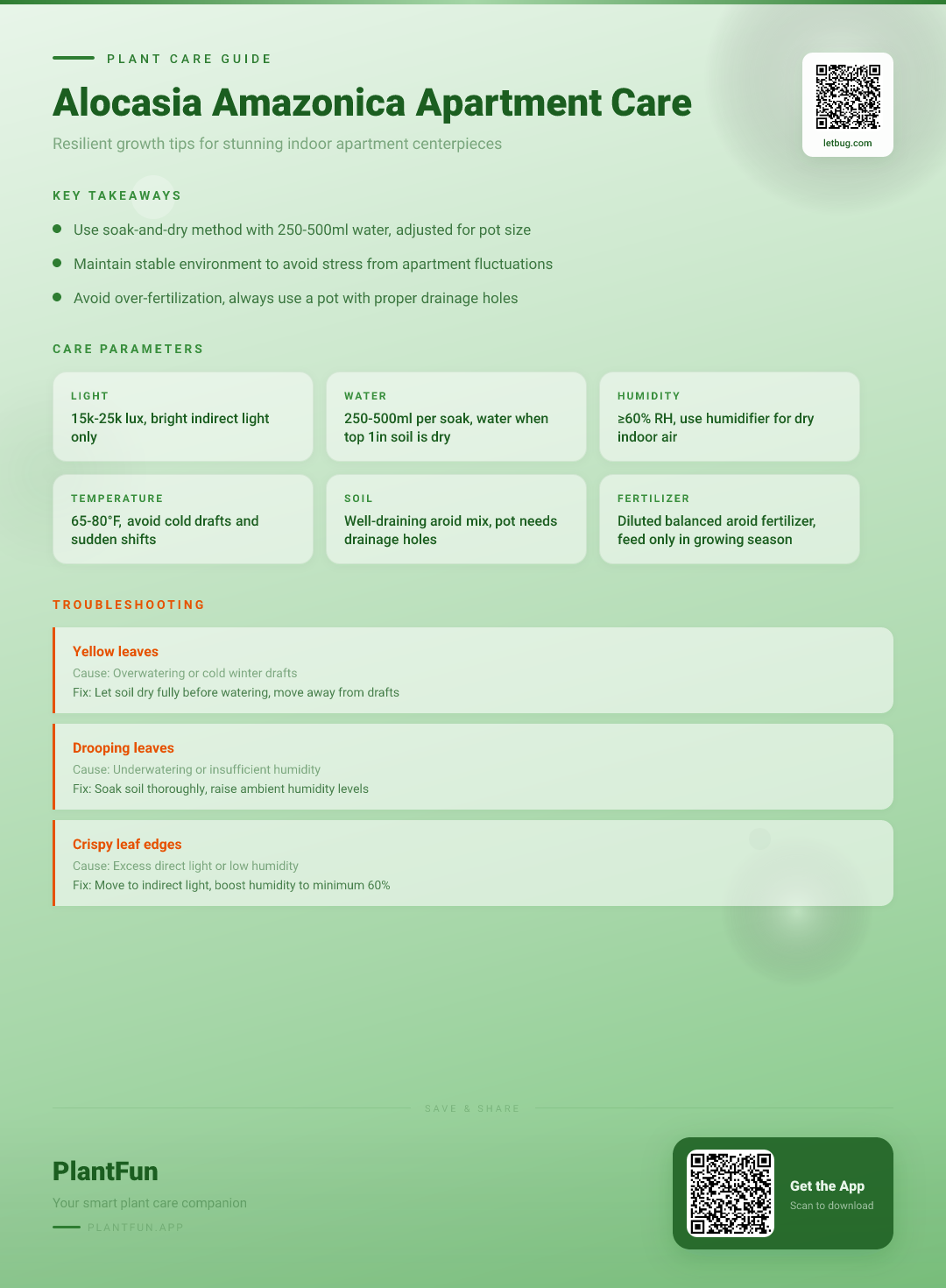
Key Takeaways
- Check soil moisture before watering — overwatering is the #1 killer of houseplants.
- Ensure your plant gets the right amount of light for its species.
- Be patient with recovery — most plants need 2–4 weeks to bounce back.
Quick Care Card
| Feature | Requirement |
|---|---|
| Light | 15k–25k lux (Bright, indirect) |
| Water | Allow top 1 inch of soil to dry |
| Humidity | 60% minimum (Optimal) |
| Temperature | 65°F–80°F (18°C–27°C) |
| Soil | Well-draining, chunky Aroid mix |
| Fertilizer | Balanced liquid feed (monthly in summer) |
| Toxicity | Toxic to cats and dogs (ASPCA, 2026) |
TL;DR: The Essence of Alocasia Resilience
Consistency is the secret to Alocasia success. Forget the myth that these plants are impossible; they simply crave stability. By maintaining a steady environment—focusing on consistent humidity and avoiding drastic temperature swings—you can prevent the “finicky” behavior often associated with the Alocasia Amazonica. If you can provide stable, bright light and mindful watering, your plant will thrive.
Why This Matters
When I first brought my Alocasia Amazonica into my urban apartment, I expected it to be a “set it and forget it” plant. I quickly learned that the Alocasia Amazonica—often a hybrid of Alocasia longiloba and Alocasia sanderiana—is sensitive to the micro-climates of modern homes (NC State Extension, 2026). Apartment living often introduces drafty windows or parched air from heaters, which can stress this tropical native. Understanding its need for stability is the foundation of successful indoor plant care.
Step-by-Step Guide: Establishing the Baseline
To master Alocasia care for beginners, you must treat the watering process with precision. I use the “soak and dry” method to ensure roots aren’t sitting in stagnant moisture, which can lead to pathogens like Pectobacterium aroidearum (Mikiciński, Warabieda, & Nowak, 2023).
- Check the Soil: Before adding a drop, stick your finger 2 inches into the substrate. If it feels damp, wait. If it is dry to that depth, proceed.
- Measure the Volume: Depending on your pot size, use 250ml to 500ml of filtered, room-temperature water. Pour evenly over the surface to avoid soil channeling.
- Drainage is Non-Negotiable: Ensure your pot has drainage holes. After 15 minutes, empty the saucer. Never allow your plant to sit in a pool of water, as this is the primary cause of root rot.
- Monitor Light: Use a light meter or a smartphone app to ensure your plant receives 15k-25k lux. If you are struggling with finding the right spot, remember that a North-facing window may need a supplemental grow light.
Seasonal Care Calendar
- Spring (Growth Phase): Increase watering frequency as temperatures rise. Apply a diluted balanced fertilizer once a month.
- Summer (Peak Growth): This is the prime Alocasia summer watering schedule. Plants will be thirsty; maintain consistent soil moisture and humidity above 60%.
- Autumn (Transition): Taper back on fertilizer. The days shorten, and the plant will naturally slow its metabolic rate.
- Winter (Dormancy): Growth stalls. Keep the soil significantly drier. My experience with Alocasia winter care confirms that overwatering during this time is the fastest way to invite disease.
Troubleshooting Guide
Yellowing Leaves
Symptom: Lower leaves turn yellow and eventually drop.
Likely cause: Natural aging or overwatering.
Fix:
- Check the soil moisture; if it’s soggy, let it dry out completely.
- If it’s a single old leaf, it may just be natural senescence.
Crispy Edges
Symptom: Leaf tips turn brown and brittle.
Likely cause: Low humidity or inconsistent watering.
Fix:
- Group with other plants to create a micro-climate.
- Introduce a humidifier to maintain 60% relative humidity.
Drooping Petioles
Symptom: The stems lose their rigidity and tilt downward.
Likely cause: Extreme thirst or lack of light.
Fix:
- Assess soil moisture; if dry, water thoroughly.
- Move the plant closer to a light source if it has been in deep shade.
Voice Search FAQ
How do I stop my Alocasia leaves from yellowing in the winter? To prevent yellowing, reduce your watering frequency during colder months. The plant’s metabolism slows down, meaning it needs less water. Also, ensure it stays away from cold drafts near windows or heating vents, which cause significant environmental stress.
Can I use a humidifier to keep my Alocasia happy in a small apartment? Yes, absolutely. A humidifier is one of the best tools for improving indoor environments. Aim for a stable 60% humidity level. This mimics the tropical origins of the Alocasia Amazonica and helps keep the foliage supple.
Is the Alocasia Amazonica safe for my cat? No. According to the ASPCA (2026), the Alocasia Amazonica is toxic to dogs and cats due to calcium oxalate crystals, which cause irritation when ingested. Keep it on a high, inaccessible shelf.
Common Mistakes to Avoid
- Mistake: Using a heavy, garden-variety potting soil.
- What happens: The soil holds too much moisture, suffocating the roots.
- Instead: Create an Alocasia soil mix recipe using one part coco coir, one part perlite, and one part bark chips for maximum aeration.
- Mistake: Using cold water directly from the tap.
- What happens: It shocks the root system, causing yellowing.
- Instead: Let water sit out for 24 hours to reach room temperature.
References
- Mikiciński, A.; Warabieda, M.; Nowak, J. (2023). First report on Pectobacterium aroidearum, a new pathogen causing soft rot on alocasia (Alocasia amazonica) in Poland. Journal of Plant Pathology. https://doi.org/10.1007/s42161-023-01369-2. Accessed 2026-03-19.
- Raju, R.; Hashi, A.; Jazib, A. (2022). Micropropagation of Alocasia amazonica through Indirect Shoot Organogenesis. Plant Tissue Culture and Biotechnology. https://doi.org/10.3329/ptcb.v32i1.60468. Accessed 2026-03-19.
- ASPCA. (2026). Toxic and Non-Toxic Plants List — ASPCA. https://www.aspca.org/pet-care/animal-poison-control/toxic-and-non-toxic-plants. Accessed 2026-03-19.
- NC State Extension. (2026). Alocasia Amazonica — NC State Extension Gardener Plant Toolbox. https://plants.ces.ncsu.edu/plants/amazonica-care/. Accessed 2026-03-19.
Optional Helper: Plantfun.App
Plantfun.App identifies your plants by photo, diagnoses pests and diseases with clear fixes, and creates personalised watering and light schedules that adapt to your home conditions — a handy companion for putting this guide into daily practice.
Found an error or have suggestions? We'd love your feedback.
Need help identifying this problem?
Get instant identification, personalized care schedules, and effective pest treatment plans directly on your phone.
Sponsored • We may earn a commission from app downloads
Related Guides
Alocasia in Low-Humidity Apartments: The Essential Guide to Keeping Leaves Healthy and Vibrant
Stop your Alocasia leaves from browning. Discover the exact 60% humidity target, precise light ranges, and a step-by-step recovery plan for lush apartment growth.
Care GuideAlocasia Amazonica in a Drafty Apartment: The Budget-Friendly Guide to Resilient Growth
Transform your finicky Alocasia Amazonica into a resilient centerpiece. Follow our budget-friendly 4-step care plan to master light, humidity, and winter survival.
Care GuideAlocasia Polly in a Low-Humidity Apartment: A 5-Step Rescue and Maintenance Plan
Revive your wilting Alocasia Polly with these 5 expert steps. Learn the exact humidity thresholds and watering triggers to stop leaf drop in your apartment today.
Pest ControlAnts on Plants: What They Mean and What to Do
Ants usually aren't eating your plant. They are farming other pests.