
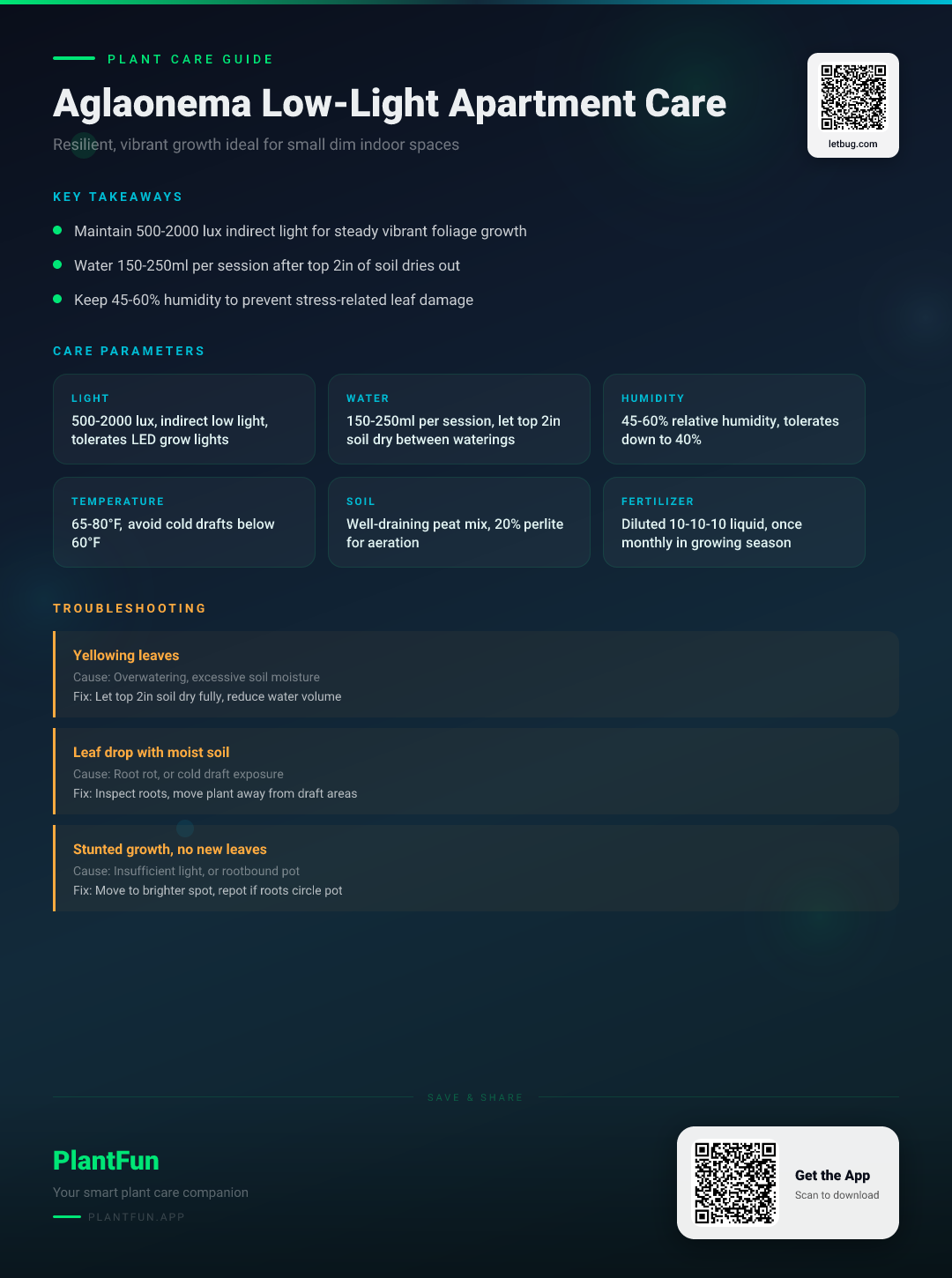
Key Takeaways
- Check soil moisture before watering — overwatering is the #1 killer of houseplants.
- Ensure your plant gets the right amount of light for its species.
- Be patient with recovery — most plants need 2–4 weeks to bounce back.
Quick Care Card: The Essential Metrics for Aglaonema Success
| Metric | Requirement |
|---|---|
| Light | 500–2,000 Lux (Low to Medium indirect) |
| Water | 150ml–250ml per 6” pot; check top 2” of soil |
| Humidity | 45–60% Relative Humidity |
| Temperature | 65°F–80°F (18°C–27°C) |
| Soil | Well-draining, peat-based mix |
| Fertilizer | Balanced liquid feed, monthly in summer |
| Toxicity | Toxic to cats and dogs (ASPCA, 2026) |
TL;DR: Why the Aglaonema is the Ultimate Apartment Champion
If you live in a space with limited windows, the Aglaonema (Chinese Evergreen) is your best ally. It is one of the few indoor plants that maintains its structural integrity and leaf coloration in low-light conditions that would leave other species struggling to survive. By mimicking its native tropical forest-floor environment through consistent soil moisture and moderate humidity, you can move from simple survival to lush, decorative growth in even the smallest studio apartment.
Understanding Your Light: Why 500-2,000 Lux is Enough for Resilience
When I first started keeping Aglaonema in my previous downtown apartment, I made the mistake of thinking “low light” meant “no light.” I shoved one in a corner far from any window. Within a month, the variegation faded, and growth stalled.
I learned that while these plants are incredibly resilient, they still need to photosynthesize. Aim for 500–2,000 lux (NC State Extension, 2026). In practice, this means your plant should ideally be within 5–8 feet of a north-facing window or placed on a shelf where it can “see” the sky, even if it doesn’t receive direct sun. Variegated varieties usually require slightly higher light levels than solid green types to maintain their patterns.
The Watering Science: Calculating 150ml-250ml for Optimal Soil Moisture
One of the most common reasons for houseplant failure is overwatering. For a standard 6-inch nursery pot, I recommend using approximately 150ml to 250ml of water per session.
Don’t water on a schedule. Instead, use the “finger test”: push your index finger 2 inches into the soil. If it feels damp, wait. If it feels dry to the touch, it is time to irrigate. The goal is to keep the potting medium evenly moist, not waterlogged, as poor drainage is the primary cause of root-related stress in indoor settings (S & Fatmi, 2024).
Humidity & Temperature Control: Keeping 45-60% Relative Humidity in Small Studios
Apartments are notorious for dry air, especially during winter heating cycles. Aglaonemas thrive in 45–60% relative humidity. If your studio falls below 40%, you may notice brown, crispy tips on the leaves. I keep my plants on a pebble tray filled with water to boost the localized humidity without needing an electric humidifier. Keep them away from direct drafts, such as air conditioning vents or heaters, which fluctuate temperatures and dehydrate the foliage.
Seasonal Growth Cycle: Adapting Care from Low-Light Winters to Peak Summer
Your Aglaonema’s metabolism slows down significantly when the days get shorter.
- Winter: Reduce watering frequency by 30-40%. The lower light levels mean the plant consumes less water (NC State Extension, 2026).
- Summer: This is your primary growth window. Increase water slightly, and if you choose to fertilize, do so only during these active months using a diluted, balanced houseplant fertilizer.
Common Mistakes: How to Avoid Leaf Yellowing and Root Rot
- Mistake: Watering on a rigid calendar date.
- What happens: The soil stays saturated too long, leading to root rot.
- Instead: Water only when the top 2 inches of soil are dry.
- Mistake: Placing the plant in a windowless room.
- What happens: Leggy, weak growth and eventual leaf drop.
- Instead: Provide a dedicated LED grow light if natural light is unavailable.
Can I keep my Aglaonema in a windowless room with just an LED lamp?
Yes, but you must be precise. If you have a room with no windows, use a full-spectrum LED grow light positioned 12–18 inches above the foliage. Run the light for 10–12 hours a day to mimic a natural photoperiod. This setup is highly effective for maintaining the plant’s health in dark apartment hallways or offices.
Why is my Aglaonema dropping leaves even though the soil feels moist?
This is a classic sign of overwatering or soil compaction. If the soil is constantly moist, the roots cannot breathe, leading to root suffocation. Even if you aren’t watering frequently, the soil may lack the aeration needed for the roots to thrive. Repotting into a mix with added perlite can significantly improve drainage and air circulation.
How do I know when it is time to move my plant to a bigger pot?
Check the drainage holes at the bottom of the pot. If you see roots circling the base or emerging from the holes, the plant has become root-bound. Choose a new pot that is only 1–2 inches larger in diameter to prevent the soil from holding too much excess moisture.
The 3-Step Troubleshooting Guide for Common Apartment Stressors
[Leaf Yellowing]
Symptom: Leaves turn yellow, starting from the lower part of the plant.
Likely cause: Overwatering or poor drainage.
Fix:
- Check for standing water in the decorative pot or saucer.
- Allow the soil to dry out completely before the next watering.
[Drooping Foliage]
Symptom: The entire plant looks limp and wilted despite moist soil.
Likely cause: Root rot, where roots have stopped functioning due to lack of oxygen.
Fix:
- Inspect roots for mushy, brown, or foul-smelling sections.
- Trim away diseased roots and repot in fresh, sterile, well-draining soil.
[Crispy Brown Tips]
Symptom: The edges and tips of the leaves are brown and brittle.
Likely cause: Low humidity or mineral buildup from tap water.
Fix:
- Group your plants together to create a micro-climate of humidity.
- Switch to filtered or distilled water if your tap water has high mineral content.
References
- Ghate, S. (2016). Assessment of Phytoremediating Potential of Aglaonema commutatum Schott for Indoor Pollutants. International Journal of Plant and Environment. https://doi.org/10.18811/ijpen.v2i1-2.6622. Accessed 2026-03-14.
- S, A.; Fatmi, U. (2024). Performance of Different Aglaonema (Aglaonema commutatum) Varieties under Prayagraj Agro-climatic Conditions. International Journal of Plant & Soil Science. https://doi.org/10.9734/ijpss/2024/v36i84833. Accessed 2026-03-14.
- ASPCA. (2026). Toxic and Non-Toxic Plants List — ASPCA. https://www.aspca.org/pet-care/animal-poison-control/toxic-and-non-toxic-plants. Accessed 2026-03-14.
- NC State Extension. (2026). Aglaonema — NC State Extension Gardener Plant Toolbox. https://plants.ces.ncsu.edu/plants/aglaonema-care/. Accessed 2026-03-14.
Optional Helper: Plantfun.App
Plantfun.App identifies your plants by photo, diagnoses pests and diseases with clear fixes, and creates personalised watering and light schedules that adapt to your home conditions — a handy companion for putting this guide into daily practice.
Found an error or have suggestions? We'd love your feedback.
Need help identifying this problem?
Get instant identification, personalized care schedules, and effective pest treatment plans directly on your phone.
Sponsored • We may earn a commission from app downloads
Related Guides
Aglaonema in Low-Light Apartments: The Complete Care Guide for Resilient, Lush Growth
Revive your Aglaonema with precise light and water metrics. Learn how to optimize your apartment space for 10,000 lux growth and keep leaves vibrant all year.
Care GuideAglaonema in Low-Light Apartments: The Essential Care Guide for Resilient, Lush Growth
Transform your dim apartment into a lush sanctuary. Master Aglaonema care with exact light metrics, seasonal watering schedules, and 3 steps for steady growth.
Care GuideThe Complete Aglaonema Care Checklist for Resilient Growth in Small Apartments
Grow lush, low-fuss Aglaonema even in cramped city apartments with this science-backed checklist, including exact light, water, and soil parameters for resilient, pest-free growth.
Pest ControlAnts on Plants: What They Mean and What to Do
Ants usually aren't eating your plant. They are farming other pests.