
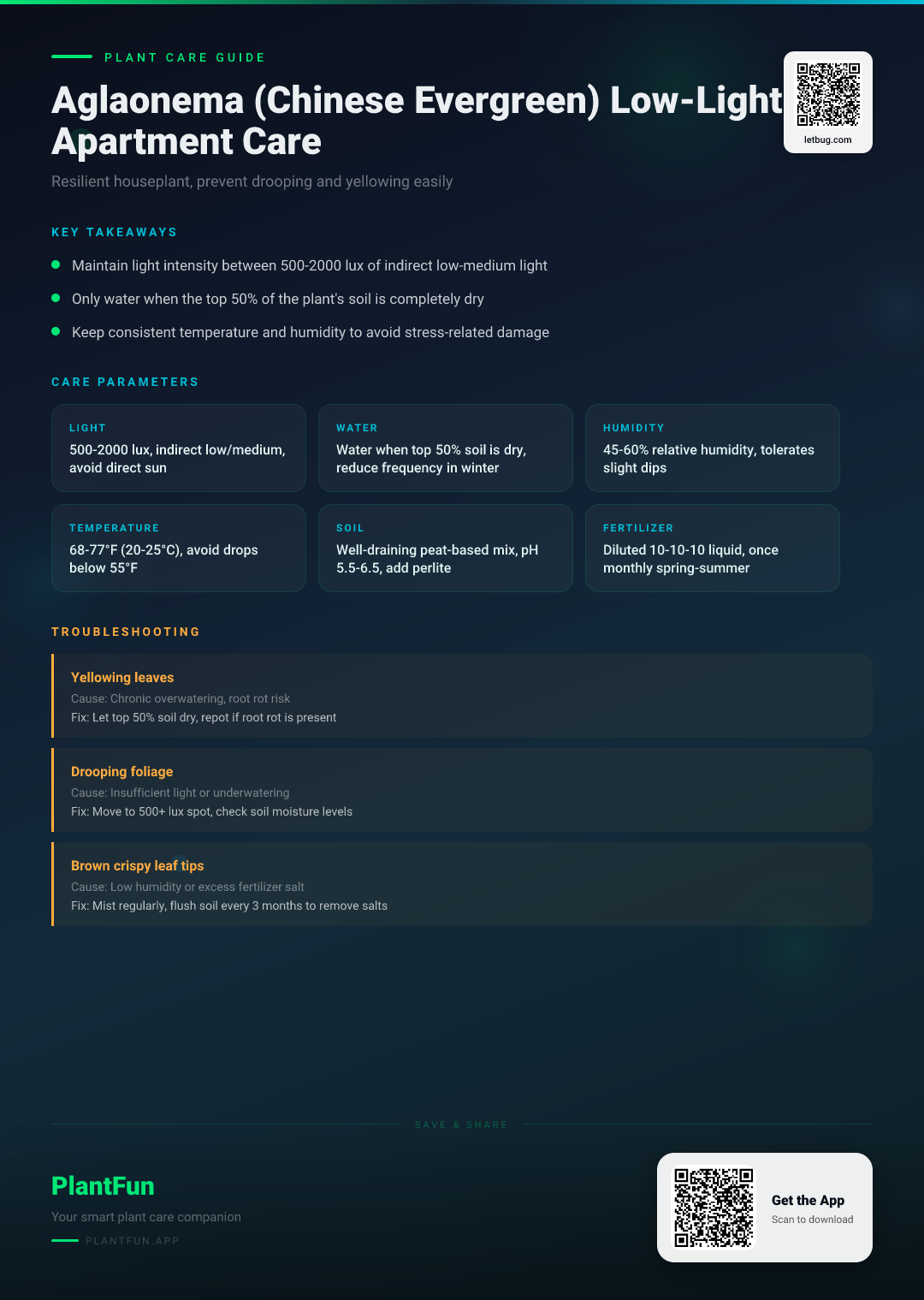
Key Takeaways
- Check soil moisture before watering — overwatering is the #1 killer of houseplants.
- Ensure your plant gets the right amount of light for its species.
- Be patient with recovery — most plants need 2–4 weeks to bounce back.
TL;DR: Keep your Aglaonema thriving by providing 500–2,000 lux of light and watering only when the top 50% of the soil is dry. Avoid overwatering, the leading cause of yellowing, and maintain humidity above 45%. These resilient plants are perfect for apartments, provided you respect their need for stable temperatures and well-draining soil.
Quick Care Card: Essential Thresholds for Aglaonema Success
| Feature | Requirement |
|---|---|
| Light | 500–2,000 lux (bright indirect) |
| Water | When top 50% of soil is dry |
| Humidity | 45–60% relative humidity |
| Temperature | 68–77°F (20–25°C) |
| Soil | Well-draining, peat-based mix |
| Fertilizer | Balanced liquid feed (monthly) |
| Toxicity | Toxic to pets/humans (ASPCA, 2026) |
My Experience: The Apartment Learning Curve
When I first brought home my ‘Silver Bay’ Aglaonema, I made the classic mistake of placing it in a dark bathroom corner and watering it on a rigid weekly schedule. Within a month, the lower leaves turned yellow and drooped. I learned the hard way that Aglaonema care for beginners isn’t about setting a calendar—it’s about responding to the specific microclimate of your apartment.
Understanding the Apartment Aglaonema: Why Your Plant is Struggling
Aglaonemas are often marketed as “low-light” champions, but there is a distinction between shade-tolerance and light-starvation. In apartments, poor air circulation and low light levels often lead to stagnant soil moisture. Research into the Aglaonema commutatum suggests that while they can perform in varied agro-climatic conditions, their physiological vigor depends on balancing light availability with consistent substrate aeration (S, A.; Fatmi, U., 2024).
Step-by-Step Guide: Achieving Balanced Light and Soil Moisture
- Assess your site: Use a light meter or a smartphone app to ensure the spot receives at least 500 lux.
- Check the soil: Before adding water, use your finger to test if the top 50% of the potting medium feels dry.
- Improve Drainage: If your plant arrived in dense nursery soil, repot your plant into a mix containing perlite or orchid bark to ensure oxygen reaches the roots.
- Monitor growth: Observe the stems; if they are stretching toward a window, move the plant 6 inches closer to the light source.
Measurable Threshold: Light Intensity (500–2,000 lux) and Positioning
Aglaonemas thrive in indirect light. Placing them directly in a south-facing window can scorch the variegated foliage. Aim for 500–2,000 lux (NC State Extension, 2026). If you notice the green patterns on the leaves fading, it is a sign of insufficient light.
Measurable Threshold: Soil Hydration (Water when top 50% of soil is dry)
Overwatering is the primary cause of root rot. In apartments, humidity is often lower, but airflow is also restricted. Stick your finger 2 inches into the soil; if it feels damp, wait. This prevents the anaerobic conditions that invite pathogens (Ghate, S., 2016).
Measurable Threshold: Humidity Requirements (45–60% relative humidity)
Standard apartments often dip below 30% humidity. To avoid brown, crispy leaf edges, group your plants together to create a humid microclimate or use a pebble tray.
Measurable Threshold: Temperature Management (68–77°F/20–25°C)
Drafts from AC units or radiators cause significant stress. Keep your Chinese Evergreen away from direct vents to maintain a steady ambient temperature (NC State Extension, 2026).
Common Mistakes to Avoid: The Dangers of Over-Caring
- Mistake: Regular misting of leaves. What happens: Fungal spots can develop on wet foliage. Instead: Use a humidifier.
- Mistake: Using tap water immediately. What happens: Mineral buildup can cause leaf tip burn. Instead: Let water sit for 24 hours to dissipate chlorine.
Seasonal Care Calendar: Transitioning from Summer Growth to Winter Dormancy
- Spring/Summer: Increase watering frequency slightly as light levels rise.
- Fall/Winter: Slow down. The plant is in a semi-dormant state; reduce water by 30% and pause fertilization (NC State Extension, 2026).
Voice Search FAQ: Why is my Aglaonema leaf turning yellow?
Yellowing is usually a sign of overwatering leading to root suffocation. Check the soil moisture first. If the soil is soggy, you must address the drainage immediately to prevent further decline.
Voice Search FAQ: How do I know when my Chinese Evergreen needs more light?
If the plant is “leggy”—meaning large gaps between leaf nodes—or if the variegation is becoming solid green, it is reaching for light. Move it to a brighter, indirect spot.
Voice Search FAQ: Can I use tap water for my indoor Aglaonema?
Yes, but let it sit in an open container for 24 hours first. This helps some dissolved minerals settle and chlorine evaporate, which is gentler on the sensitive root systems of these indoor-adapted species.
Troubleshooting Guide: Identifying Pests and Root Rot Early
Root Rot
Symptom: Yellow, mushy leaves and a damp, unpleasant smell from the soil.
Likely cause: Consistently wet soil suffocating the root system.
Fix:
- Remove the plant from the pot and trim off any brown, mushy roots.
- Repot in fresh, well-draining soil with added perlite.
Spider Mites
Symptom: Fine webbing between stems and speckled leaves.
Likely cause: Dry, stagnant apartment air.
Fix:
- Wipe leaves with a damp cloth.
- Increase humidity to above 50%.
References
- Ghate, S. (2016). Assessment of Phytoremediating Potential of Aglaonema commutatum Schott for Indoor Pollutants. International Journal of Plant and Environment. https://doi.org/10.18811/ijpen.v2i1-2.6622. Accessed 2026-03-19.
- S, A.; Fatmi, U. (2024). Performance of Different Aglaonema (Aglaonema commutatum) Varieties under Prayagraj Agro-climatic Conditions. International Journal of Plant & Soil Science. https://doi.org/10.9734/ijpss/2024/v36i84833. Accessed 2026-03-19.
- ASPCA. (2026). Toxic and Non-Toxic Plants List — ASPCA. https://www.aspca.org/pet-care/animal-poison-control/toxic-and-non-toxic-plants. Accessed 2026-03-19.
- NC State Extension. (2026). Aglaonema — NC State Extension Gardener Plant Toolbox. https://plants.ces.ncsu.edu/plants/aglaonema-care/. Accessed 2026-03-19.
Optional Helper: Plantfun.App
Plantfun.App identifies your plants by photo, diagnoses pests and diseases with clear fixes, and creates personalised watering and light schedules that adapt to your home conditions — a handy companion for putting this guide into daily practice.
Found an error or have suggestions? We'd love your feedback.
Need help identifying this problem?
Get instant identification, personalized care schedules, and effective pest treatment plans directly on your phone.
Sponsored • We may earn a commission from app downloads
Related Guides
The Complete Aglaonema Care Checklist for Resilient Growth in Small Apartments
Grow lush, low-fuss Aglaonema even in cramped city apartments with this science-backed checklist, including exact light, water, and soil parameters for resilient, pest-free growth.
Care GuideThe Complete Aglaonema Care Guide for 1-Bedroom Apartments: Seasonal Tips for Resilient Growth
Grow a lush, hardy Aglaonema even in a small, low-light apartment. Get exact light, water, and humidity thresholds plus a 4-season care checklist to avoid yellow leaves and stunted growth.
Care GuideThe Complete Aglaonema Care Checklist for Small Urban Apartments Under $20 a Year
Grow lush, resilient Aglaonema in your small urban apartment without expensive specialty products. Follow our free 12-step checklist, exact care thresholds, and zero-waste budget tips to avoid yellow leaves and stunted growth.
Pest ControlAnts on Plants: What They Mean and What to Do
Ants usually aren't eating your plant. They are farming other pests.