
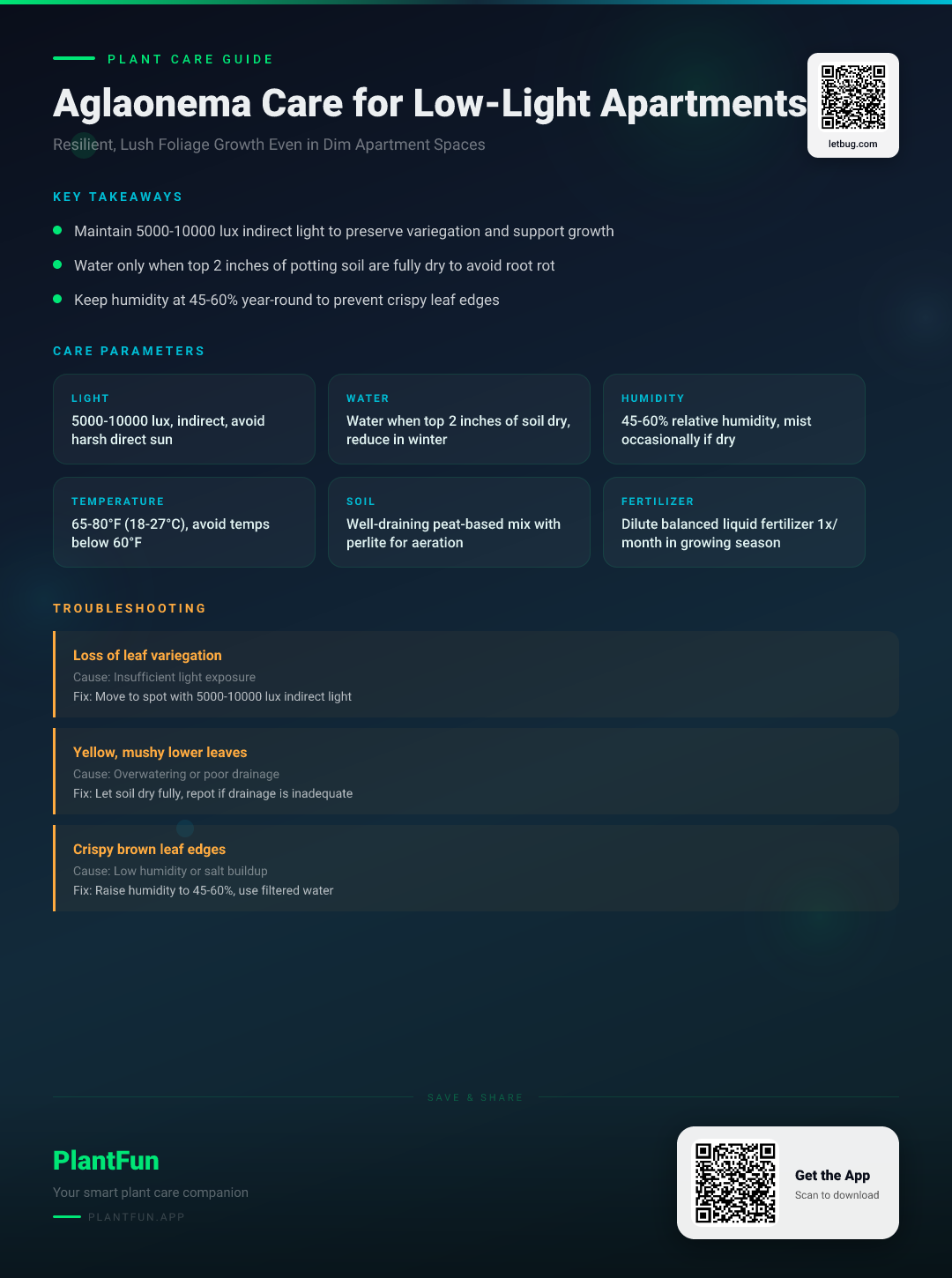
Key Takeaways
- Check soil moisture before watering — overwatering is the #1 killer of houseplants.
- Ensure your plant gets the right amount of light for its species.
- Be patient with recovery — most plants need 2–4 weeks to bounce back.
Quick Care Card: Essential Thresholds for Apartment Aglaonemas
| Feature | Requirement |
|---|---|
| Light | 5,000–10,000 lux (Bright indirect) |
| Water | Allow top 2 inches of soil to dry |
| Humidity | 45%–60% RH |
| Temperature | 65°F–80°F (18°C–27°C) |
| Soil | Well-draining, airy peat/perlite mix |
| Fertilizer | Balanced liquid feed, diluted to half-strength |
| Toxicity | Toxic to cats and dogs (ASPCA, 2026) |
TL;DR: The 30-Second Solution for Struggling Apartment Plants
Stop treating your Aglaonema like a closet dweller. While they are resilient, they need at least 5,000 lux to thrive. If your plant is suffering, move it closer to a window, stop watering on a schedule (wait for the top 2 inches of soil to dry), and ensure it is not sitting in stagnant air. In my experience, most “low-light” failures are simply cases of chronic underwatering followed by “love-bomb” overwatering in dark corners.
Why Your Aglaonema Struggles in Small Apartments: The ‘Dim Corner’ Myth
When I first started keeping Aglaonemas in my small studio, I tucked one into a dark corner, thinking its reputation as a “low-light plant” meant it thrived in near-total darkness. I was wrong. The industry classifies them as low-light tolerant, which is a massive difference from low-light loving. In a cramped apartment, light drops off exponentially as you move away from a window. Without sufficient light, the plant cannot perform photosynthesis, leading to stunted growth and the classic “leggy” look (NC State Extension, 2026).
Light Requirements: How to Measure and Maximize 5,000-10,000 Lux Indoors
To truly optimize for Aglaonema care for beginners, you need to understand light as a measurable metric rather than a “bright or dim” feeling. I suggest using a basic light-meter app to ensure your plant is receiving between 5,000 and 10,000 lux. In an apartment, this typically means a spot within 3 feet of a window, provided it is not scorched by direct afternoon sun.
Hydration Strategy: Watering When the Top 2 Inches of Soil Dry Out
“How often to water Aglaonema?” is the most common question I get. The answer is never a calendar date; it is always a soil test.
- Insert your index finger 2 inches into the soil.
- If it feels moist, leave it alone.
- If it is dry, water thoroughly until liquid drains from the bottom.
This simple check prevents the common pitfalls of root rot in indoor plant light requirements that are otherwise managed well (S & Fatmi, 2024).
Humidity and Airflow: Maintaining 45-60% Relative Humidity in Dry Urban Living Rooms
Dry apartment air is the enemy of lush foliage. If your humidity drops below 40%, you will likely see browning tips. I use a simple humidifier near my collection to maintain 45-60% relative humidity, which is the sweet spot for these tropical Aroids. Proper airflow is equally vital; ensure your plant isn’t shoved into a “dead air” corner, which invites fungal issues.
Temperature Control: Keeping Your Plant Between 65-80°F (18-27°C) Year-Round
Aglaonemas are sensitive to cold drafts. In my apartment, I keep them away from HVAC vents and drafty windows during the winter. A steady temperature between 65°F and 80°F (18°C–27°C) ensures stable metabolic activity (S & Fatmi, 2024).
Small-Space Placement: Why Height and Corner Access Matter for Photosynthesis
I recommend placing your plant on a plant stand or a dedicated shelf at waist height. This keeps the foliage above floor-level drafts and puts it closer to the window light. Avoid “floor-only” placement, which usually provides 50% less usable light in an apartment setting.
Seasonal Care Calendar: Adjusting for Winter Light Drops and Summer Growth
- Spring/Summer: Growth phase. Increase water slightly as temperatures rise. Apply liquid fertilizer monthly (NC State Extension, 2026).
- Fall/Winter: Dormancy phase. Reduce watering by 30%. Light drops, so move the plant closer to the window if necessary. Stop fertilizing until March.
FAQ 1: Why is my Aglaonema losing its variegation in my bedroom?
Your plant is “reverting” because it is searching for more light. In a dim bedroom, it produces more chlorophyll to compensate, causing the colorful patterns to fade to plain green. Move it closer to a window.
FAQ 2: How can I tell if my plant is getting too much water?
Check the base of the stems. If you see yellowing leaves (particularly the lower ones) and the soil remains soggy for days, you are likely overwatering. This is a common cause of why is my Aglaonema leaves yellowing (NC State Extension, 2026).
FAQ 3: Can I keep my Aglaonema on a low bookshelf away from a window?
Only if that shelf receives auxiliary light. If you must keep it there, rotate the plant weekly or supplement with a grow light to ensure it reaches that 5,000 lux threshold.
Common Mistakes: Avoiding Over-Potting and Tap Water Salt Accumulation
- Mistake: Using a pot that is too large.
- What happens: Extra soil holds too much water, leading to root rot.
- Instead: Only move up one pot size (1–2 inches wider) at a time.
- Mistake: Using straight tap water.
- What happens: Salt and mineral accumulation burns leaf tips.
- Instead: Use filtered or room-temperature distilled water.
Conclusion: Building a Long-Term Relationship with Your Resilient Aglaonema
Aglaonemas are exceptional at clearing indoor pollutants (Ghate, 2016), making them perfect companions for city living. By providing consistent light and monitoring your soil moisture, you move past the “struggling” phase into a long-term, rewarding experience. Remember, as noted by the ASPCA (2026), keep them out of reach if you have curious pets.
References
- ASPCA. (2026). Toxic and Non-Toxic Plants List — ASPCA. https://www.aspca.org/pet-care/animal-poison-control/toxic-and-non-toxic-plants. Accessed 2026-03-14.
- Ghate, S. (2016). Assessment of Phytoremediating Potential of Aglaonema commutatum Schott for Indoor Pollutants. International Journal of Plant and Environment. https://doi.org/10.18811/ijpen.v2i1-2.6622. Accessed 2026-03-14.
- NC State Extension. (2026). Aglaonema — NC State Extension Gardener Plant Toolbox. https://plants.ces.ncsu.edu/plants/aglaonema-care/. Accessed 2026-03-14.
- S, A.; Fatmi, U. (2024). Performance of Different Aglaonema (Aglaonema commutatum) Varieties under Prayagraj Agro-climatic Conditions. International Journal of Plant & Soil Science. https://doi.org/10.9734/ijpss/2024/v36i84833. Accessed 2026-03-14.
Optional Helper: Plantfun.App
Plantfun.App identifies your plants by photo, diagnoses pests and diseases with clear fixes, and creates personalised watering and light schedules that adapt to your home conditions — a handy companion for putting this guide into daily practice.
Found an error or have suggestions? We'd love your feedback.
Need help identifying this problem?
Get instant identification, personalized care schedules, and effective pest treatment plans directly on your phone.
Sponsored • We may earn a commission from app downloads
Related Guides
Aglaonema in Low-Light Apartments: A Resilient Guide for Vibrant Growth in Small Spaces
Transform your dim apartment into a lush sanctuary. Learn precise Aglaonema care steps, including exact water volumes and light thresholds for vibrant growth.
Care GuideThe Complete Aglaonema Care Checklist for Small Urban Apartments Under $20 a Year
Grow lush, resilient Aglaonema in your small urban apartment without expensive specialty products. Follow our free 12-step checklist, exact care thresholds, and zero-waste budget tips to avoid yellow leaves and stunted growth.
Care GuideThe Complete Aglaonema Care Checklist for Resilient Growth in Small Apartments
Grow lush, low-fuss Aglaonema even in cramped city apartments with this science-backed checklist, including exact light, water, and soil parameters for resilient, pest-free growth.
Pest ControlAnts on Plants: What They Mean and What to Do
Ants usually aren't eating your plant. They are farming other pests.