
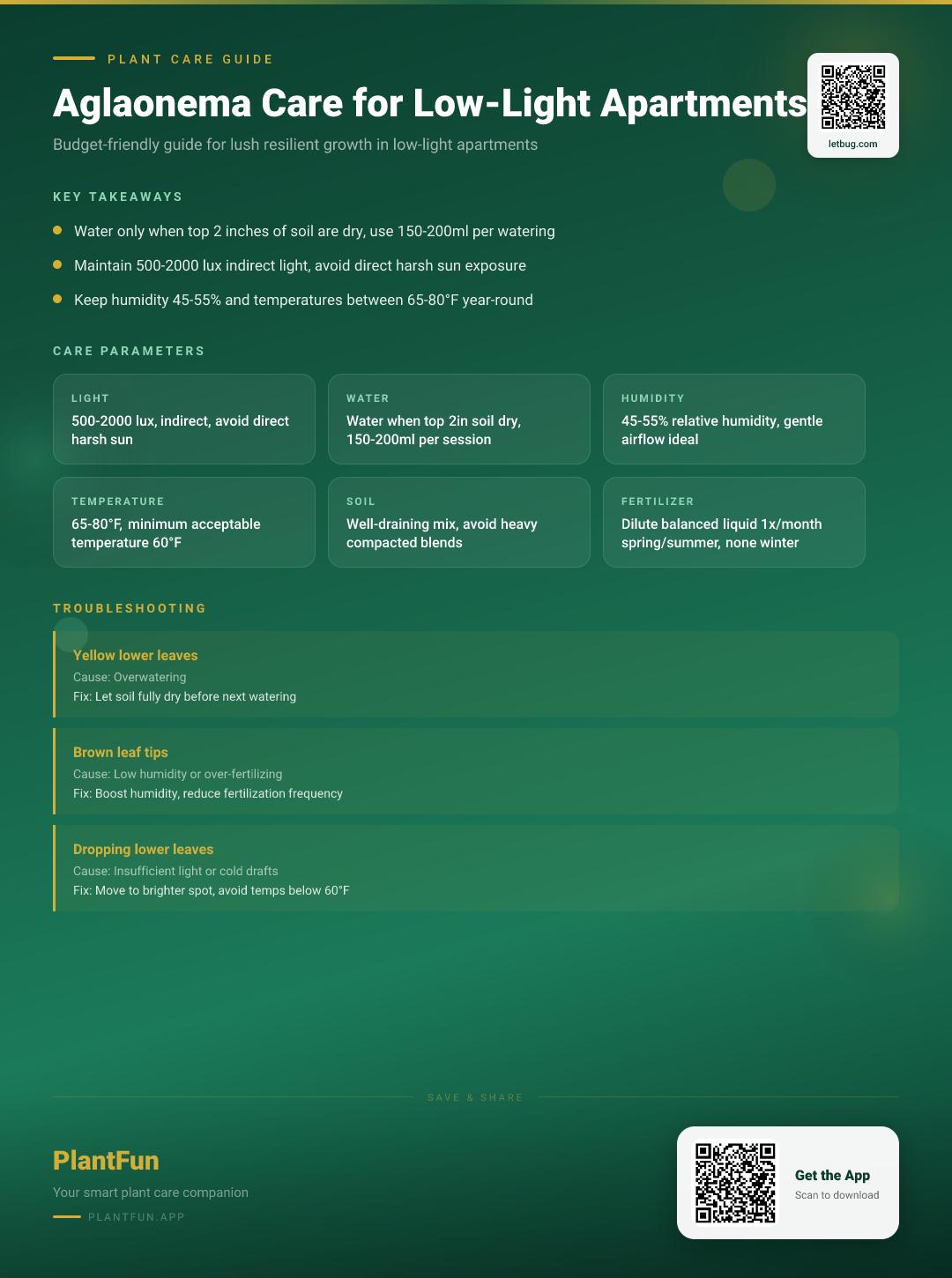
Key Takeaways
- Check soil moisture before watering — overwatering is the #1 killer of houseplants.
- Ensure your plant gets the right amount of light for its species.
- Be patient with recovery — most plants need 2–4 weeks to bounce back.
Quick Care Card: Essential Thresholds for Apartment Aglaonemas
| Feature | Requirement |
|---|---|
| Light | 500–2,000 lux (indirect) |
| Watering | When top 2 inches feel dry (approx. 150-200ml) |
| Humidity | 45–55% relative humidity |
| Temperature | 65–80°F (min 60°F) |
| Soil | Well-draining, peat-free mix |
| Fertilizer | Balanced liquid feed during growing season |
| Toxicity | Toxic to cats and dogs (ASPCA, 2026) |
TL;DR: The Low-Maintenance Secret to Aglaonema Success
To keep your Chinese Evergreen thriving in an apartment, stop over-parenting. Place it in moderate, indirect light, allow the top two inches of soil to dry out completely between waterings, and keep it away from drafty windows. It is the perfect resilient indoor plant for beginners because it tolerates lower light levels better than most tropicals (NC State Extension, 2026).
Why Your Apartment is Perfect (or Dangerous) for Aglaonemas
When I first got my ‘Silver Bay’ Aglaonema, I tucked it into a dark corner, assuming it was a “low light” plant that needed zero intervention. Within a month, the vibrant variegation faded to a muddy green. I learned the hard way that while these plants are resilient, they aren’t magic; they still perform photosynthesis. Apartment micro-climates—specifically the heat from radiators and the lack of air circulation—are the most common stressors I see (S & Fatmi, 2024).
Step 1: Mastering Light (Threshold: 500-2,000 lux)
Aglaonemas don’t need expensive grow lights. They thrive in ambient, indirect light.
- The Test: If you can comfortably read a book in the spot without straining, your plant is likely getting enough light.
- The Adjustment: Avoid south-facing windows unless you have a sheer curtain. For most apartments, a spot 3-5 feet away from a window is the sweet spot.
Step 2: Watering Science (Threshold: Dry top 2 inches, roughly 150-200ml)
I never use a rigid schedule. Instead, I use the “Finger Method.”
- Push your finger two inches into the soil. If it feels damp, wait two more days.
- When watering, use roughly 150-200ml of water for a standard 6-inch pot.
- Ensure your pot has drainage holes; sitting in water leads to root rot, which is the leading cause of leaf drop (NC State Extension, 2026).
Step 3: Humidity and Airflow (Threshold: 45-55% relative humidity)
Many assume Aglaonemas need misting, but misting actually does little for long-term humidity.
- Budget Tip: Place your plant on a tray filled with pebbles and a small amount of water to create a localized humidity zone.
- Airflow: Ensure there is gentle air movement. Stagnant air in windowless corners often invites pests like mealybugs.
Step 4: Temperature Control (Threshold: 65-80°F, minimum 60°F)
Your Aglaonema will show stress if it dips below 60°F. Keep it away from AC units in summer and radiators in winter. Consistent temperatures help maximize the plant’s ability to act as a natural air purifier (Ghate, 2016).
Seasonal Care Calendar: From Summer Spikes to Winter Dormancy
- Spring/Summer: Growth phase. Increase water slightly and apply a balanced fertilizer once per month.
- Fall/Winter: Dormancy phase. Reduce watering by 30%. Your plant is growing slowly, so avoid all fertilization.
Common Mistakes: Why Brown Tips Aren’t Always a Watering Issue
Root Inefficiency
Symptom: Brown, crispy tips on lower leaves.
Likely cause: Mineral buildup or inconsistent watering patterns.
Fix:
- Flush the soil with distilled water to remove salt deposits.
- Standardize your watering routine by checking the soil depth weekly.
Inadequate Drainage
Symptom: Yellowing lower leaves that feel mushy.
Likely cause: Soil staying saturated too long.
Fix:
- Repot into a mix with added perlite for better airflow.
- Ensure the pot has drainage holes.
FAQ: Why is my Aglaonema dropping lower leaves in my hallway?
This is usually a natural aging process if it only happens to the lowest, oldest leaves. However, if multiple leaves drop simultaneously, it is likely a symptom of “low light starvation” (S & Fatmi, 2024).
FAQ: Can I keep my Chinese Evergreen in a room with no windows?
Unfortunately, no. While they are resilient, they require ambient light to photosynthesize. A windowless room will eventually kill the plant.
FAQ: How do I tell if my plant is getting too little light?
Look for “leggy” growth—long stems with wide gaps between leaves—and a loss of leaf color/variegation.
Budget-Friendly DIY Soil Mixes for Better Drainage
Don’t buy expensive specialized soil. Create a high-drainage mix by combining:
- 60% standard indoor potting soil
- 40% perlite or pumice (available in bulk at most garden centers) This simple, low-cost mix prevents the compaction that leads to root issues.
References and Botanical Resources
- Ghate, S. (2016). Assessment of Phytoremediating Potential of Aglaonema commutatum Schott for Indoor Pollutants. International Journal of Plant and Environment. https://doi.org/10.18811/ijpen.v2i1-2.6622. Accessed 2026-03-12.
- S, A.; Fatmi, U. (2024). Performance of Different Aglaonema (Aglaonema commutatum) Varieties under Prayagraj Agro-climatic Conditions. International Journal of Plant & Soil Science. https://doi.org/10.9734/ijpss/2024/v36i84833. Accessed 2026-03-12.
- ASPCA. (2026). Toxic and Non-Toxic Plants List — ASPCA. https://www.aspca.org/pet-care/animal-poison-control/toxic-and-non-toxic-plants. Accessed 2026-03-12.
- NC State Extension. (2026). Aglaonema Care — NC State Extension Gardener Plant Toolbox. https://plants.ces.ncsu.edu/plants/aglaonema-care/. Accessed 2026-03-12.
Optional Helper: Plantfun.App
Plantfun.App identifies your plants by photo, diagnoses pests and diseases with clear fixes, and creates personalised watering and light schedules that adapt to your home conditions — a handy companion for putting this guide into daily practice.
Found an error or have suggestions? We'd love your feedback.
Need help identifying this problem?
Get instant identification, personalized care schedules, and effective pest treatment plans directly on your phone.
Sponsored • We may earn a commission from app downloads
Related Guides
Aglaonema in Low-Light Apartments: The Essential Care Guide for Resilient, Lush Growth
Transform your dim apartment into a lush sanctuary. Master Aglaonema care with exact light metrics, seasonal watering schedules, and 3 steps for steady growth.
Care GuideThe Complete Aglaonema Care Checklist for Resilient Growth in Small Apartments
Grow lush, low-fuss Aglaonema even in cramped city apartments with this science-backed checklist, including exact light, water, and soil parameters for resilient, pest-free growth.
Care GuideThe Complete Aglaonema Care Guide for 1-Bedroom Apartments: Seasonal Tips for Resilient Growth
Grow a lush, hardy Aglaonema even in a small, low-light apartment. Get exact light, water, and humidity thresholds plus a 4-season care checklist to avoid yellow leaves and stunted growth.
Pest ControlAnts on Plants: What They Mean and What to Do
Ants usually aren't eating your plant. They are farming other pests.