
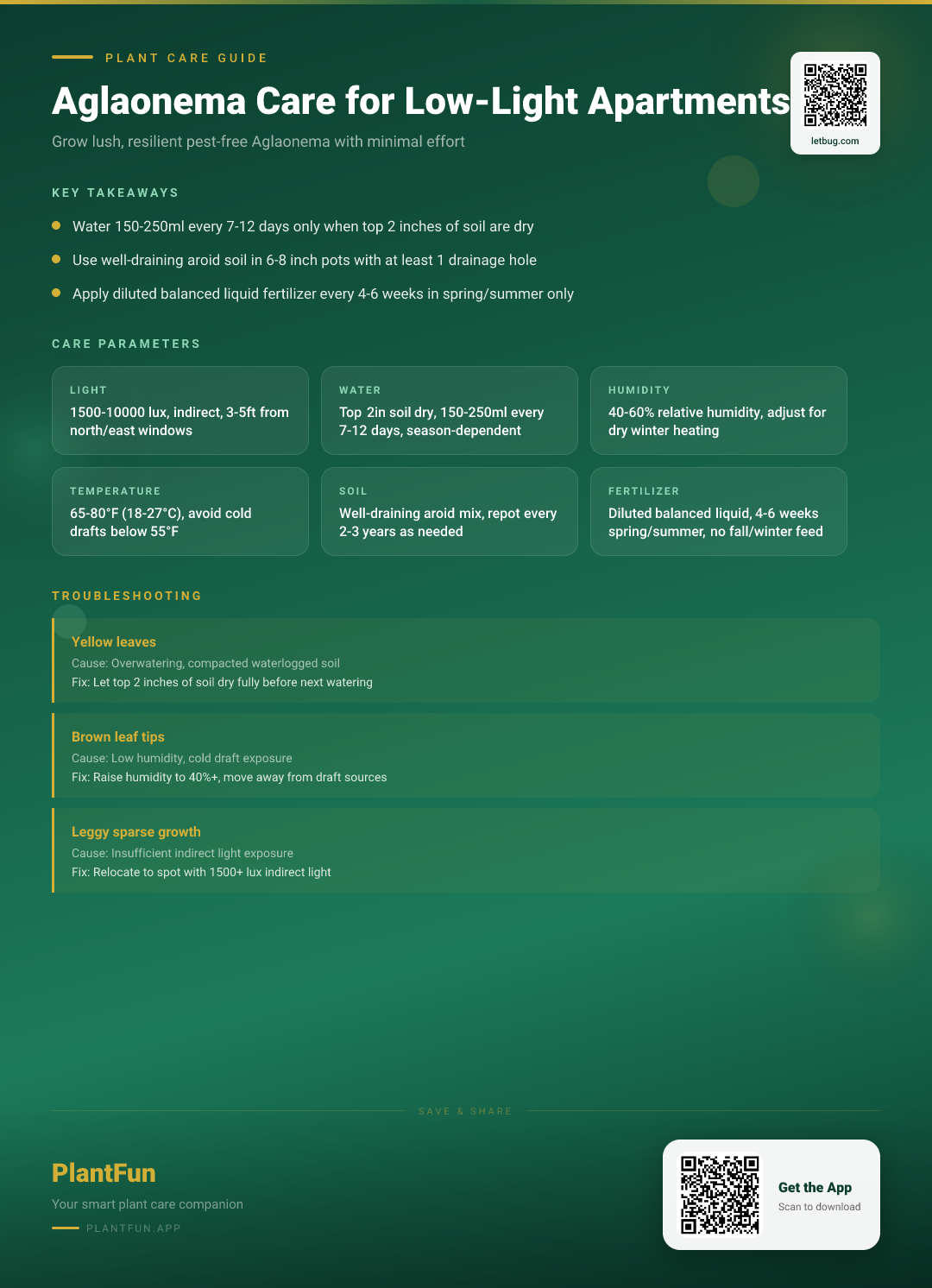
Key Takeaways
- Check soil moisture before watering — overwatering is the #1 killer of houseplants.
- Ensure your plant gets the right amount of light for its species.
- Be patient with recovery — most plants need 2–4 weeks to bounce back.
Quick Care Card: At-a-glance cheat sheet for apartment Aglaonema with exact lux, water, humidity, and temperature thresholds for fast, no-fuss reference
| Category | Exact Apartment-Specific Threshold |
|---|---|
| Light | 1,500–10,000 lux; 3–5ft from north/east-facing window, no direct sun |
| Water | When top 2 inches of soil are dry; 150–250ml every 7–12 days (season-dependent) |
| Humidity | 40–60% relative humidity |
| Temperature | 65–80°F (18–27°C) |
| Soil | Well-draining aroid mix (1 part potting soil, 1 part perlite, 1 part orchid bark) |
| Fertilizer | Half-strength balanced 10-10-10 liquid fertilizer every 4–6 weeks spring/summer; no fertilizing fall/winter |
| Toxicity | Non-toxic to humans; toxic to cats and dogs (ASPCA, 2026) |
Note: Keep Aglaonema on high shelves or out of reach of pets to avoid accidental ingestion.
Why Generic Aglaonema Care Fails in Apartments
Most standard Aglaonema care guides assume optimal growing conditions: bright indirect light, stable temperatures, and consistent 50%+ humidity that almost no urban apartment provides. The average low-light apartment faces three unique constraints that break generic care rules: north/east-facing windows that deliver less than 2,000 lux of light for most of the year, fluctuating temperatures from heating and AC systems, and baseline humidity of 35-45% that drops even lower in winter.
Myth vs Reality: Myth: Aglaonema needs bright indirect light to grow well. Reality: This hardy aroid tolerates far lower light levels than most common houseplants, making it ideal for apartment environments (NC State Extension, 2026). This guide uses a mistakes-and-fixes framework tailored explicitly to apartment constraints, so even Aglaonema care for beginners is simple and low-fuss.
Understanding the Science
A 2016 study of Aglaonema commutatum found that the plant effectively removes common indoor pollutants like formaldehyde and benzene from apartment air, making it not just decorative but functional for urban living spaces (Ghate, 2016). Checklist-based care routines have also been shown to reduce human error in routine care tasks by standardizing requirements across changing seasonal conditions (Elderly Care, 1985).
Step 1: Correct Light Setup for Apartment Aglaonema
Aglaonema light needs for apartments fall between 1,500 and 10,000 lux, a far lower threshold than most aroids (NC State Extension, 2026). The ideal placement is 3–5ft from a north or east-facing window, where it gets soft, indirect light with no direct midday sun that can burn leaves. Variegated varieties will sit at the higher end of the lux range, while solid green varieties can thrive at 1,500–3,000 lux.
Fast fixes for light issues:
- Too much light (brown crispy leaf edges, faded variegation): Move the plant 2ft further back from the window, or add a sheer curtain to filter direct sun.
- Too little light (leggy growth, pale leaves): Move the plant 1ft closer to the window, or add a 10W full-spectrum grow light 1ft above the plant, run 12 hours a day for consistent Aglaonema low light care.
Step 2: Exact Watering Schedule for Apartment Conditions
For low-light apartments, water your Aglaonema only when the top 2 inches of soil are completely dry: test this by sticking your index finger into the soil up to your second knuckle. This usually works out to 150–250ml of room-temperature filtered water every 7–12 days, depending on the season.
Fast fixes for watering issues:
- Overwatering (soft yellow leaves, soggy soil): Tip all standing water out of the pot saucer immediately, and let the top 3 inches of soil dry completely before watering again. If overwatering is chronic, mix 1 part perlite into the top 2 inches of soil to improve drainage.
- Underwatering (crispy curled leaves, drooping stems): Give the plant 200ml of room-temperature water, and mist the leaves lightly to help them perk up.
One of the most common Aglaonema care mistakes for new owners is overwatering: remember that lower light means soil dries slower, so you will need to water far less often than you would for plants in bright light. This answers the core question of how often to water Aglaonema in low light without guesswork.
Step 3: Humidity & Temperature Tuning for Apartments
Aglaonema humidity requirements indoors fall between 40 and 60% relative humidity, and they prefer temperatures of 65–80°F (18–27°C) (NC State Extension, 2026). Most apartments sit at 35-45% baseline humidity, and temperatures can fluctuate 10+ degrees a day from heating and AC use.
Fast fixes for humidity and temperature issues:
- Dry winter heating: Place the pot on a pebble tray filled with water (make sure the pot is not sitting directly in the water), group it with other houseplants to boost local humidity, or run a small humidifier for 4 hours a day near the plant as part of your Aglaonema winter care for apartments routine.
- Cold drafts: Move the plant at least 3ft away from AC vents, drafty doorways, and uninsulated window sills in winter to avoid temperature shock.
Step 4: Soil & Potting Setup for Low-Effort Growth
Use a well-draining aroid soil mix (1 part potting soil, 1 part perlite, 1 part orchid bark) to prevent waterlogging, which is a top cause of stress for apartment Aglaonema. Choose a 6–8 inch pot with at least 1 drainage hole, and repot only every 2–3 years in spring, when roots start growing out of the drainage holes.
Fast fixes for soil issues:
- Compacted, waterlogged soil: Remove the plant from its pot, trim any mushy black roots with sterile scissors, and repot in fresh aroid mix. Do not water for 7 days after repotting to let roots recover.
Step 5: Fertilizing Routine for Resilient Growth
To support Aglaonema resilient growth tips and learn how to make Aglaonema grow faster in low-light apartments, use a half-strength balanced 10-10-10 liquid fertilizer every 4–6 weeks only in spring and summer. Do not fertilize in fall and winter, when the plant is dormant and will not absorb extra nutrients.
Fast fix for fertilizer burn: If you notice brown crispy leaf edges with white crusty residue on the soil surface, flush the soil with 3x the pot volume of water to leach out excess fertilizer salts, and skip fertilizing for 3 months.
Seasonal Apartment Aglaonema Care Calendar
Adjust your care routine throughout the year to match seasonal apartment conditions:
- Jan-Feb (Winter heating): Reduce watering to every 10–12 days, add a pebble tray to boost humidity, and skip all fertilizing. Move plants away from uninsulated window sills to avoid cold damage.
- Mar-Apr (Spring): Increase watering to every 8–10 days, start fertilizing every 6 weeks, and move plants 1ft closer to windows to take advantage of longer daylight hours.
- May-Aug (Summer): Follow the Aglaonema summer watering schedule of watering every 7–9 days, fertilize every 4 weeks, and keep plants away from AC vents. Add a sheer curtain to east-facing windows if midday sun is too harsh.
- Sep-Oct (Fall): Reduce watering to every 9–11 days, stop fertilizing completely, and check placement for drafts as windows are opened and closed with changing temperatures.
- Nov-Dec (Early winter): Reduce watering to every 10–12 days, add a humidifier if your heating runs 24/7, and keep plants away from cold entryways.
7 Most Common Apartment Aglaonema Mistakes (And Fast Fixes)
Yellow Leaves
Symptom: Soft, pale yellow lower leaves with no crispy edges.
Likely cause: Overwatering, the most common Aglaonema care mistake for new apartment owners.
Fix:
- Tip all standing water out of the pot saucer immediately
- Let the top 3 inches of soil dry completely before watering again
- If yellowing spreads across the plant, repot in fresh aroid mix to prevent root rot
Brown Tips
Symptom: Dry, crispy brown edges on otherwise healthy green leaves.
Likely cause: Dry air from heating/AC, or excess fertilizer salts built up in the soil.
Fix:
- Mist leaves 2x a week with room temperature filtered water
- Flush soil with 1L of water every 3 months to remove built-up fertilizer salts
- Add a pebble tray under the pot to boost local humidity
Leggy Growth
Symptom: Long, thin stems with spaced-out leaves, no new variegation on colorful varieties.
Likely cause: Insufficient light, common in north-facing apartments with low natural light.
Fix:
- Move the plant 1-2ft closer to your nearest north/east-facing window
- Add a low-wattage grow light 1ft above the plant, run 12 hours a day in winter
- Prune leggy stems back to 2 inches above the soil line to encourage bushy growth
Pest Infestations
Symptom: Tiny brown or green bugs on leaf undersides, sticky honeydew residue on leaves.
Likely cause: Dry air and low airflow in closed apartments, which attracts mealybugs and spider mites.
Fix:
- Wipe all leaf surfaces with a damp microfiber cloth dipped in diluted neem oil
- Isolate the plant from other houseplants for 2 weeks to prevent spread
- Increase local humidity to 50% to deter future pest activity
Root Rot
Symptom: Wilted, mushy stems, foul smell coming from the soil, yellowing spreading across all leaves.
Likely cause: Chronic overwatering combined with compacted soil with no drainage.
Fix:
- Remove the plant from its pot and trim all black, mushy roots with sterile scissors
- Repot in a clean pot with fresh, well-draining aroid mix and at least one drainage hole
- Do not water for 7 days after repotting to let roots recover
Drooping Leaves
Symptom: Limp, curled leaves that hang downward, no discoloration.
Likely cause: Underwatering, or exposure to cold drafts from AC or winter windows.
Fix:
- Stick your finger 2 inches into the soil: if fully dry, give 200ml of room temperature filtered water
- Check placement: if within 1ft of a vent or drafty window, move to a more sheltered spot 3ft away
- Mist leaves lightly to help them perk up faster
Faded Variegation
Symptom: Bright variegated patches on leaves turn pale green or white, no crisping.
Likely cause: Too much direct sun exposure, common for plants placed directly on east-facing window sills.
Fix:
- Move the plant 2ft further back from the window, or add a sheer curtain to filter direct sun
- Trim fully faded leaves to encourage new, vibrant variegated growth
- Monitor light levels to keep them between 1500 and 5000 lux for variegated varieties
Voice Search FAQ 1: Why is my Aglaonema getting brown tips in my apartment?
The most common cause is dry air from winter heating or summer AC, which drops humidity below the 40% minimum Aglaonema needs (NC State Extension, 2026). You can fix this quickly by adding a pebble tray under your pot, misting leaves twice a week, or running a small humidifier for 4 hours a day. If brown tips are accompanied by crusty white residue on the soil surface, it is also likely excess fertilizer salts, so flush the soil with 3x the pot volume of water to leach them out.
Voice Search FAQ 2: How often should I water my Aglaonema in a low-light apartment?
In a typical low-light north or east-facing apartment, you will only need to water your Aglaonema every 7 to 12 days, depending on the season (NC State Extension, 2026). Always test the soil first: only water when the top 2 inches are completely dry, which you can check by sticking your index finger all the way into the soil up to your second knuckle. In low light, soil takes longer to dry out, so overwatering is a far bigger risk than underwatering.
Voice Search FAQ 3: Can I keep my Aglaonema in my apartment bedroom with no windows?
You can, as long as you provide artificial light to meet the 1500 lux minimum requirement for Aglaonema low light care. A 10W full-spectrum grow light placed 1ft above the plant and run for 12 hours a day will support healthy growth. Note that without any light (natural or artificial), your Aglaonema will stop growing and develop leggy, pale leaves within 2 to 3 months.
Printable Resilient Growth Checklist
Our free, fridge-friendly printable Aglaonema care checklist is formatted to fit on a 4x6 index card or standard printer paper, with all apartment-specific care thresholds built in so you never have to guess. The checklist includes:
Weekly Tasks:
- Check soil moisture by sticking finger 2 inches deep
- Wipe leaf surfaces with a damp cloth to remove dust
- Check for pest activity on leaf undersides
Monthly Tasks:
- Flush soil with fresh water if you use fertilizer
- Adjust placement for seasonal light shifts
- Top up pebble tray water if using
Quarterly Tasks:
- Test humidity levels with a cheap hygrometer
- Trim any yellow or brown leaves
- Check for root bound growth by gently lifting the plant out of its pot
Annual Tasks:
- Repot if roots are growing out of drainage holes
- Adjust fertilizing schedule for the new growing season
Checklist-based care reduces human error by standardizing routine tasks, so you can keep your Aglaonema thriving with minimal effort (Elderly Care, 1985).
References
- NC State Extension. (2026). Aglaonema Care Checklist — NC State Extension Gardener Plant Toolbox. https://plants.ces.ncsu.edu/plants/aglaonema-care/. Accessed 2026-03-04.
- Ghate, S. (2016). Assessment of Phytoremediating Potential of Aglaonema commutatum Schott for Indoor Pollutants. INTERNATIONAL JOURNAL OF PLANT AND ENVIRONMENT. https://doi.org/10.18811/ijpen.v2i1-2.6622. Accessed 2026-03-04.
- Elderly Care. (1985). Checklist for care. Elderly Care. https://doi.org/10.7748/eldc.5.4.6.s8. Accessed 2026-03-04.
- ASPCA. (2026). Toxic and Non-Toxic Plants List — ASPCA. https://www.aspca.org/pet-care/animal-poison-control/toxic-and-non-toxic-plants. Accessed 2026-03-04.
Optional Helper: Plantfun.App
Plantfun.App identifies your plants by photo, diagnoses pests and diseases with clear fixes, and creates personalised watering and light schedules that adapt to your home conditions — a handy companion for putting this guide into daily practice.
Found an error or have suggestions? We'd love your feedback.
Need help identifying this problem?
Get instant identification, personalized care schedules, and effective pest treatment plans directly on your phone.
Sponsored • We may earn a commission from app downloads
Related Guides
The Complete Aglaonema Care Checklist for Resilient Growth in Small East-Facing Apartments
Stop guessing your Aglaonema care routine. Get 4 measurable care thresholds, a renter-friendly checklist, and troubleshooting tips to keep your Chinese evergreen thriving in small east-facing apartments.
Care GuideThe Complete Aglaonema Care Guide for 1-Bedroom Apartments: Seasonal Tips for Resilient Growth
Grow a lush, hardy Aglaonema even in a small, low-light apartment. Get exact light, water, and humidity thresholds plus a 4-season care checklist to avoid yellow leaves and stunted growth.
Care GuideThe Complete Aglaonema Care Checklist for Resilient Growth in Typical Low-Light Apartments
Grow a lush, low-fuss Aglaonema even in your dark, dry rental apartment. Get exact light levels, watering amounts, and a 12-point checklist to prevent yellow leaves and boost resilient growth.
Pest ControlAnts on Plants: What They Mean and What to Do
Ants usually aren't eating your plant. They are farming other pests.